

Flying exposes you to cosmic radiation that Earth’s atmosphere normally blocks. A cross-country flight delivers roughly one-third of a chest X-ray dose. Frequent flyers accumulate meaningful doses over time.
Beyond cosmic rays, airplanes concentrate EMFEMF stands for electromagnetic field (also called electromagnetic frequency or electromagnetic force). EMFs are invisible fields of energy produced by electrically charged objects. They exist on a spectrum ranging from... from WiFi and passenger devices. Device management and targeted protection can reduce in-cabin EMF exposure.
Medical Disclaimer: This article is for informational purposes only. It is not, nor is it intended to be, a substitute for professional medical advice, diagnosis, or treatment and should never be relied upon for specific medical advice.
Key Takeaways
- Flying exposes you to cosmic radiation and in-cabin RF from WiFi, Bluetooth, and passenger devices
- A cross-country flight delivers about 0.03-0.04 mSv of cosmic radiation—roughly one-third of a chest X-ray
- Frequent flyers accumulate 2-4 mSv annually from flying, potentially doubling their background radiation exposure
- Cosmic radiation cannot be shielded with portable products—focus protection efforts on controllable RF sources
- Device management (airplane mode, Faraday bags) and wired accessories reduce in-cabin EMF exposure, especially for frequent flyers and flight crew
What Radiation Are You Exposed to on Airplanes?
When people ask about airplane radiation, they’re usually thinking of one thing. But flying actually exposes you to multiple types of electromagnetic energy, each with different characteristics and health implications.
Cosmic Radiation
The primary radiation concern during flight is cosmic radiation. These high-energy particles originate from the sun and deep space, constantly bombarding Earth. At ground level, our atmosphere absorbs most of this radiation before it reaches us. But at cruising altitude of 30,000 to 40,000 feet, you’re above much of that protective layer.
Cosmic radiation is ionizing radiationIonizing radiation is electromagnetic energy with enough power to remove electrons from atoms, creating charged particles called ions. This includes X-rays, gamma rays, and ultraviolet radiation. Unlike the non-ionizing radiation..., meaning it has enough energy to remove electrons from atoms in your body. This is the same category as X-rays and gamma rays. While the doses from flying are small compared to medical procedures, they’re not zero.
In-Cabin WiFi and Bluetooth
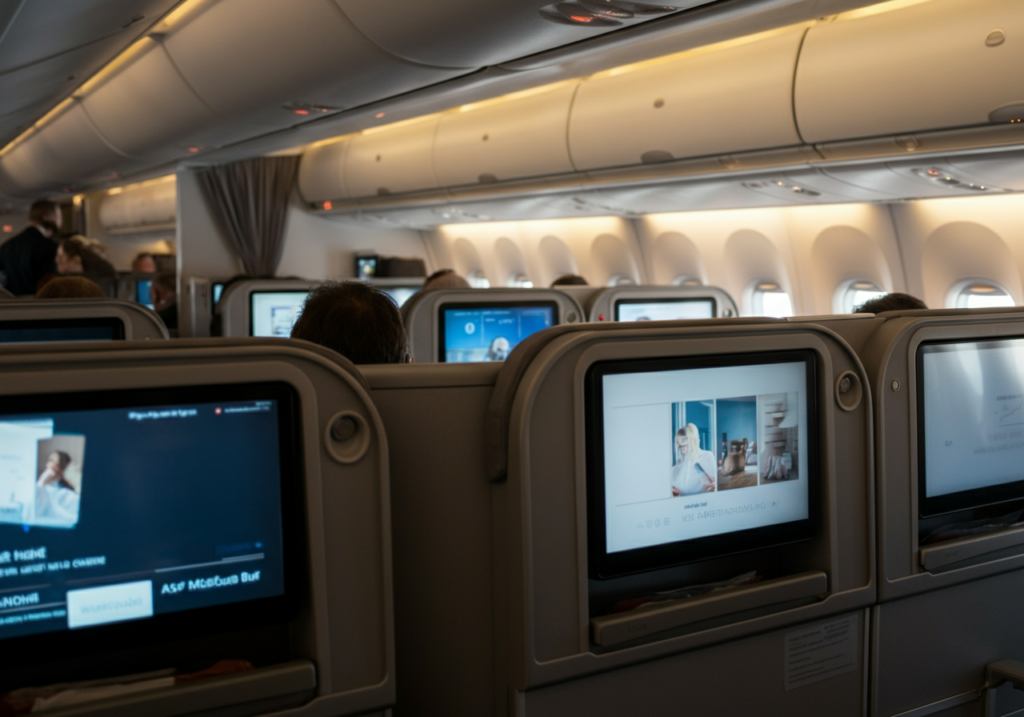
Modern aircraft are increasingly connected. Onboard WiFi systems broadcast RF radiation throughout the cabin, and these systems must be powerful enough to maintain connections for hundreds of passengers simultaneously. Add to this the Bluetooth signals from wireless headphones, the cellular signals from phones searching for towers, and the RF emissions from tablets and laptops, and you have a concentrated EMF environment.
Passenger Devices
Even with your own phone in airplane mode, you’re surrounded by other passengers’ devices. On a full flight, dozens or hundreds of phones, tablets, and laptops emit RF radiation. The metal fuselage reflects these signals, creating an enclosed space filled with wireless emissions.
Airport Security Scanners
Before you even board, you pass through security scanners. Millimeter waveMillimeter wave (mmWave) refers to electromagnetic frequencies between 30 GHz and 300 GHz, where wavelengths range from 1 to 10 millimeters. This spectrum enables extremely fast data transmission. Millimeter wave... scanners use non-ionizing RF radiation, while older backscatter X-ray machines use ionizing radiation. Most US airports now use millimeter wave technology, which poses less concern than the X-ray alternatives.
How Cosmic Radiation Works During Flight
Understanding cosmic radiation helps put your exposure in perspective. This isn’t radiation from the airplane itself; it’s radiation from space that the airplane flies through.
Earth’s Atmosphere as Shield
Think of Earth’s atmosphere as a thick blanket of protection. Cosmic particles collide with atmospheric molecules, losing energy with each collision. By the time they reach sea level, most have been absorbed or significantly weakened. This is why background radiation at sea level is relatively low.
Altitude Effects
At cruising altitude, you’ve risen above approximately 80% of the atmosphere’s mass. The protective blanket is much thinner. Cosmic radiation intensity roughly doubles for every 6,500 feet of altitude gain. At 35,000 feet, you’re receiving significantly more cosmic radiation than you would on the ground.
Latitude Effects
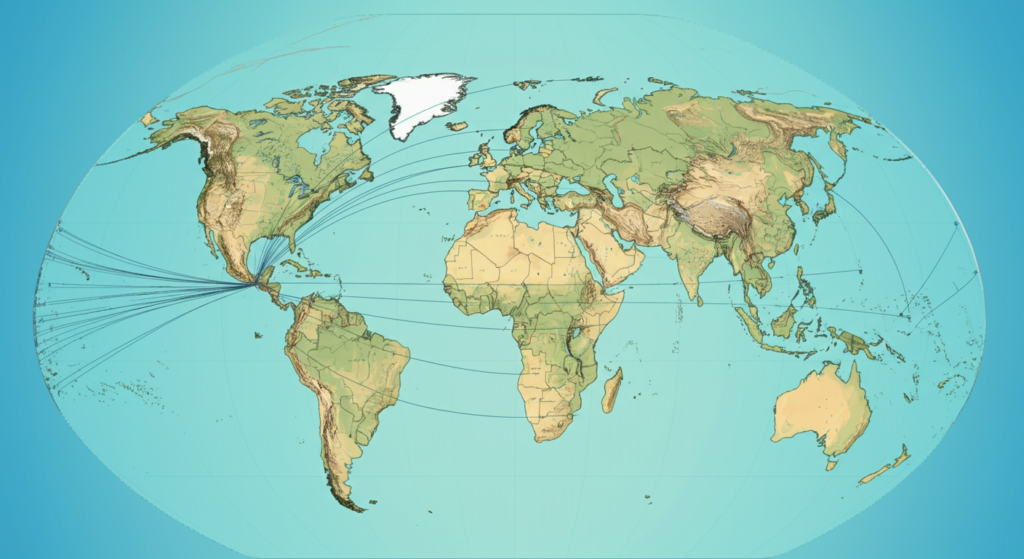
Your flight path matters. Cosmic radiation is strongest near the poles and weakest at the equator. This is because Earth’s magnetic field deflects charged particles toward the poles, concentrating cosmic radiation at higher latitudes.
A polar route from New York to Tokyo exposes you to more radiation than an equatorial route of similar distance. Airlines factor this into crew scheduling, but passengers rarely consider it when booking flights.
Solar Activity
The sun’s activity level affects cosmic radiation reaching Earth. During solar maximum (peak sunspot activity), the sun’s magnetic field actually deflects some galactic cosmic rays, slightly reducing exposure. During solar minimum, more galactic cosmic rays reach Earth.
However, solar storms can dramatically increase radiation, particularly on polar routes. Airlines monitor space weather and may alter routes during significant solar events to protect crew and passengers.
How Much Radiation Do You Get From Flying?
Quantifying flight radiation helps contextualize the exposure. Scientists measure radiation dose in millisieverts (mSv) or microsieverts (μSv).
Dose Comparisons
| Exposure Source | Approximate Dose |
|---|---|
| Annual background radiation (US average) | 3.0 mSv |
| Chest X-ray | 0.1 mSv |
| Cross-country flight (NY to LA) | 0.03-0.04 mSv |
| Transatlantic flight (NY to London) | 0.05-0.08 mSv |
| Transpacific flight (LA to Tokyo) | 0.08-0.12 mSv |
| CT scan (chest) | 7.0 mSv |
| Annual limit for radiation workers | 50 mSv |
A single cross-country flight delivers roughly one-third of a chest X-ray. For perspective, you’d need to take about 100 such flights to equal the dose from a single chest CT scan.
Cumulative Exposure
The concern isn’t any single flight but cumulative exposure over time. A business traveler taking 100,000 miles of flights annually might accumulate 2-4 mSv from flying alone, roughly doubling their annual radiation exposure compared to someone who doesn’t fly.
Flight crew face the highest occupational exposure. Pilots and flight attendants can receive 2-5 mSv annually from cosmic radiation, putting them among the most radiation-exposed workers in any profession. The FAA classifies flight crew as radiation workers, though they’re not subject to the same monitoring requirements as nuclear plant employees.
For a detailed breakdown of flight radiation doses, see our guide on how much radiation you get from flying.
Who Should Be Most Careful About Flying Radiation
While occasional flying poses minimal risk for most people, certain groups warrant extra consideration.
Flight Crew
Pilots and flight attendants accumulate the highest doses due to frequent, prolonged exposure at altitude. Studies have examined cancer rates among flight crew, with some showing elevated rates of certain cancers, though establishing direct causation is complex given other occupational factors.
The European Union classifies flight crew as radiation workers and requires airlines to monitor and limit crew exposure. US regulations are less stringent, though the FAA acknowledges the occupational radiation exposure.
Frequent Business Travelers
Road warriors who fly 100,000+ miles annually approach flight crew exposure levels. If you’re in this category, your cumulative dose deserves consideration, particularly if you have other radiation exposure sources or risk factors.
Pregnant Women
Developing fetuses are more sensitive to radiation than adults. Most health organizations consider occasional flying safe during pregnancy, but frequent flying may warrant discussion with your healthcare provider. Some airlines restrict pregnant crew members from flying during certain periods.
The concern isn’t a single flight but cumulative exposure. A pregnant flight attendant working full routes throughout pregnancy could accumulate doses approaching recommended limits for fetal exposure.
Children
Children are generally more sensitive to radiation than adults because their cells divide more rapidly and they have more years ahead for potential effects to manifest. For occasional family travel, this isn’t a significant concern. For children who fly very frequently, parents may want to factor this into travel planning.
People Undergoing Radiation Therapy
If you’re receiving radiation treatment for cancer, your oncologist may have specific guidance about flying. The additional cosmic radiation exposure, while small, adds to your therapeutic dose.
In-Cabin EMF: The Often Overlooked Exposure
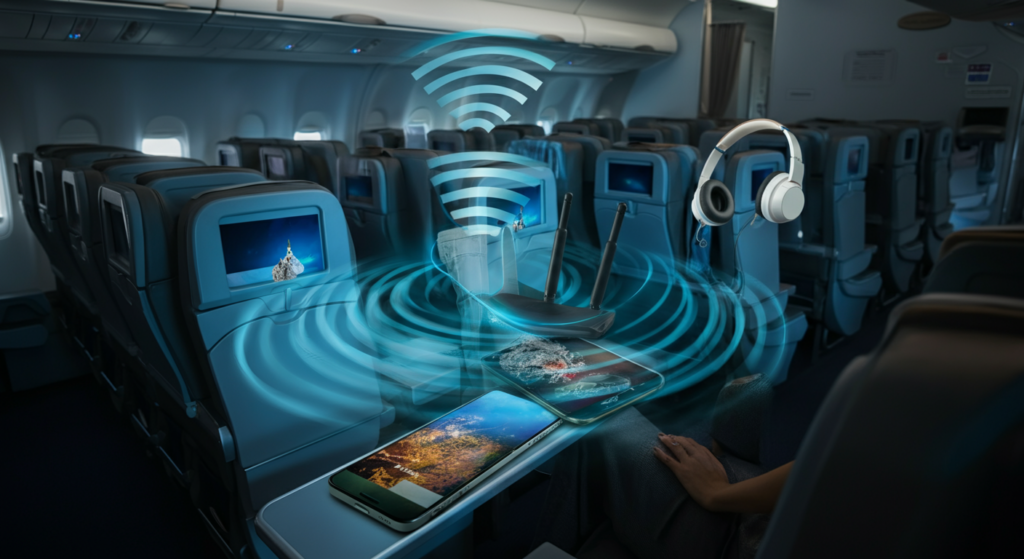
Most discussions of airplane radiation focus exclusively on cosmic radiation. But the EMF environment inside the cabin deserves attention too, and unlike cosmic rays, you can actually do something about it.
Onboard WiFi Systems
Aircraft WiFi systems must broadcast strong signals to serve an entire plane. These systems operate continuously during flight, bathing the cabin in RF radiation. The metal fuselage creates an enclosed space that contains and reflects these signals.
The Device Concentration Problem
Consider a full flight: 150-300 passengers, many with phones, some with tablets, others with laptops. Even with devices in airplane mode, many passengers keep WiFi or Bluetooth enabled. The concentration of wireless devices in a small space creates an RF environment unlike most everyday situations.
Why Airplane Mode Helps (But Doesn’t Solve Everything)
Putting your own phone in airplane mode eliminates its RF emissions. This is worth doing. But it doesn’t protect you from the cabin WiFi or other passengers’ devices. You’re reducing your contribution to the EMF environment without eliminating your exposure to it.
Duration Matters
A transcontinental or transoceanic flight means hours of continuous exposure to this concentrated EMF environment. While any individual moment of exposure is unremarkable, the duration compounds the cumulative dose.
Practical Ways to Reduce Your Exposure While Flying
You can’t avoid cosmic radiation at altitude. But you can minimize your overall exposure through smart choices and targeted protection.
Route Selection
When you have flexibility, consider:
- Direct flights over connections (less total time at altitude)
- Lower-latitude routes when available (less cosmic radiation)
- Daytime flights if choosing between options (marginally lower cosmic radiation than night flights)
Device Management
- Use airplane mode with WiFi and Bluetooth OFF (not just airplane mode, which may leave these enabled)
- Download entertainment before flying rather than streaming
- Use wired headphones instead of Bluetooth
- Keep devices away from your body when not in use
Seat Selection
Window seats receive slightly less cosmic radiation than aisle seats because the fuselage provides marginal shielding. The difference is small but real for very frequent flyers.
Antioxidant Support
Some research suggests antioxidants may help mitigate radiation damage. While this isn’t a reason to fly more carelessly, ensuring adequate antioxidant intake before and after flights may provide some protective benefit. Vitamins C and E, along with foods rich in antioxidants, are commonly recommended.
What Doesn’t Work
Be skeptical of products claiming to “block cosmic radiation” during flight. The physics simply don’t support this. Cosmic rays are highly penetrating; the amount of shielding required to meaningfully reduce them would weigh far more than any wearable product.
However, products that shield RF radiation from devices can reduce your in-cabin EMF exposure. The key is understanding what each product can and cannot do.
EMF Protection Products for Air Travel
For the RF component of in-cabin exposure, certain products offer genuine protection.
Faraday Bags
A Faraday bag completely blocks all wireless signals to and from enclosed devices. When you place your phone inside a properly constructed Faraday bag, it cannot emit or receive RF radiation. This eliminates your device’s contribution to the cabin EMF environment.
Faraday bags are also valuable for:
- Privacy (preventing tracking and remote access)
- Security (protecting against wireless hacking attempts)
- Battery preservation (your phone won’t drain searching for signals)
Phone Pouches and Shields
When you need your phone accessible but want to reduce body exposure, shielded pouches deflect radiation away from your body while allowing the phone to function. These are useful throughout travel, not just during flights.
What These Products Cannot Do
No portable product can shield cosmic radiation. Anyone claiming otherwise doesn’t understand the physics involved. Cosmic rays require massive shielding (think feet of concrete or lead) for meaningful attenuation. The protection products above address RF radiation from devices, not cosmic radiation from space.
For comprehensive travel protection strategies, see our travel EMF protection guide.
The Bottom Line
Flying exposes you to radiation from two distinct sources: cosmic radiation from space and RF radiation from wireless devices. For occasional travelers, neither poses significant health concern. For frequent flyers, cumulative exposure warrants awareness and reasonable precautions.
You cannot shield yourself from cosmic radiation at cruising altitude. The atmosphere normally does this job, and at 35,000 feet, you’re simply above most of that protection. What you can do is make informed choices about flight frequency, route selection, and in-cabin device management.
The in-cabin EMF environment offers more opportunity for intervention. Using airplane mode properly, choosing wired over wireless accessories, and employing Faraday products for device isolation all reduce your RF exposure during flight.
The goal isn’t to fear flying. It’s to understand your exposure and take sensible steps to minimize it without sacrificing the benefits that air travel provides.
Common Misconceptions
Misconception: The airplane itself emits harmful radiation.
Reality: The radiation concern during flight comes from cosmic rays (from space) and wireless devices (from passengers and aircraft systems), not from the airplane’s structure or engines. The aircraft is essentially a metal tube flying through a radiation environment, not a radiation source itself.
Misconception: Airplane mode completely protects you from in-flight EMF.
Reality: Airplane mode eliminates emissions from your own device, but you remain exposed to cabin WiFi and other passengers’ devices. It’s a valuable step but not complete protection.
Misconception: Special clothing or pendants can block cosmic radiation during flight.
Reality: Cosmic rays are highly penetrating particles that require massive shielding to attenuate. No wearable product can meaningfully reduce cosmic radiation exposure. Products claiming to do so misunderstand the physics involved.
Misconception: Flying is dangerous because of radiation exposure.
Reality: For most travelers, flight radiation exposure is comparable to everyday activities like a chest X-ray. The risk becomes more relevant for very frequent flyers and flight crew who accumulate significant doses over time.
Misconception: First class has less radiation than economy.
Reality: Cosmic radiation is essentially uniform throughout the cabin. Your seat class doesn’t affect your cosmic radiation dose. Minor variations from seat position are negligible.
Frequently Asked Questions
For occasional travelers, airplane radiation poses minimal health risk. A cross-country flight delivers roughly the equivalent of a chest X-ray. The concern increases with frequency: flight crew and very frequent travelers accumulate meaningful doses over time that may warrant monitoring or lifestyle adjustments.
A typical cross-country US flight (about 2,500 miles) delivers approximately 0.03-0.04 millisieverts of cosmic radiation. This is roughly one-third of a chest X-ray or about 1% of average annual background radiation. Longer flights at higher latitudes deliver proportionally more.
No practical shielding exists for cosmic radiation during flight. These high-energy particles require massive amounts of dense material (feet of concrete or lead) for meaningful attenuation. No wearable product or cabin modification can significantly reduce cosmic radiation exposure. However, you can shield yourself from RF radiation emitted by wireless devices using Faraday products.
Slightly the opposite, actually. Window seats receive marginally less cosmic radiation because the aircraft fuselage provides minor shielding. The difference is small but measurable for frequent flyers. Aisle seats are exposed to radiation from all directions, while window seats have partial shielding on one side.
Most health organizations consider occasional flying safe during pregnancy. The concern is cumulative exposure rather than single flights. Pregnant women who fly very frequently, particularly on long-haul or polar routes, should discuss this with their healthcare provider. Some airlines restrict pregnant crew members from flying during certain periods.
Airplane mode eliminates RF radiation from your own device, which is valuable. However, it doesn't protect you from cabin WiFi or other passengers' devices. For maximum protection, enable airplane mode AND turn off WiFi and Bluetooth (which some phones leave enabled in airplane mode), and consider a Faraday bag for complete device isolation.
Yes, significantly. Pilots and flight attendants receive 2-5 millisieverts annually from cosmic radiation, among the highest occupational exposures of any profession. The European Union classifies flight crew as radiation workers. Passengers on occasional flights receive a tiny fraction of this exposure.