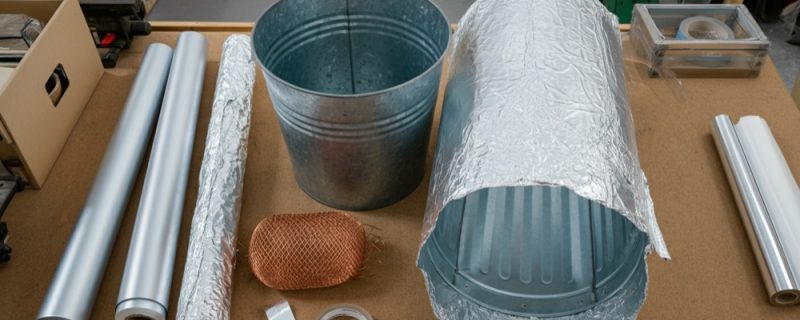

You can build a DIY Faraday cage using common materials like aluminum foil, metal trash cans, or copper mesh. The key is creating a complete conductive enclosure with no gaps.
Wrap items in multiple layers of aluminum foil, use a metal container with a tight-fitting conductive lid, or construct a frame covered with metal mesh for stronger protection.
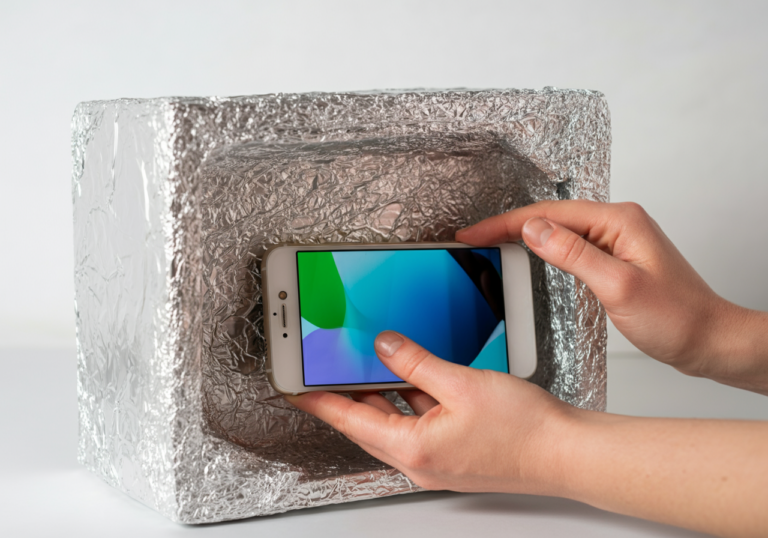
Test by placing a phone inside. If calls fail to connect, your cage is working. DIY cages work for basic protection, but they may not match the reliability of commercial products for daily use.
Key Takeaways
- A functional DIY Faraday cage requires complete coverage with conductive material and proper sealing of all openings
- Aluminum foil (3+ layers), galvanized steel trash cans, and copper mesh are the most common DIY materials
- The biggest challenge in DIY construction is eliminating gaps at closures and seams. This is where most homemade cages fail.
- DIY solutions work best for storage protection. Portable daily use typically requires commercial products.
- Always test your DIY cage with a cell phone before trusting it with important electronics
What You Need to Know Before Building
Before starting your DIY Faraday cage project, it helps to understand what makes these enclosures effective and where homemade versions commonly fail.
The Science in Brief
A Faraday cage blocks electromagnetic signals by surrounding items with conductive material. When electromagnetic waves hit the enclosure, free electrons in the metal redistribute to cancel the incoming field. The protected items inside remain isolated from external signals.
For this to work, the conductive barrier must be continuous (no gaps, holes, or breaks), conductive throughout (all surfaces must connect electrically), and properly sealed (closures must maintain electrical continuity).
Put simply: if signals can find a path through, they will.
Where DIY Versions Struggle
Here’s the truth about DIY Faraday cages: the most common failure point is the closure. Getting a tight electromagnetic seal where the lid meets the body is challenging without specialized materials.
Other common issues include incomplete coverage where signals leak through, poor electrical contact at seams that touch but don’t conduct well, material degradation as foil tears or corrosion develops, and inconsistent construction where variations in technique affect performance.
Understanding these challenges will help you build a more effective cage and recognize when your project needs improvement.
Choosing Your DIY Approach

Different construction methods suit different needs. Consider what you’re trying to protect and how you’ll use it.
Method 1: Aluminum Foil Wrapping

Best for: Quick protection of small items, emergency preparedness
Difficulty: Easy
Cost: Under $5
Effectiveness: Moderate (60-80% signal reduction with proper technique)
Aluminum foil is the most accessible faraday shielding material for DIY projects. It’s cheap, widely available, and provides decent RF attenuation when used correctly.
Method 2: Metal Container Cage

Best for: Protecting multiple items, more permanent solutions
Difficulty: Easy to Moderate
Cost: $15-50
Effectiveness: Good (80-95% signal reduction if properly sealed)
Galvanized steel trash cans, metal ammunition boxes, and other metal containers can serve as Faraday cages. The challenge is ensuring the lid makes continuous electrical contact with the body.
Method 3: Copper Mesh Construction

Best for: Custom sizes, reusable enclosures, higher effectiveness
Difficulty: Moderate
Cost: $30-100+
Effectiveness: Very good (90-99% signal reduction with proper construction)
Building a cage from copper or aluminum mesh allows custom sizing and often provides better performance than the simpler methods.
Method Comparison
| Method | Cost | Skill Level | Portability | Effectiveness | Best Use Case |
|---|---|---|---|---|---|
| Foil wrap | $5 | Beginner | Poor | 60-80% | Emergency, small items |
| Metal container | $15-50 | Beginner | Poor | 80-95% | Storage, multiple items |
| Copper mesh | $30-100+ | Intermediate | Moderate | 90-99% | Custom sizes, higher protection |
| Commercial product | $20-200+ | None needed | Excellent | 95-99%+ | Daily use, critical protection |
Method 1: Aluminum Foil Faraday Cage
The simplest DIY Faraday cage uses layers of heavy-duty aluminum foil.
Materials Needed
- Heavy-duty aluminum foil (regular foil tears too easily)
- Cardboard box or plastic container (to protect items from direct foil contact)
- Aluminum tape (optional, for sealing seams)
- Packing tape (to hold foil in place)
Step-by-Step Instructions
Step 1: Prepare the inner container. Choose a cardboard box or plastic container slightly larger than what you want to protect. This creates a buffer between your electronics and the foil, preventing scratches and ensuring the foil doesn’t short-circuit any components.
Step 2: Wrap with first foil layer. Cover the entire container with heavy-duty aluminum foil, shiny side out. Overlap all edges by at least 2 inches. Press firmly to eliminate air gaps and ensure the foil conforms to the shape.
Step 3: Apply second layer perpendicular to first. Add a second layer of foil, wrapping in the opposite direction. If the first layer wrapped horizontally, wrap this one vertically. This covers any gaps from the first layer.
Step 4: Apply third layer. A minimum of three layers provides adequate redundancy. More layers increase protection but also bulk and weight.
Step 5: Seal all seams. Use aluminum tape to cover all edges and seams where foil sheets meet. Regular tape doesn’t conduct. Only aluminum tape maintains electrical continuity.
Step 6: Create the closure. For the opening, leave enough excess foil to fold over multiple times when closing. The fold-over creates overlapping conductive layers that help seal the opening.
Tips for Better Results
Here’s something worth knowing: don’t stretch the foil tight. Wrinkles actually help by creating more contact points. Also avoid puncturing the foil, since any hole compromises the shield. Replace damaged or corroded foil periodically, and store foil-wrapped items in a dry location to prevent corrosion.
Method 2: Metal Container Faraday Cage
A galvanized steel trash can makes an effective Faraday cage with minimal modification.
Materials Needed
- Galvanized steel trash can with tight-fitting lid (10-30 gallon)
- Aluminum tape
- Cardboard or foam padding
- Fine steel wool or aluminum mesh (optional, for improved lid seal)
Step-by-Step Instructions
Step 1: Inspect the container. Check for rust, holes, or dents that could create gaps. The can should be clean and intact. Galvanized steel works better than painted or coated containers because the coating can interfere with conductivity.
Step 2: Line the interior. Add cardboard or foam padding to prevent items from touching the metal walls directly. This protects electronics from scratches and potential short circuits.
Step 3: Address the lid seal. This is the critical step. Most trash can lids don’t make continuous electrical contact with the body. To improve the seal:
- Run aluminum tape around the rim where the lid meets the body
- Place a ring of fine steel wool or aluminum mesh along the rim
- Apply conductive gasket material (available from electronics suppliers)
Step 4: Test fit the lid. With your sealing material in place, ensure the lid still closes completely. The lid should compress the sealing material slightly, creating pressure for better electrical contact.
Step 5: Seal the handle hole. If the lid has a handle with a hole, cover it with aluminum tape on both sides.
Alternative: Ammunition Cans
Military surplus ammunition cans often have better sealing than trash cans because they’re designed to be waterproof. The rubber gasket isn’t conductive, but the metal-to-metal contact around the rim is usually good.
To improve an ammo can: add aluminum tape around the rim where metal meets metal, line the interior with cardboard, and test before relying on it.
Method 3: Copper Mesh Construction
For custom sizes or higher effectiveness, building from copper or aluminum mesh provides more control over the final product. If you want quality materials, Faraday shielding fabrics designed for this purpose offer better consistency than hardware store alternatives.
Materials Needed
- Copper or aluminum mesh (0.5mm aperture or smaller for cellular/WiFi blocking)
- Wooden or PVC frame (to support the mesh)
- Copper or aluminum tape
- Wire or conductive clips (to join mesh sections)
- Hinges and conductive gasket material (for door/lid)
Step-by-Step Instructions
Step 1: Build the frame. Construct a box frame from wood or PVC in your desired size. The frame provides structure for the mesh. For a collapsible cage, consider using a hinged design.
Step 2: Cut mesh panels. Measure and cut mesh for each side, including the top and bottom. Add 2-3 inches to each dimension for overlap.
Step 3: Attach mesh to frame. Staple, screw, or tie the mesh to the frame, pulling it taut. The mesh must be secure but not stretched to the point of tearing.
Step 4: Join mesh sections electrically. Where mesh panels meet at corners and edges, ensure electrical continuity by overlapping mesh by at least 1 inch, binding overlapping sections with wire, and applying copper or aluminum tape over seams.
Step 5: Create the access door. Hinge one side to serve as a door. This is where most DIY mesh cages fail. The door-to-frame junction needs continuous electrical contact.
Use conductive gasket material or overlapping mesh flaps to maintain the seal when closed.
Step 6: Test and refine. After construction, test with a cell phone. If signals get through, examine all seams and the door seal for gaps. Add tape or additional overlap as needed.
Mesh Selection Guide
| Mesh Type | Aperture Size | Blocks | Cost per sq ft |
|---|---|---|---|
| Copper mesh, fine | 0.5mm | All cellular, WiFi, Bluetooth, GPS | $8-15 |
| Copper mesh, standard | 1-2mm | Most cellular, WiFi (may pass 5G5G is the fifth generation of wireless cellular technology, offering faster data speeds, lower latency, and greater network capacity than 4G LTE. It began rolling out commercially in 2019. 5G... mmWave) | $4-8 |
| Aluminum window screen | 1-2mm | Most cellular, WiFi | $1-3 |
| Hardware cloth | 6mm | FM radio, some cellular (not reliable) | $0.50-2 |
For effective blocking of modern wireless signals, choose mesh with apertures under 2mm. Smaller is better.
Testing Your DIY Faraday Cage
Never trust a DIY Faraday cage without testing it first. This is not optional.
The Phone Call Test
- Place a cell phone inside your completed cage
- Close the cage completely
- Call the phone from another device
- Wait 30 seconds
Pass: The call fails to connect or goes directly to voicemail (not after ringing)
Fail: The phone rings, even once
If the test fails, examine all seams, closures, and joints for gaps. Re-tape or add shielding material and test again.
The Signal Strength Test
For more detailed feedback:
- Check your phone’s signal strength in settings (displayed in dBm)
- Place the phone in the cage and seal it
- Wait 2-3 minutes
- Open the cage and immediately check the signal display
A phone that maintained signal shows your cage is leaking. A phone showing “No Service” or “Searching” indicates the cage blocked the signal.
The WiFi Test
- Connect a device to WiFi
- Start a video stream or speed test
- Place the device in the cage while monitoring the connection
- Watch for the connection to drop
This confirms your cage blocks the 2.4 GHz and 5 GHz frequencies used by WiFi.
When DIY Isn’t Enough
DIY Faraday cages work well for certain applications, but they have limitations. Being honest about those limitations helps you make the right choice.
DIY Works Best For
- Emergency preparedness: Protecting backup electronics from electromagnetic pulse
- Storage protection: Keeping devices shielded while not in use
- Learning and experimentation: Understanding electromagnetic shielding
- Large enclosures: When commercial options are too expensive or unavailable
Consider Commercial Products When
- Portability matters: DIY cages aren’t designed for daily carrying
- Consistent performance is critical: Commercial products are tested and warranted
- Convenience is important: Opening and closing a DIY cage multiple times daily is impractical
- Professional use: Security, law enforcement, and business applications need reliability
For everyday portable protection, pre-made Faraday bags offer significant advantages:
| Factor | DIY Cage | Commercial Faraday Bag |
|---|---|---|
| Portability | Bulky, fragile | Pocket-sized, durable |
| Reliability | Variable | Lab-tested, consistent |
| Daily usability | Impractical | Designed for repeated use |
| Closure quality | DIY sealing | Engineered closures |
| Cost per use | Higher (replacements) | Lower (lasts years) |
| Professional appearance | No | Yes |
The choice depends on your specific needs. For storing electronics at home as EMP protection, a well-built DIY cage is cost-effective. For carrying a phone or key fob daily, commercial products make more sense.
Safety Considerations
DIY Faraday cage construction is generally safe, but keep these points in mind.
Sharp Edges
Metal mesh and cut foil can have sharp edges. Wear gloves when handling, and tape or fold over cut edges on finished cages.
Electrical Hazards
Never connect a Faraday cage to electrical ground without understanding what you’re doing. For RF shielding purposes, grounding isn’t necessary, and improper grounding can create safety hazards.
Static Discharge
Electronics can be damaged by static discharge. Before removing items from a DIY cage, touch a grounded metal object to discharge any static buildup.
Don’t Block Emergency Communications
If you store a phone in a Faraday cage, ensure you have another way to call emergency services if needed. A shielded phone cannot receive or make calls.
Expert Insight
“Aluminum foil does block EMFEMF stands for electromagnetic field (also called electromagnetic frequency or electromagnetic force). EMFs are invisible fields of energy produced by electrically charged objects. They exist on a spectrum ranging from.... While it’s not as powerful as silver or copper, it does provide adequate EMF protection while also being very cost-effective. The only downside of using homemade aluminum foil EMF protection is that aluminum foil is incredibly fragile.”
— R Blank, Empowered: A Practical Guide to Protecting Yourself from EMF
The physics of DIY Faraday cages is sound. The same principles protect MRI rooms and government secure facilities. The challenge is execution: achieving the complete enclosure and proper sealing that professional solutions provide through engineering and quality control.
You can build something that works. Just test it before you trust it.
Common Misconceptions
Misconception: Any metal container works as a Faraday cage.
Reality: The container must be conductive throughout, including the closure. Many metal containers have non-conductive coatings or lids that don’t seal properly, reducing or eliminating shielding effectiveness.
Misconception: Thicker foil is always better.
Reality: Multiple layers of standard foil often outperform a single layer of thick foil because you get better coverage of gaps. Three layers of heavy-duty foil is more effective than one layer of thick aluminum sheet with poor sealing.
Misconception: DIY Faraday cages are just as good as commercial products.
Reality: A well-built DIY cage can provide good protection, but achieving the consistent 99%+ shielding of quality commercial products requires careful construction and testing. Many DIY cages have leaks the builder isn’t aware of.
Misconception: Wrapping electronics in foil protects them permanently.
Reality: Foil degrades over time. It tears, corrodes, and loses continuity. DIY solutions require periodic inspection and replacement to remain effective.
Frequently Asked Questions
A properly constructed DIY Faraday cage can protect electronics from electromagnetic pulse events, including those from solar flares or nuclear detonations. The key is complete coverage with no gaps. For critical electronics, consider storing them in multiple nested layers of protection.
The simplest method is wrapping the fob in three layers of aluminum foil when not in use. For a reusable solution, use a small metal tin (like an Altoids container) lined with foil and sealed with aluminum tape around the rim. Test with your key fob by trying to unlock your car while the fob is inside. If it doesn't work, your cage is effective.
No. The shielding effect comes from electron redistribution in the conductive material, which happens whether or not the cage is grounded. Grounding can help dissipate static charge but isn't required for RF blocking.
The most common reasons are incomplete sealing at closures, gaps at seams where foil or mesh sections meet, holes or tears in the shielding material, and non-conductive coatings on metal containers. Systematically check each potential leak point and add aluminum tape or additional shielding material.
Yes, but it's a significant project. You'd need to cover walls, ceiling, and floor with conductive material (shielding paint, foil, or mesh), ensure all surfaces connect electrically, and install shielded doors and windows. Professional installation is recommended for room-sized shielding due to the complexity and cost.