
Yes, microwave ovens emit radiation. Specifically, they produce non-ionizing radiofrequencyRadiofrequency (RF) refers to electromagnetic waves in the frequency range of approximately 3 kHz to 300 GHz. This portion of the electromagnetic spectrum is used for wireless communication. RF energy... (RF) radiation at a frequency of 2.45 GHz. This radiation is generated by a component called a magnetron and directed into the cooking chamber to heat food.
The key distinction is between the radiation used for cooking (which stays inside the oven) and radiation that may leak around the door seal. Modern microwave ovens are designed to contain their radiation, but some small amount of leakage is normal and regulated by the FDA.
Medical Disclaimer: This article is for informational purposes only. It is not, nor is it intended to be, a substitute for professional medical advice, diagnosis, or treatment and should never be relied upon for specific medical advice.
Key Takeaways
- Microwave ovens emit RF radiation at 2.45 GHz, the same frequency band used by WiFi routers and Bluetooth devices
- The magnetron tube converts electrical power into microwave radiation at power levels of 600-1,200 watts
- Metal walls and the mesh door screen act as a Faraday cage to contain radiation inside the cooking chamber
- Some radiation leakage around the door is normal; FDA regulations limit it to 5 mW/cm² at 5 cm distance
- The radiation stops immediately when the microwave is turned off; no residual radiation remains
The Short Answer
If you’re wondering whether your microwave oven emits radiation, the answer is straightforward: yes, it does. That’s exactly how it cooks your food.
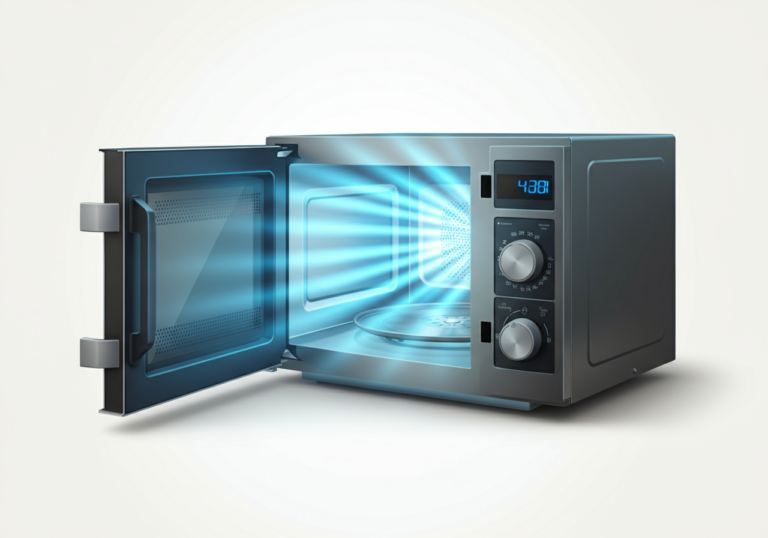
For a comprehensive overview of microwave oven safety, including how to test for leakage and practical tips for reducing exposure, see our complete microwave radiation guide.
But the word “radiation” often triggers unnecessary alarm. To understand what this really means, let’s look at what type of radiation we’re talking about and how it differs from other forms.
What Type of Radiation Do Microwaves Emit?
Microwave ovens emit radiofrequency (RF) radiation, which sits in a specific band of the electromagnetic spectrumThe electromagnetic spectrum is the complete range of electromagnetic radiation, organized by wavelength and frequency. It spans from radio waves (lowest frequency) through microwaves, infrared, visible light, ultraviolet, X-rays, to... between radio waves and infrared light.
Here’s where microwave radiation fits compared to other types:
| Radiation Type | Frequency Range | Examples |
|---|---|---|
| Radio waves | 3 kHz – 300 MHz | AM/FM radio, TV broadcasts |
| Microwaves | 300 MHz – 300 GHz | Microwave ovens, WiFi, radar, cell phones |
| Infrared | 300 GHz – 400 THz | Heat lamps, remote controls |
| Visible light | 400 – 800 THz | Sunlight, light bulbs |
| Ultraviolet | 800 THz – 30 PHz | Sunlight, tanning beds |
| X-rays | 30 PHz – 30 EHz | Medical imaging |
| Gamma rays | > 30 EHz | Nuclear reactions |
Microwave ovens specifically operate at 2.45 GHz (2,450 MHz). This frequency was chosen because it’s efficiently absorbed by water, fats, and sugars, making it effective for heating food. It’s also a frequency that was available for industrial use without interfering with communications.
How the Magnetron Generates Radiation
At the heart of every microwave oven is a vacuum tube called a magnetron. This component is responsible for converting electrical energy into microwave radiation.
Here’s how the process works:
- Electrical power enters the magnetron – When you start the microwave, high voltage electricity (typically around 4,000 volts) flows to the magnetron
- Electrons are emitted – A heated cathode releases electrons into the vacuum chamber
- Magnetic fields shape the electron flow – Powerful magnets cause the electrons to spiral in circular paths
- Resonant cavities create oscillation – As electrons pass by specially shaped cavities in the magnetron, they induce oscillating electromagnetic fields at 2.45 GHz
- Microwaves are channeled out – The radiation exits through an antenna into a waveguide that directs it into the cooking chamber
The magnetron typically produces between 600 and 1,200 watts of microwave power, depending on your oven’s specifications. This is roughly 10,000 times more power than a WiFi router emits.
How Shielding Contains the Radiation
While the magnetron generates substantial power, the oven is designed to keep that radiation contained inside the cooking chamber.
The Metal Enclosure
The walls of the microwave oven are made of metal, which reflects microwave radiation back into the cooking chamber. This creates what’s essentially a Faraday cage, an enclosure that blocks electromagnetic fields from entering or exiting.
The Door Screen
The door features a metal mesh screen that serves a dual purpose. The holes in the mesh are typically about 1 millimeter in diameter. This is small enough to block microwaves (which have a wavelength of about 12 centimeters) while allowing visible light to pass through so you can see your food.
Think of it like a chain-link fence that stops a basketball but lets a tennis ball through. The microwaves simply can’t fit through the tiny holes.
The Door Seal
Around the door’s perimeter, a rubber or silicone gasket creates a seal when the door closes. This seal serves two purposes: it helps maintain the cooking chamber’s integrity and it reduces any gaps where radiation might escape.
Safety Interlocks
Modern microwaves include safety switches that automatically shut off the magnetron if the door is opened. Most units have multiple redundant interlocks to ensure the microwave cannot operate with the door open.
Leakage vs. Intentional Emission
There’s an important distinction to understand here:
Intentional emission is the radiation deliberately generated to cook food. This is contained within the cooking chamber and poses no exposure risk during normal operation.
Leakage refers to any radiation that escapes the cooking chamber, typically around the door seal. Even well-designed microwaves allow some minimal leakage; the question is how much.
The FDA regulates microwave leakage and sets the limit at 5 milliwatts per square centimeter (mW/cm²) measured at 5 centimeters from any surface of the oven. In practice, new microwaves typically emit far less, usually between 0.1 and 0.5 mW/cm² at the same distance.
If you want to measure the leakage yourself, the best EMF detectors can provide accurate readings around your microwave.
Comparison to Other Household EMF Sources
To put microwave oven radiation in context, here’s how it compares to other RF sources in your home:
| Device | Frequency | Typical Power | Distance of Use |
|---|---|---|---|
| Microwave oven | 2.45 GHz | 600-1,200 W (internal) | 1-3 feet |
| WiFi router | 2.4 or 5 GHz | 100 mW | Throughout home |
| Cell phone | 700 MHz – 2.5 GHz | 200 mW – 2 W | Against body |
| Bluetooth headphones | 2.4 GHz | 1-100 mW | Against head |
| Smart meter | 900 MHz – 2.4 GHz | 1 W | Exterior wall |
The critical difference with microwave ovens is that their radiation is contained. When functioning properly, the amount of radiation you’re exposed to from your microwave is minimal compared to devices you carry on your body.
When You Stop the Microwave, the Radiation Stops
One common concern is whether radiation lingers after the microwave stops. The answer is no.
When you turn off a microwave oven, the magnetron immediately stops generating radiation. There is no residual microwave radiation in the cooking chamber, in your food, or anywhere else. The radiation exists only while the magnetron is actively powered.
This is fundamentally different from radioactive materials, which emit radiation continuously due to nuclear decay. Microwave radiation requires an active power source and stops the instant that power is cut.

Does My Food Become Radioactive?
No. Microwave radiation does not make food radioactive.
Radioactivity requires altering atomic nuclei, which takes ionizing radiationIonizing radiation is electromagnetic energy with enough power to remove electrons from atoms, creating charged particles called ions. This includes X-rays, gamma rays, and ultraviolet radiation. Unlike the non-ionizing radiation... (like gamma rays or neutrons) at very high energy levels. Microwave radiation is non-ionizing, meaning it doesn’t carry enough energy per photon to affect atomic structure.
What microwaves do is cause molecules (especially water) to vibrate and rotate, generating heat through friction. When the microwaves stop, the molecules stop being excited. Nothing changes at the atomic level, and nothing radioactive is created or left behind.
Factors That Affect Emission Levels
Several factors influence how much radiation might leak from a microwave oven:
- Age of the unit – Older microwaves may have degraded seals and components
- Door seal condition – Damaged or dirty seals allow more leakage
- Door alignment – Warped doors or worn hinges create gaps
- Manufacturing quality – Higher-quality units typically have better shielding
- Physical damage – Dents or corrosion can compromise the metal enclosure
If you’re concerned about your microwave’s emissions, the article on is microwave radiation harmful explores the health research in more detail.
How to Minimize Your Exposure
While microwave ovens are designed to contain their radiation, a few simple practices can further reduce your exposure:
- Maintain distance – Stand a few feet away while the microwave runs
- Inspect regularly – Check the door seal for damage or debris
- Close the door properly – Ensure it latches securely each time
- Replace damaged units – Don’t use a microwave with a faulty door
- Consider age – Evaluate units over 10 years old for potential replacement
The Bottom Line
Yes, microwave ovens emit radiation. That’s how they work. The magnetron generates RF radiation at 2.45 GHz, which heats your food by causing water molecules to vibrate.
The key points to remember:
- The radiation is non-ionizing (it cannot directly damage DNA like X-rays)
- The oven is designed to contain this radiation within the cooking chamber
- Some small leakage is normal and regulated by the FDA
- The radiation stops immediately when the oven is turned off
- Your food does not become radioactive
Understanding how your microwave works helps you use it wisely. Distance remains your best friend. Standing back a few feet while your food heats is a simple, zero-cost way to minimize exposure from any leakage that may occur.
Common Misconceptions
Misconception: Microwave ovens make food radioactive
Reality: Microwave radiation is non-ionizing and cannot alter atomic nuclei. It heats food by causing water molecules to vibrate, not by creating radioactive material. When the microwave stops, no radiation of any kind remains in the food.
Misconception: Standing near a microwave oven is dangerous
Reality: Modern microwave ovens are designed as Faraday cages that contain radiation inside the cooking chamber. FDA regulations limit leakage to 5 mW/cm² at 5 cm distance, and new ovens typically emit far less. Standing a few feet away reduces exposure even further.
Misconception: Microwave radiation lingers after the oven is turned off
Reality: Microwave radiation stops the instant the magnetron is powered down. Unlike radioactive materials that emit radiation continuously due to nuclear decay, a microwave oven requires active electrical power to generate any radiation at all.
Frequently Asked Questions
Yes, microwave ovens emit non-ionizing radiofrequency (RF) radiation at a frequency of 2.45 GHz, which is necessary for cooking food.
Microwave radiation is non-ionizing and does not damage DNA. The FDA regulates leakage, and modern microwaves are designed to contain radiation within the cooking chamber.
No, microwave radiation does not make food radioactive. It only causes water molecules to vibrate and generate heat.
Inspect the door seal for damage and consider replacing units over 10 years old, as older microwaves may have degraded seals and components.
To minimize exposure, maintain distance while the microwave runs, regularly inspect the door seal, and ensure the door closes properly.