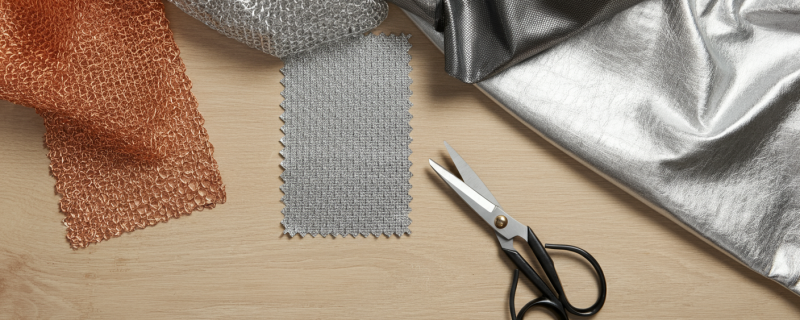

EMFEMF stands for electromagnetic field (also called electromagnetic frequency or electromagnetic force). EMFs are invisible fields of energy produced by electrically charged objects. They exist on a spectrum ranging from... shielding fabric is material woven with conductive metal fibers (silver, copper, stainless steel) that blocks electromagnetic radiationElectromagnetic radiation (EMR) is energy that travels through space as waves of oscillating electric and magnetic fields. It includes everything from radio waves to visible light to gamma rays. All... from cell phones, WiFi, and other wireless sources.
Shielding effectiveness ranges from 20 dB (up to 99% blocking) to 60+ dB (up to 99.9999%). These fabrics work for DIY curtains, bed canopies, device pouches, and custom clothing.
Key Takeaways
- Silver fabric offers the highest conductivity and is best for wearable applications (hypoallergenic, breathable)
- Copper mesh provides excellent RF shielding at lower cost but is heavier and less suitable for clothing
- Shielding effectiveness is measured in decibels (dB): 30 dB = up to 99.9% blocking, 40 dB = up to 99.99%
- DIY projects require attention to seams and closures — gaps reduce effectiveness
- Testing with an RF meter confirms your project actually works
What Is EMF Shielding Fabric?
EMF shielding fabric is textile material containing metal fibers or coatings that block electromagnetic fields. The conductive properties of these metals create a barrier that reflects, absorbs, or redirects electromagnetic waves away from whatever is behind the fabric.

This is the same principle used in ready-made EMF protection clothing, but purchasing raw shielding fabric allows you to create custom solutions for your specific needs.
EMF shielding fabrics come in various forms:
| Type | Description | Best For |
|---|---|---|
| Silver-coated fabric | Silver threads woven into textile | Clothing, bed canopies |
| Copper mesh | Woven copper wire | Window screens, room shielding |
| Nickel-copper fabric | Nickel-copper plated polyester | High-performance applications |
| Stainless steel mesh | Steel wire weave | Industrial, heavy-duty projects |
| Aluminum mesh | Woven aluminum | Budget window screening |
Types of EMF Shielding Fabric
Silver Fabric
Silver is the most conductive metal and the preferred choice for wearable or body-contact applications.

Properties:
- Highest electrical conductivity
- Naturally antimicrobial
- Hypoallergenic
- Temperature regulating
- Soft and comfortable against skin
- Machine washable
Shielding Effectiveness: 30-50 dB typical (up to 99.999% blocking)
Frequency Range: Effective from MHz to GHz (cellular, WiFi, 5G5G is the fifth generation of wireless cellular technology, offering faster data speeds, lower latency, and greater network capacity than 4G LTE. It began rolling out commercially in 2019. 5G...)
Best Applications:
- Custom clothing modifications
- Bed canopy liners
- Face masks or head coverings
- Baby blankets
Limitations:
- Higher cost than other metals
- Can tarnish over time (doesn’t affect shielding)
Copper Mesh
Copper provides excellent EMF shielding at lower cost than silver but is heavier and stiffer.
Properties:
- Excellent conductivity (second only to silver)
- Corrosion resistant with proper coating
- Durable and long-lasting
- Visible metallic appearance
Shielding Effectiveness: 40-60 dB typical (up to 99.9999% blocking)
Frequency Range: Broad spectrum including low frequencies
Best Applications:
- Window screens
- Wall or ceiling installations
- Equipment enclosures
- Room-level shielding
Limitations:
- Heavier than fabric options
- Stiffer, not suitable for clothing
- May require grounding for low-frequency shielding
Nickel-Copper Fabric
Nickel-copper coated fabrics offer high shielding in a flexible format.
Properties:
- Very high shielding effectiveness
- Flexible like regular fabric
- Lighter than pure copper mesh
- Often polyester base with metal coating
Shielding Effectiveness: 40-80 dB depending on construction
Frequency Range: Broad spectrum including microwave frequencies
Best Applications:
- Professional equipment shielding
- EMF-sensitive environments
- High-frequency blocking needs
- Industrial applications
Limitations:
- May cause skin reactions in some people (nickel sensitivity)
- Not ideal for direct skin contact
- Higher performance means higher cost
Stainless Steel Fabric
Steel-based fabrics offer durability and moderate shielding.
Properties:
- Highly durable
- Lower cost than silver
- Corrosion resistant
- Heavier feel
Shielding Effectiveness: 20-40 dB typical
Frequency Range: Good for RF, limited low-frequency shielding
Best Applications:
- Durable projects needing longevity
- Outdoor installations
- Combined with other materials
Limitations:
- Less effective than silver or copper at same weight
- Can be scratchy against skin
- Heavier than silver fabric
Shielding Fabric Comparison
| Fabric Type | Shielding (dB) | Weight | Washable | Skin-Safe | Relative Cost | Best For |
|---|---|---|---|---|---|---|
| Silver mesh | 30-50 | Light | Yes | Yes | $$$ | Clothing, canopies |
| Silver-coated polyester | 25-40 | Light | Yes | Yes | $$ | Budget wearables |
| Copper mesh | 40-60 | Heavy | No | Neutral | $$ | Windows, walls |
| Nickel-copper fabric | 40-80 | Medium | Limited | No (nickel) | $$$ | High-performance |
| Stainless steel fabric | 20-40 | Heavy | Yes | Neutral | $ | Durable projects |
DIY EMF Shielding Projects
Project 1: EMF-Blocking Curtains
Window curtains can reduce RF radiation entering your home from cell towers, neighbors’ WiFi, and other external sources.

Materials Needed:
- EMF shielding fabric (silver or copper mesh)
- Curtain lining fabric (optional, for aesthetics)
- Curtain rod and rings
- Sewing supplies
Steps:
-
Measure your windows including overlap on all sides (at least 6″ beyond the window frame)
-
Cut shielding fabric to size, adding seam allowance
-
If lining: Attach lining to hide the shielding fabric, sewing edges together
-
Create hanging mechanism using pocket hem for rod or attach rings
-
Install with full coverage ensuring fabric overlaps window frame edges
-
Test with RF meter inside and outside curtain coverage area
Tips for Maximum Effectiveness:
- Use weights at bottom hem to keep curtain against wall
- Overlap panels rather than having gaps between
- Extend past window frame edges
- Consider blackout backing for sleep areas
Project 2: Device Pouch
Create a simple Faraday pouch for your phone or other devices when you want complete signal blocking.
Materials Needed:
- Two pieces of EMF shielding fabric (approx. 8″ x 10″ each)
- Velcro or snap closure
- Sewing supplies
Steps:
-
Cut two rectangular pieces large enough for your device plus seam allowance
-
Place good sides together and sew three edges, leaving top open
-
Turn right-side out so shielding faces outward
-
Attach closure — velcro strip across the opening
-
Test before use — place phone inside, close fully, check if calls go through
Important: The pouch must seal completely to work. Any gap in the closure allows signal through.
Project 3: Bed Canopy Liner
A bed canopy creates a shielded sleeping environment by blocking RF radiation from all directions except the floor.
Materials Needed:
- EMF shielding fabric sufficient for canopy dimensions
- Canopy frame or ceiling attachment points
- Grounding kit (optional, for low-frequency shielding)
Steps:
-
Measure sleeping area adding extra for draping (typically 6-10 feet square for a bed)
-
Calculate fabric needed for top and sides extending to floor or bed frame
-
Construct or purchase canopy frame sized for your bed
-
Attach fabric panels to frame, ensuring overlap at seams
-
Seal gaps between panels using conductive tape or overlap seaming
-
Optional grounding: Connect to earth ground for low-frequency field reduction
-
Test inside the canopy with RF meter to verify shielding
Note: This is a significant project. For simpler head protection while sleeping, consider Faraday hats or a silver-based pillowcase.
Project 4: Custom Clothing Modification
Add EMF shielding to existing garments by lining specific areas with silver fabric.
Materials Needed:
- Silver shielding fabric
- Existing garment to modify
- Sewing supplies
Ideas:
- Line the crown of a regular hat with silver fabric
- Add a pocket lining that shields a phone-carrying pocket
- Create removable shielding inserts for jacket pockets
- Line the front panel of a hoodie
Tips:
- Washing care follows the shielding fabric requirements (no fabric softener)
- Consider removable inserts that can be washed separately
- Focus on areas closest to body or sensitive organs
How to Test EMF Shielding Fabric
Using an RF Meter
The most accurate way to test shielding effectiveness:

- Establish baseline: Measure ambient RF levels in your test location
- Create consistent source: Place your phone on speakerphone for a stable signal
- Measure unshielded: Note the reading with meter exposed
- Measure shielded: Wrap the meter (or phone) completely in the fabric
- Calculate reduction: Compare shielded vs. unshielded readings
A quality shielding fabric should show up to 90%+ reduction in RF readings.
Using Your Phone
A simpler but less precise test:
- Note full signal strength in a consistent location
- Wrap phone completely in the shielding fabric
- Seal all openings (fold edges under)
- Wait 60 seconds for signal to attempt reconnection
- Check signal strength — should show significant reduction or “No Service”
If your phone maintains full signal while wrapped, either the fabric isn’t working or there’s a gap in your seal.
Testing Tips
- Test at multiple frequencies if possible (different carriers use different bands)
- Ensure complete wrapping — any gap compromises results
- Test in locations with moderate signal (very strong signals may penetrate weak shielding)
- Compare multiple fabric samples if purchasing
Understanding Shielding Specifications
Decibel (dB) Ratings
Shielding effectiveness is measured in decibels:

| dB Rating | Percentage Blocked | What It Means |
|---|---|---|
| 10 dB | Up to 90% | Minimal shielding |
| 20 dB | Up to 99% | Good for most applications |
| 30 dB | Up to 99.9% | Very good shielding |
| 40 dB | Up to 99.99% | Professional grade |
| 50 dB | Up to 99.999% | Military/medical grade |
| 60 dB | Up to 99.9999% | Maximum practical |
Percentages represent theoretical maximums under ideal laboratory conditions.
For DIY projects, 20-40 dB is typically sufficient and achievable with common shielding fabrics.
Frequency Range
Different EMF sources operate at different frequencies:
| Frequency Range | Common Sources | What Blocks It |
|---|---|---|
| 50-60 Hz (ELF) | Power lines, wiring | Requires grounded metal or mu-metal |
| 900 MHz – 2.4 GHz | Cell phones, WiFi 2.4G | All conductive fabrics |
| 5-6 GHz | WiFi 5G band | All conductive fabrics |
| 24-40 GHz | 5G mmWave | Dense weave required |
Most shielding fabrics work well for RF frequencies (MHz to GHz) but don’t significantly block extremely low frequencyExtremely low frequency (ELF) refers to electromagnetic fields with frequencies between 3 Hz and 300 Hz. This range includes the 50/60 Hz fields produced by electrical power systems. ELF fields... (ELF) fields from electrical wiring without grounding.
Common Mistakes in DIY Shielding
Mistake 1: Gaps in Coverage
The problem: Any gap or opening significantly reduces effectiveness. EMF travels through the path of least resistance.

The solution: Overlap seams, seal edges, and ensure closures seal completely.
Mistake 2: Using the Wrong Fabric for the Application
The problem: Choosing based on cost alone without considering the use case. Copper mesh is great for windows but unsuitable for clothing.
The solution: Match fabric type to application. Use silver for body contact, copper for structural installations.
Mistake 3: Not Testing After Construction
The problem: Assuming the project works without verification. Construction issues can void shielding effectiveness.
The solution: Always test with an RF meter or phone signal test before relying on your project.
Mistake 4: Expecting Low-Frequency Shielding Without Grounding
The problem: Assuming fabric will block magnetic fields from wiring. Ungrounded conductive fabric doesn’t shield ELF effectively.
The solution: For low-frequency concerns, fabric must be grounded or use specialized mu-metal.
Mistake 5: Creating a Partial Faraday Cage That Amplifies
The problem: Incomplete enclosures can potentially concentrate rather than block fields in some configurations.
The solution: Either create complete enclosures with proper sealing or use single-sided shielding (like bed canopies that are open at the bottom).
Common Misconceptions
Misconception: All EMF shielding fabrics block the same frequencies
Reality: Different fabrics are effective at different frequency ranges. Silver mesh works well for RF frequencies (cellular, WiFi, 5G) but does not block extremely low frequency (ELF) fields from electrical wiring without grounding. Always check the tested frequency range before purchasing.
Misconception: EMF shielding fabric needs to be grounded to work
Reality: For RF shielding (cell phones, WiFi, Bluetooth), grounding is not required. The conductive material reflects and absorbs high-frequency radiation on its own. Grounding only becomes necessary for blocking low-frequency electric fields from household wiring.
Misconception: Washing EMF shielding fabric destroys its effectiveness
Reality: Many silver-based shielding fabrics are machine washable and maintain their effectiveness through multiple wash cycles. The key is following manufacturer care instructions, such as avoiding fabric softeners that can coat the conductive fibers. Regular testing after washing confirms continued performance.
Where to Source EMF Shielding Fabric
What to Look For
When purchasing EMF shielding fabric, verify:
- Shielding effectiveness rating (in dB at specified frequencies)
- Metal content and construction method
- Washability if needed for your application
- Width and pricing (calculate total cost for your project)
- Third-party testing documentation
Reputable Sources
Look for suppliers specializing in EMF shielding materials who provide:
- Technical specifications with dB ratings
- Frequency range information
- Sample swatches for testing
- Return policies if material doesn’t meet specifications
Note: SYB offers finished EMF protection products but does not currently sell raw shielding fabric. For ready-made solutions, see our EMF Protection Clothing and Faraday Hats. If you’re looking for ready-made EMF shielding options for your home, our EMF blanket comparison reviews some popular products. For a head-to-head comparison of two popular EMF clothing brands, check out our SYB vs Lambs comparison.
For ready-made EMF protection solutions, see our EMF Protection Clothing guide. For head-specific protection, check out our Faraday Hats buyer’s guide.
Frequently Asked Questions
For wearable applications, silver-based fabrics offer the best combination of high conductivity, comfort, and skin safety. For structural installations like windows, copper mesh provides excellent shielding at lower cost. The "best" choice depends on your specific application, budget, and comfort requirements.
Grounding is optional for blocking RF radiation (cell phones, WiFi) but recommended for reducing low-frequency electric fields from house wiring. For most DIY projects targeting wireless device radiation, grounding isn't necessary. For bed canopies where you want comprehensive protection including ELF fields, grounding improves effectiveness.
Yes, with the right fabric and sewing skills. Use silver-based shielding fabric for any body-contact applications. Consider that professional EMF clothing is designed for optimal coverage and comfort — DIY options may not match the fit and finish of manufactured garments, but can be effective for specific applications like pocket liners or hat modifications.
Test with an RF meter before and after shielding. The shielded reading should show 90%+ reduction compared to baseline. For a simpler test, wrap your phone completely in the fabric and check if it loses signal. If calls don't go through and signal drops to zero, the fabric is working.
Quality silver shielding fabric maintains effectiveness through many washes when cared for properly. Use mild soap without bleach or fabric softener (softener coats the metal fibers). Silver doesn't degrade from washing itself. Effectiveness may decrease over time due to physical wear of the fibers, not the washing process.
Most EMF shielding fabrics effectively block RF frequencies from approximately 30 MHz to 20+ GHz, covering cellular (all generations including 5G), WiFi, Bluetooth, and other wireless protocols. They do NOT effectively block extremely low frequency (ELF) fields from power lines and house wiring without grounding.
Nickel can cause skin reactions in people with nickel sensitivity (estimated 10-15% of the population). Nickel-copper fabrics are best used for applications without direct skin contact, such as device pouches or lined pockets. For wearable applications with skin contact, silver-based fabrics are safer.