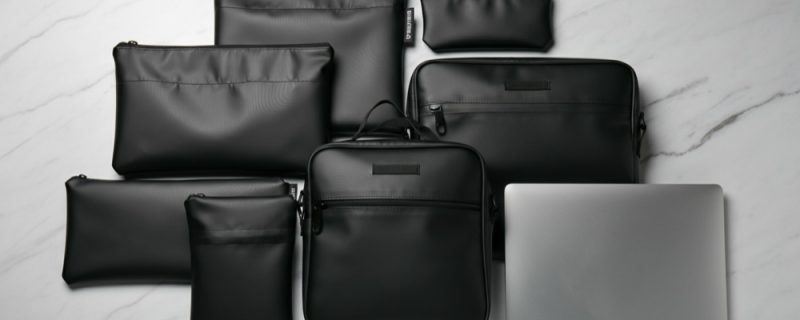

A Faraday bag is a portable enclosure made with conductive fabric that blocks electromagnetic signals, including cellular, WiFi, Bluetooth, GPS, and RFID, from reaching devices inside.
Based on Faraday cage technology developed in the 1830s, these bags make phones and other electronics electronically invisible. People use them to prevent tracking, protect against hacking, stop relay theft of key fobs, and reduce radiation exposure.
People use them to prevent location tracking, protect against remote hacking, stop relay theft of car key fobs, and reduce cell phone radiation exposure. When choosing a phone Faraday bag, look for lab-tested shielding effectiveness, quality closures, and the right size for your devices.
Medical Disclaimer: This article is for informational purposes only. It is not, nor is it intended to be, a substitute for professional medical advice, diagnosis, or treatment and should never be relied upon for specific medical advice.
Key Takeaways
- Faraday bags block all wireless signals (cellular, WiFi, Bluetooth, GPS, RFID, NFC) using conductive fabric that surrounds your device
- Unlike DIY Faraday cages, commercial bags are designed for daily portable use with engineered closures
- Key fob Faraday pouches prevent relay theft, where thieves amplify your fob’s signal to unlock and start your car
- Quality varies significantly. Look for products with independent lab testing showing 40+ dB attenuation.
- Faraday bags offer complete signal blocking. For EMFEMF stands for electromagnetic field (also called electromagnetic frequency or electromagnetic force). EMFs are invisible fields of energy produced by electrically charged objects. They exist on a spectrum ranging from... reduction while maintaining device functionality, consider partial shielding products.
What Is a Faraday Bag?

A Faraday bag is a flexible, portable version of a Faraday cage. It uses conductive fabric—typically woven with silver, copper, or nickel threads—to create an electromagnetic shield around electronic devices.
When you place a phone, laptop, key fob, or other device inside a properly sealed Faraday bag, all wireless communication stops:
- Cellular signals (2G through 5G5G is the fifth generation of wireless cellular technology, offering faster data speeds, lower latency, and greater network capacity than 4G LTE. It began rolling out commercially in 2019. 5G...) cannot reach the device
- WiFi and Bluetooth connections are blocked
- GPS cannot track the device’s location
- RFID and NFC readers cannot access embedded chips
- Remote access attempts fail because the device is unreachable
Put simply: the device inside becomes electronically invisible. It cannot transmit data, receive calls, or be located by any wireless means.
How Faraday Bags Differ from EMF Protection Products
There’s an important distinction between Faraday bags and EMF protection products.
Faraday bags provide complete signal isolation. Your device is offline and unusable while inside. This is ideal for privacy, security, and complete EMF elimination.
EMF protection products (like shielded phone pouches) block radiation on one side while allowing the device to remain functional. They reduce your exposure without cutting off connectivity.
If you want to use your phone while reducing EMF exposure, a partial shielding product is more practical. If you want complete signal blocking for privacy or security, a Faraday bag is the right choice.
Why People Use Faraday Bags
Faraday bags serve multiple purposes, from security to health. Understanding these use cases helps you choose the right product for your needs.
Privacy Protection

Modern smartphones continuously broadcast their location and can be remotely accessed by sophisticated attackers. Faraday bags eliminate these vulnerabilities:
- Location tracking: Your phone cannot be tracked via cellular triangulation, GPS, or WiFi positioning while inside a Faraday bag
- Remote surveillance: Malware that activates microphones or cameras cannot transmit when the phone is shielded
- Data harvesting: Background processes cannot upload data to cloud services
- Cell-site simulators: Law enforcement surveillance devices (sometimes called “stingrays”) cannot access shielded phones
Privacy-conscious individuals, journalists, activists, executives, and anyone concerned about surveillance use Faraday bags during sensitive meetings, personal time, or when traveling.
Key Fob Protection (Anti-Theft)

Here’s something worth knowing: relay theft has become a significant problem for modern vehicles with keyless entry.
- Thieves use an amplifier near your home to capture your key fob’s signal
- A second device near your car rebroadcasts that signal
- Your car thinks the key fob is present and unlocks
This can happen in seconds, without breaking windows or triggering alarms. Vehicles have been stolen from driveways while owners slept inside.
A Faraday pouch blocks your key fob’s signal when you’re not using it, preventing thieves from amplifying and capturing the transmission. Many car owners now store their fobs in Faraday pouches as standard practice.
Digital Evidence Preservation
Law enforcement and digital forensics teams use Faraday bags to preserve evidence on seized devices:
- Prevents remote wiping of phone data
- Stops automatic cloud synchronization
- Blocks potential tampering through network access
- Maintains chain of custody for digital evidence
EMF Exposure Reduction
While most Faraday bag users focus on privacy and security, complete signal blocking also eliminates EMF exposure from the shielded device.
When your phone is inside a Faraday bag:
– No RF radiation is emitted
– No Bluetooth or WiFi signals reach your body
– The device is completely electromagnetically dormant
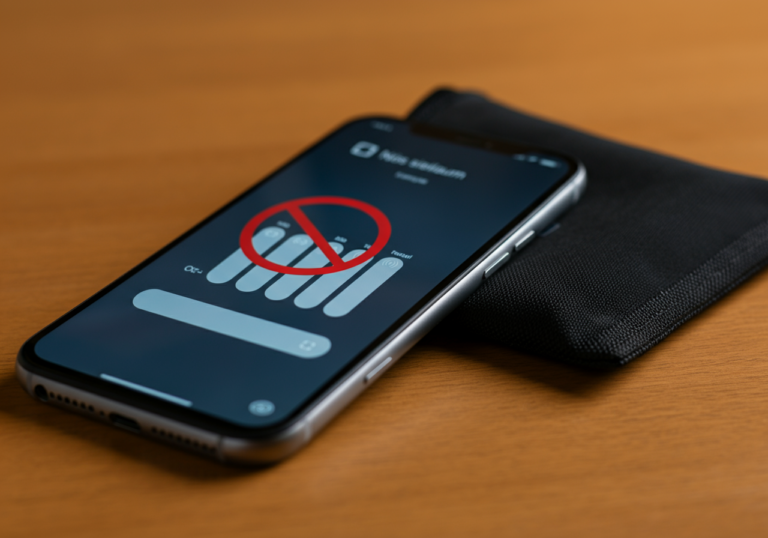
For those concerned about EMF exposure during sleep or extended periods, placing phones in Faraday bags is more effective than airplane mode (which some phones implement inconsistently) and ensures no signals are transmitted.
Travel and Border Security
Some travelers use Faraday bags to:
– Prevent unauthorized access to devices during border crossings
– Protect against RFID skimming of passport chips or credit cards
– Block corporate or government surveillance in sensitive locations
– Maintain personal boundaries regarding device access
Types of Faraday Bags
Faraday products come in various sizes and designs for different devices and use cases.
Phone Pouches and Sleeves
The most common Faraday products, sized to fit smartphones. Features to look for:
- Closure type: Roll-top, magnetic, or hook-and-loop (Velcro)
- Shielding verification: Window showing when device is properly shielded
- Accessibility: Easy to use multiple times daily
- Size compatibility: Fits your phone with or without a case
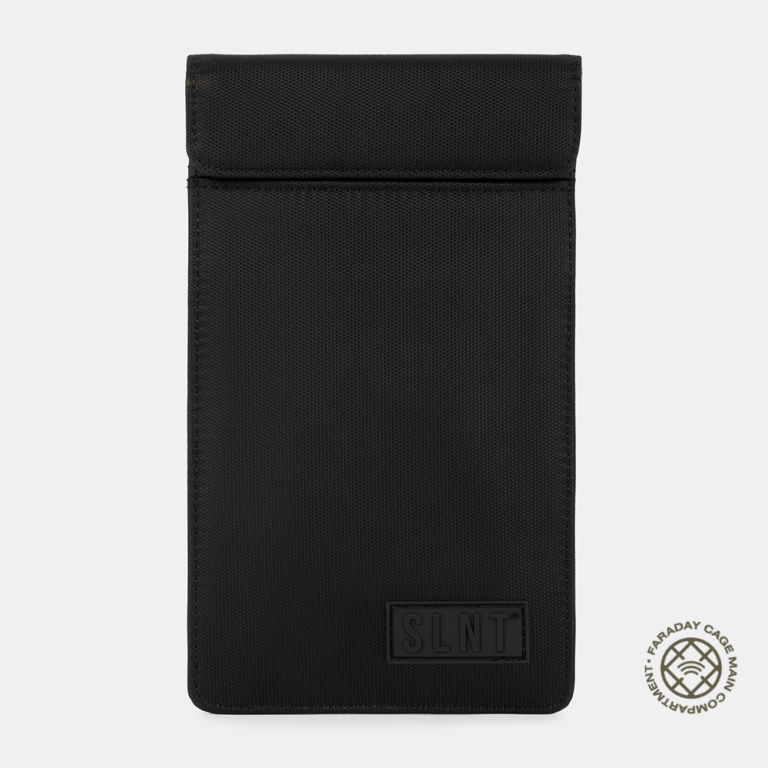
Phone pouches range from basic single-layer designs to premium options with multiple shielding layers and enhanced closures. We carry several options including the SLNT Faraday Phone Sleeve and PoM Shield Phone Faraday Cages in different materials and price points.
Laptop and Tablet Bags
Larger Faraday enclosures for computers and tablets. The SLNT Faraday Laptop Bag is designed specifically for this purpose. Considerations include:
- Interior padding: Protects devices during transport
- Size options: Match to your specific laptop dimensions
- Weight: Shielding material adds some weight
- Access: Zippers with conductive fabric overlap at seams
Key Fob Pouches
Small pouches specifically designed for car key fobs:
- Compact size: Fits in pocket or on keychain
- Quick access: Easy to remove fob when needed
- Durability: Handles daily use over years
- Signal blocking verification: Way to confirm fob is shielded
Multi-Device Faraday Bags
Larger bags that can hold multiple devices or larger equipment. Options like the SLNT Clear-Front Faraday Bag offer visibility while maintaining shielding:
- Capacity: Holds multiple phones, tablets, or specialized equipment
- Professional use: Law enforcement, security, corporate
- Construction quality: Heavy-duty for frequent use
- Organization: Pockets or dividers for multiple items
Specialized Products
- Faraday backpacks: Full backpacks with shielded compartments
- Faraday wallets: Protect RFID-enabled credit cards and ID cards (like the SLNT RFID Passport Wallet)
- Faraday purses: Fashion-conscious designs with shielding built in
- Faraday laptop sleeves: Slides into existing bags while providing shielding
What to Look for When Buying

Not all Faraday bags perform equally. Here’s how to evaluate quality.
Shielding Effectiveness
The most important specification is attenuation—how much the bag reduces signal strength, measured in decibels (dB).
| Attenuation | Signal Reduction | Quality Level |
|---|---|---|
| 20 dB | 99% | Basic |
| 30 dB | 99.9% | Good |
| 40 dB | 99.99% | Very Good |
| 50 dB | 99.999% | Excellent |
| 60+ dB | 99.9999%+ | Professional |
Look for products with independent lab testing documentation. Claims without third-party verification are difficult to evaluate. Quality manufacturers publish test results showing performance across multiple frequency bands.
Closure Design
Here’s the truth about Faraday bags: the closure is the most critical component. Without a proper seal, even excellent shielding fabric won’t work.
Quality closure characteristics:
– Multiple fold-overs or overlapping layers at the opening
– Conductive contact maintained when closed
– Durable construction that won’t degrade with use
– Clear indication of proper sealing
Red flags:
– Simple Velcro-only closures without overlap
– Zippers with exposed non-conductive teeth
– Flap designs with single-point contact
– Loose or imprecise fit
Material Quality
Shielding fabric quality affects both performance and durability:
- Thread type: Silver offers the highest conductivity; copper and nickel also work well
- Weave density: Tighter weaves block higher frequencies better
- Durability: Quality fabric maintains effectiveness over years of use
- Interior: Soft lining protects devices from scratches
Size and Fit
A Faraday bag that’s too small won’t close properly. One that’s too large may be bulky to carry.
- Measure your device (with any case you use)
- Check product dimensions including interior space
- Allow for closure material which reduces usable space
- Consider your use case (pocket carry vs. bag storage)
Brand Reputation
Established brands with track records offer more assurance than unknown sellers:
- Published test results from independent laboratories
- Customer reviews discussing actual signal blocking
- Warranty or guarantee on shielding performance
- Responsive customer support for questions and issues
Faraday Bags vs. Other Solutions
How do Faraday bags compare to alternatives for privacy and EMF protection?
vs. Airplane Mode
Airplane mode disables wireless transmission through software.
Advantages of Faraday bags over airplane mode:
– Works with any device regardless of settings
– Cannot be overridden by software bugs or malware
– Blocks all signals including those airplane mode may miss
– Provides physical evidence of signal blocking
Disadvantages:
– Requires carrying an additional item
– Device is completely inaccessible while shielded
– Cost (airplane mode is free)
vs. DIY Solutions
DIY Faraday cages (foil, metal containers) can provide shielding at lower cost.
Advantages of commercial Faraday bags:
– Engineered closures that maintain seal
– Lab-tested, verified performance
– Designed for portable daily use
– Durable construction
– Professional appearance
Disadvantages:
– Higher cost than DIY alternatives
– Limited customization options
For occasional use or large-item storage, DIY may be sufficient. For daily portable protection, commercial products offer meaningful advantages.
vs. Signal-Blocking Phone Cases
Some phone cases claim to block signals while remaining functional.
The physics problem: A case that blocks signals in all directions would prevent your phone from working. Cases that claim signal blocking usually mean they reduce exposure on one side (body-facing) while allowing signals through on the other side.
These are EMF protection products, not Faraday products. They serve different purposes:
– EMF protection case: Reduces exposure while phone remains connected
– Faraday bag: Complete signal isolation with phone offline
Cost Comparison
| Solution | Initial Cost | Ongoing Cost | Effectiveness | Convenience |
|---|---|---|---|---|
| Airplane mode | Free | None | Variable | High |
| DIY foil wrap | $5 | Replacement | 60-80% | Low |
| Budget Faraday bag | $15-30 | None | 80-95% | Medium |
| Quality Faraday bag | $30-100 | None | 95-99%+ | High |
| Premium Faraday bag | $100+ | None | 99%+ | High |
How to Test a Faraday Bag
Always verify that a Faraday bag works before relying on it.
Basic Phone Test
- Place your phone inside the bag
- Close the bag completely according to instructions
- Call your phone from another device
- Wait at least 30 seconds
Pass: Call fails to connect (doesn’t go to voicemail after ringing)
Fail: Phone rings or call connects
WiFi Test
- Connect your phone to WiFi
- Start a video stream or large download
- Place the phone in the bag and close it
- Check if the connection drops within seconds
Signal Strength Test
- Check your phone’s signal strength (Settings > About > Cellular)
- Note the reading in dBm
- Place phone in bag, wait 2 minutes
- Check display—should show “No Service” or “Searching”
What If It Fails?
If your bag fails testing:
– Verify you’re closing it correctly (follow manufacturer instructions)
– Check for damage to the shielding fabric
– Ensure the closure is making proper contact
– Contact the manufacturer for warranty service
Using Faraday Bags Effectively
Getting the most from your Faraday bag requires proper usage.
Daily Use Tips
- Close completely: Partial closure provides partial (or zero) protection
- Check the seal: Make sure closure is fully engaged
- Store properly: Don’t fold or compress in ways that could damage fabric
- Clean carefully: Follow manufacturer instructions; avoid harsh chemicals
When to Use
- During sensitive meetings or conversations
- While sleeping (if concerned about bedroom EMF)
- When storing devices not in use
- During travel in high-risk areas
- When parking your car (key fob protection)
When Not to Use
- When you need to receive calls or messages
- In emergencies when phone access is critical
- When using your device (obviously)
Battery Considerations
A phone inside a Faraday bag will continuously search for signal, which drains the battery faster than normal. For extended storage:
– Turn the phone off, or
– Enable airplane mode before placing in the bag
This prevents battery drain while maintaining physical signal blocking as a backup.
Expert Insight
“Faraday pouches are powerful tools for privacy, for security, for data isolation. They’re excellent for protecting key fobs, shielding sensitive electronics, or safeguarding against digital surveillance. And yes, by virtue of how they work, they do offer EMF protection too.”
— R Blank, CEO of Shield Your Body and author of Overpowered: The Dangers of Electromagnetic RadiationElectromagnetic radiation (EMR) is energy that travels through space as waves of oscillating electric and magnetic fields. It includes everything from radio waves to visible light to gamma rays. All...
The fundamental physics of Faraday bags is sound—the same principles that protect MRI rooms and government secure facilities work in portable form. What matters is implementation: quality materials, effective closures, and verified performance.
These devices offer protection against everything from basic RF radiation to electromagnetic pulse events, making them valuable for both everyday privacy and emergency preparedness.
Common Misconceptions
Misconception: All Faraday bags work equally well.
Reality: Quality varies dramatically. Cheap products often have inadequate closures or thin shielding material that doesn’t provide complete blocking. Look for lab-tested products with verified attenuation ratings.
Misconception: Faraday bags will damage electronics.
Reality: Faraday bags are passive shielding with no electrical components. They cannot damage devices. Your phone simply experiences the same state as being in an area with no cellular coverage.
Misconception: My phone says “No Service” so the bag must be working.
Reality: Some phones take minutes to display signal loss. Always test with a phone call rather than relying on the display, which may show cached information.
Misconception: I can use my phone while it’s in a Faraday bag.
Reality: No. Complete signal blocking means your phone cannot send or receive any wireless data while inside a sealed Faraday bag. If you can use your phone, the bag isn’t working.
Misconception: Faraday bags protect against physical theft.
Reality: Faraday bags block signals, not physical access. They prevent remote theft (key fob relay attacks, data theft) but not someone physically taking your device.
Looking for Faraday protection? Browse our Faraday bag collection to find the right solution for your phone, key fob, or laptop.
Frequently Asked Questions
Yes. When your phone is properly sealed inside a Faraday bag, it cannot be tracked via GPS, cellular triangulation, or WiFi positioning. The phone is completely invisible to wireless networks.
No. A phone inside a properly functioning Faraday bag cannot receive or transmit signals, making it untrackable by any wireless means including cell-site simulators used by law enforcement.
If your phone is on, it will search for signal while inside the bag, which uses battery. To prevent this, turn off the phone or enable airplane mode before placing it in the bag. The bag itself doesn't use or affect battery directly.
The terms are often used interchangeably. "Pouch" typically refers to smaller products for phones or key fobs, while "bag" may refer to larger products for laptops or multiple devices. Both work the same way.
Quality Faraday bags should last years with normal use. The shielding fabric doesn't wear out under normal conditions. Closures may eventually need attention if they become loose or worn. Inspect periodically and test to verify continued effectiveness.
Follow manufacturer instructions. Many can be gently hand-washed, but harsh detergents or machine washing may damage the conductive threads. Air dry completely before use.