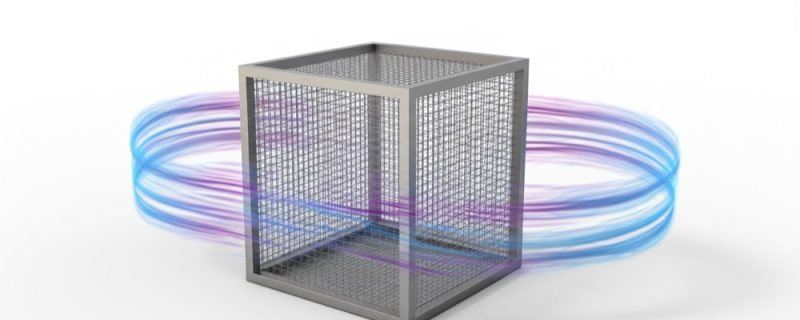

A Faraday cage is an enclosure made of conductive material that blocks electromagnetic fields from entering or exiting. Electrons in the metal redistribute to cancel the field inside.
This principle, discovered by Michael Faraday in the 1830s, now protects everything from hospital MRI rooms to portable phone pouches.
Key Takeaways
- Faraday cages block electromagnetic fields by redistributing electric charge across their conductive surface, requiring no power or batteries
- Silver, copper, and aluminum are the most effective shielding materials, with silver offering the highest conductivity
- Even small gaps or openings can significantly compromise shielding effectiveness, which is why closure design matters as much as material quality
- Modern Faraday products range from room-size medical enclosures to portable pouches that fit in your pocket
- The same physics that blocked static electricity in 1836 blocks your phone’s 5G5G is the fifth generation of wireless cellular technology, offering faster data speeds, lower latency, and greater network capacity than 4G LTE. It began rolling out commercially in 2019. 5G... signal today
What is a Faraday Cage?
Here’s something worth understanding: a technology developed nearly 200 years ago remains one of the most effective ways to protect your privacy and control your electromagnetic environment.
A Faraday cage is an enclosure made of conductive material that prevents electromagnetic fields from passing through its walls. Put simply, it creates a shield. When wireless signals, electrical interference, or any electromagnetic radiationElectromagnetic radiation (EMR) is energy that travels through space as waves of oscillating electric and magnetic fields. It includes everything from radio waves to visible light to gamma rays. All... hits the cage, the conductive material redistributes electric charges across its surface. This creates a counter-field that cancels the incoming energy before it can reach whatever is inside.
What does this mean for you? It means that a device inside a properly sealed Faraday cage becomes electronically invisible. No cellular signal. No WiFi. No Bluetooth. No GPS tracking. No remote access of any kind.
The History Behind the Discovery
Michael Faraday discovered this principle in the 1830s during his investigations into the nature of electricity. In his famous demonstration at the Royal Institution in London, Faraday lined a room with metal foil and placed a sensitive electroscope at its center. Despite generating intense electrical activity outside the enclosure, the instrument inside showed no reaction.

What made this discovery profound was its implications: certain structures of conductive metals could block, redirect, or contain electromagnetic energy. The science was sound then, and it remains sound today.
Consider this: Faraday was a self-taught scientist who rose from a blacksmith’s family to become one of the most influential figures in the history of electricity and magnetism. He had little formal education but possessed an insatiable curiosity about natural phenomena. His work on electromagnetic shielding emerged from noticing something simple but important. When he applied an electric charge to a metal container, the charge distributed itself entirely on the outer surface, leaving the interior unaffected.
This observation led to what we now call Faraday shielding.
Why This Matters Today
The same physics that Faraday demonstrated nearly 200 years ago now protects sensitive medical equipment, military communications, and personal devices. MRI suites in hospitals use Faraday shielding to prevent interference with imaging equipment. Government facilities use it to prevent electromagnetic eavesdropping. And increasingly, everyday people use portable Faraday products to take control of their own electromagnetic environment.
The technology is proven. The question is how you want to apply it.
How Faraday Cages Work
Understanding how Faraday cages work helps you evaluate which products actually deliver on their claims and which fall short.

Electromagnetic fields consist of two components: electric fields and magnetic fields. When these fields encounter a Faraday cage, the conductive material responds to each component differently.
Electric Field Shielding
When an electric field hits a conductive surface, free electrons within the material redistribute themselves almost instantaneously. They move to oppose the external field, creating a counter-field that cancels out the incoming radiation.
Think of it this way: the electrons in the conductive material act as a team, repositioning themselves to neutralize any intruding electric field. The stronger the incoming field, the more the electrons shift to compensate. The result is that the space inside the cage experiences little to no electric field, regardless of what’s happening outside.
This is why lightning doesn’t harm passengers in cars. The metal body acts as a Faraday cage, redistributing the massive electric charge around the exterior while protecting the interior. The same principle protects your phone inside a Faraday pouch.
Magnetic Field Shielding
Now let’s look at something more challenging. Low-frequency magnetic fields are harder to block. Standard conductive materials like copper and aluminum have limited effectiveness against extremely low frequencyExtremely low frequency (ELF) refers to electromagnetic fields with frequencies between 3 Hz and 300 Hz. This range includes the 50/60 Hz fields produced by electrical power systems. ELF fields... (ELF) magnetic fields from sources like power lines and electrical wiring.
Magnetic fields require specialized materials like mu-metal, a nickel-iron alloy, to redirect magnetic flux lines away from the protected space. These materials have high magnetic permeability, meaning they provide an easier path for magnetic field lines than air does.
The good news is that for most consumer applications involving wireless signals, magnetic field shielding is less critical. RF radiation operates at much higher frequencies where standard conductive materials work well.
RF Shielding
For radio frequency radiation, which includes cellular signals, WiFi, Bluetooth, and GPS, conductive meshes and solid enclosures work by reflecting and absorbing the high-frequency waves. The effectiveness depends on several factors:
- Material conductivity: Higher conductivity means better reflection of RF waves
- Mesh aperture size: Ope
nings must be much smaller than the wavelength being blocked
- Material thickness: Thicker materials provide more absorption
- Continuity: Any gaps create pathways for RF leakage
At cellular frequencies (700 MHz to 2.7 GHz), wavelengths range from about 11 to 43 centimeters. A mesh with openings smaller than a few millimeters will effectively block these signals. For higher frequencies like 5G millimeter waveMillimeter wave (mmWave) refers to electromagnetic frequencies between 30 GHz and 300 GHz, where wavelengths range from 1 to 10 millimeters. This spectrum enables extremely fast data transmission. Millimeter wave... (24-39 GHz), wavelengths are just 8-12 millimeters, so even smaller apertures are needed.
The Critical Factor: Continuity
Here’s the truth about Faraday shielding: the most important factor is continuity. Even small gaps or openings allow electromagnetic energy to leak through, which is why proper construction and sealing are essential.
A common misconception is that any metal box provides good shielding. The reality is that the lid-to-body junction of most metal containers has gaps that allow significant RF leakage. This is why commercial Faraday products use specialized closures, often with conductive gaskets or overlapping folds, to maintain electrical continuity when sealed.
What this means for you: when evaluating Faraday products, pay close attention to how closures are designed. The shielding material itself may be excellent, but poor closure design will undermine performance.
Faraday Cage Materials: What Works Best
The effectiveness of a Faraday cage depends largely on the shielding materials used in its construction. Different metals offer varying levels of conductivity and practical advantages.

| Material | Conductivity | RF Attenuation | Best Applications | Considerations |
|---|---|---|---|---|
| Silver | Highest | 40-60+ dB | Shielding fabrics, high-end pouches | Most expensive; antibacterial |
| Copper | Second highest | 40-60 dB | Room shielding, mesh enclosures | Excellent all-around performance |
| Aluminum | Third | 30-50 dB | Foil, window films, affordable shielding | Cost-effective; fragile as foil |
| Gold | Very high | 40-60 dB | Specialized applications | Prohibitively expensive |
| Steel | Moderate | 20-40 dB | Structural shielding, enclosures | Heavy; some magnetic shielding |
| Stainless Steel | Lower | 15-30 dB | Woven fabrics, meshes | Durable; lower conductivity |
Silver holds the highest position for EMFEMF stands for electromagnetic field (also called electromagnetic frequency or electromagnetic force). EMFs are invisible fields of energy produced by electrically charged objects. They exist on a spectrum ranging from... conductivity among all metals. Many commercial shielding products contain silver threads because, in addition to being effective at deflecting electromagnetic radiation, silver is also antibacterial and antimicrobial.
Copper offers the highest conductivity among non-precious metals and is widely used in professional shielding applications, from MRI room construction to cable shielding.
Aluminum provides adequate protection at a much lower cost. While aluminum foil does block EMF, it tears easily and requires careful handling to maintain continuous coverage.
For low-frequency magnetic fields, standard conductive metals have limited effectiveness. Specialized materials like mu-metal are required to redirect magnetic flux lines.
Types of Faraday Shielding: From Rooms to Pouches
Faraday shielding comes in many forms, each designed for specific applications. Understanding your options helps you choose the right approach for your goals.
Room-Size Faraday Cages
The largest Faraday enclosures are built into the structure of buildings. MRI suites in hospitals feature copper or aluminum layers embedded in walls, ceiling, and floor. These enclosures protect sensitive imaging equipment from external interference while preventing the powerful magnetic fields generated by MRI machines from escaping.

Government secure communication facilities, known as TEMPEST rooms, use similar construction to prevent electromagnetic eavesdropping and signal leakage.
Shielding Fabrics and Canopies
Conductive fabrics woven with silver, copper, or stainless steel threads provide flexible shielding options. These materials can be sewn into clothing, draped over beds as canopies, used as window curtains, or applied as wall coverings.

Shielding bed canopies create low-EMF sleeping zones. If you’re concerned about the wireless signals in your home affecting your sleep, a canopy creates a protected space without requiring you to turn off your router or remove devices from the bedroom.
Personal Faraday Products
The most accessible form of Faraday shielding comes in portable products designed for everyday use:


Faraday pouches and sleeves completely enclose phones, tablets, or laptops in conductive material. When properly sealed, these create a barrier that blocks cellular, WiFi, Bluetooth, GPS, and RFID signals.
Key fob protectors shield car key fobs from relay attacks, where thieves amplify the fob’s signal to unlock and start vehicles. This has become a significant problem with modern keyless entry systems.
Faraday bags offer larger enclosures for multiple devices or sensitive equipment.
For portable protection, Faraday bags offer a practical solution that works without batteries, software, or settings. Just physics.
DIY vs. Commercial Faraday Solutions
You have two main options for Faraday protection: build your own Faraday cage or purchase commercial products. Both can work. The question is which approach fits your needs.
DIY Faraday Cages
What works in their favor:
- Lower cost for basic protection
- Customizable to specific needs
- Educational experience
Where they struggle:
- Achieving a complete seal is difficult
- Material quality varies significantly
- No standardized testing or verification
- Gaps and openings are common failure points
Common DIY approaches include aluminum foil wrapping, metal trash cans with tight-fitting lids, and copper mesh enclosures. While these can provide some shielding, effectiveness varies widely based on construction quality.
Commercial Faraday Products
What works in their favor:
- Engineered for complete signal blocking
- Tested and verified effectiveness
- Proper closures and sealing mechanisms
- Consistent performance
The trade-off:
- Higher cost than basic DIY options
- Quality varies between manufacturers
| Factor | DIY Solution | Commercial Product |
|---|---|---|
| Cost | $5-50 | $20-200+ |
| Effectiveness | Variable (30-80%) | Consistent (95-99%+) |
| Convenience | Requires assembly | Ready to use |
| Durability | Low to moderate | High |
| Testing | Self-verified | Lab tested |
| Sealing | Often incomplete | Engineered closures |
The bottom line: DIY cages work for storage protection and emergency preparedness. For daily portable use where you need consistent, reliable performance, commercial products offer meaningful advantages.
Choosing the Right Faraday Protection
Selecting the appropriate Faraday shielding depends on what you’re trying to accomplish. Different goals require different approaches.
For Privacy and Security
If your primary concern is preventing tracking, remote access, or signal-based surveillance, you need complete signal isolation. This is what traditional Faraday products provide.
Key fob protection: Car relay theft is increasingly common. Thieves use signal amplifiers to capture your fob’s signal while you’re inside your home, then use it to unlock and start your vehicle. A Faraday pouch blocks the signal when you’re not using it, preventing this attack.
Phone privacy: When you want to ensure your phone isn’t transmitting location data or accessible to remote exploits, a Faraday pouch makes it electronically invisible. This is useful during sensitive meetings, personal time, or when traveling.
Device storage: Law enforcement and digital forensics teams use Faraday bags to preserve evidence on seized devices, preventing remote wiping or tampering.
For EMF Exposure Reduction
If your goal is reducing electromagnetic radiation exposure rather than complete signal blocking, you have additional options.
Faraday products: When your device is sealed in a Faraday enclosure, it emits no radiation. But it’s also unusable. If you’re comfortable being disconnected, this is the most complete protection available.
Partial shielding products: These block radiation on one side of a device while allowing it to remain functional. For example, phone pouches that shield the back (body-facing side) while leaving the front open for screen access.
Distance and airplane mode: If your goal is simply to stop emissions, airplane mode accomplishes this without any product. It also conserves battery, since a phone in a Faraday bag will continuously ramp up power trying to find a signal.
Matching Solution to Goal
| Your Goal | Best Solution | Why |
|---|---|---|
| Prevent car relay theft | Faraday key fob pouch | Blocks amplification attacks |
| Stop phone tracking | Faraday phone pouch | Complete signal isolation |
| Reduce EMF while using phone | EMF protection pouch | Shields body-facing side only |
| Protect electronics from EMP | Faraday cage/bag | Prevents damage from pulse events |
| Create low-EMF sleeping area | Shielding canopy + distance | Reduces ambient RF exposure |
| Secure sensitive meeting | Faraday bags for all devices | Prevents eavesdropping |
The choice is yours. If your focus is privacy and security, a Faraday enclosure is the right call. If your goal is EMF protection while maintaining device functionality, consider partial shielding products or simply increasing distance from your devices.
Modern Applications of Faraday Cages
Faraday shielding has evolved far beyond Faraday’s original experiments. Today, these principles protect critical infrastructure, medical equipment, and personal privacy across numerous industries.
Medical and Scientific
Medical facilities were among the first to adopt Faraday shielding at scale, and they remain the most rigorous users of this technology.
MRI suites: Magnetic Resonance Imaging machines generate extremely powerful magnetic fields and are highly sensitive to external interference. MRI rooms are built with copper or aluminum layers embedded in walls, ceiling, and floor. Without this shielding, images could show artifacts that lead to misdiagnosis.
Research laboratories: Scientific instruments like electron microscopes, mass spectrometers, and quantum computing hardware require ultra-clean electromagnetic environments. Even small levels of interference can corrupt data or skew experimental results.
Electrophysiology labs: Brain research and cardiac monitoring facilities shield against external electromagnetic noise that could contaminate the tiny electrical signals being measured from the body.
Security and Privacy
Government facilities use TEMPEST shielding to prevent electromagnetic surveillance and signal leakage. Data centers protect against electromagnetic pulse (EMP) and interference. Secure meeting rooms block wireless signals to prevent eavesdropping.
Automotive Security
Modern keyless entry systems are vulnerable to relay attacks. Thieves use signal amplifiers to capture and extend the range of key fob signals, allowing them to unlock and start vehicles remotely. This can happen in seconds, without breaking windows or triggering alarms. Vehicles have been stolen from driveways while owners slept inside.

Faraday pouches for key fobs block these signals when not in use.
5G and WiFi 6 Considerations
As wireless technology advances, some wonder whether existing shielding still works. The answer is yes. Faraday cages block electromagnetic radiation across the frequency spectrum, including:
- 5G networks (600 MHz to 39 GHz)
- WiFi 6 (2.4 GHz and 5 GHz bands)
- Bluetooth (2.4 GHz)
- GPS (1.2-1.6 GHz)
The same physics that blocked static electricity in the 1830s blocks modern wireless signals today. Higher frequencies are often easier to shield because their shorter wavelengths are blocked by smaller mesh apertures.
Testing Faraday Cage Effectiveness
How do you know if a Faraday cage actually works? Several methods can verify shielding performance, from simple tests you can do at home to professional measurements.
Simple Phone Test
- Place your phone inside the Faraday enclosure
- Seal the enclosure completely
- Call the phone from another device
- Wait at least 30 seconds
If properly shielded, the call should fail to connect. The phone shouldn’t ring at all. If it goes to voicemail after several rings, signals are getting through.
Signal Strength Measurement
- Check your phone’s signal strength before entering the enclosure (usually displayed in dBm in settings)
- Seal the phone inside the Faraday cage
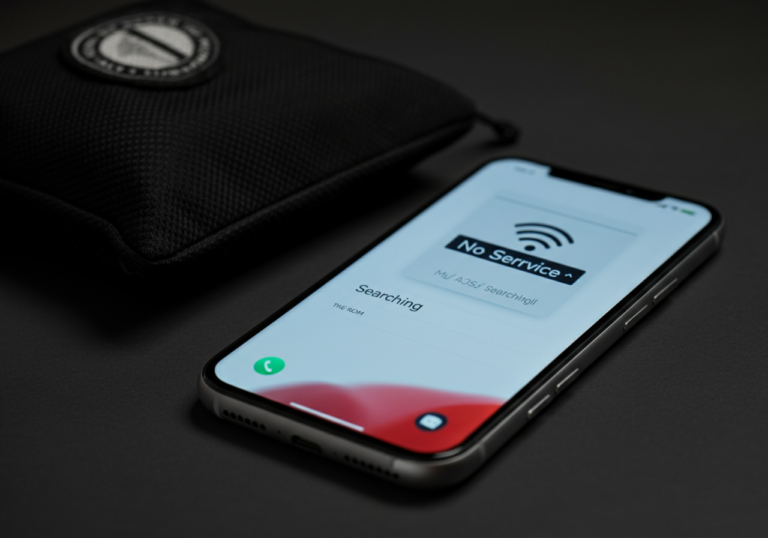
- After several minutes, check if the phone shows “No Service” or “Searching”
Worth noting: some phones take time to update their display. The phone call test is more reliable than watching the signal bars.
Professional RF Meter Testing
For precise measurements, use an RF meter to:
- Measure ambient RF levels outside the enclosure
- Place the meter inside and seal the cage
- Compare readings to calculate attenuation in decibels (dB)
| Attenuation Level | Signal Reduction | What It Means |
|---|---|---|
| 10 dB | 90% | Minimal protection |
| 20 dB | 99% | Basic protection |
| 30 dB | 99.9% | Good protection |
| 40 dB | 99.99% | Excellent protection |
| 50+ dB | 99.999%+ | Professional grade |
Quality commercial Faraday products typically achieve 40-60 dB of attenuation across relevant frequencies. If a product doesn’t publish its attenuation numbers, that’s a red flag.
Common Mistakes in Faraday Cage Construction
Building an effective Faraday cage requires attention to detail. These common errors can compromise shielding:
Incomplete Sealing
Any gap allows electromagnetic energy to enter. Common failure points include seams that don’t overlap properly, closures that don’t make continuous contact, and penetrations for cables or vents.
This is particularly troubling with DIY projects. A gap that looks insignificant can allow substantial signal leakage.
Mesh Aperture Too Large
For mesh enclosures, the opening size matters. The mesh aperture should be significantly smaller than the wavelength of the frequencies you’re blocking. For WiFi and cellular signals, mesh openings should be no larger than a few millimeters.
Single-Layer Construction
One layer of aluminum foil provides limited protection. Multiple layers or thicker materials increase effectiveness. If you’re going the DIY route, three layers minimum.
Ignoring Grounding
For permanent installations, proper grounding helps dissipate accumulated charge and improves electric field shielding. This isn’t critical for portable products, but matters for room-size enclosures.
Using Damaged Materials
Holes, tears, or corrosion in shielding materials create pathways for electromagnetic energy. Inspect your shielding periodically if you’re relying on it for protection.
The Future of Electromagnetic Shielding
As wireless technology evolves, so does the need for electromagnetic protection. Several trends are shaping the future of Faraday shielding.
Increasing Wireless Density
The proliferation of IoT devices means more wireless signals in our environment than ever before. Smart homes, connected cars, wearable devices, and industrial sensors all contribute to a denser electromagnetic landscape. This creates both more potential privacy vulnerabilities and more sources of EMF exposure.
Faraday shielding remains effective regardless of how many wireless protocols are in use. The same physics that blocks one signal blocks them all, making Faraday products future-proof against new wireless standards.
5G and Millimeter Wave Frequencies
5G networks, particularly millimeter wave deployments, use frequencies up to 39 GHz, much higher than previous cellular generations. Some have wondered whether existing shielding products work against these new frequencies.
The answer is yes. Conductive materials that block lower frequencies also block higher ones. In fact, higher frequencies are often easier to shield because their shorter wavelengths are blocked by smaller mesh apertures. A product that effectively shields 4G4G is the fourth generation of cellular network technology, providing mobile broadband internet access. The most common 4G standard is LTE (Long Term Evolution). 4G networks offer significantly faster data... LTE will also shield 5G.
Advanced Materials
Research continues into new shielding materials that offer improved performance, flexibility, or cost-effectiveness. Graphene-based materials offer excellent conductivity with extreme thinness. Metamaterials can selectively block specific frequencies. Conductive polymers provide flexible, lightweight alternatives to metal-based fabrics. Transparent conductive films allow shielding of windows and screens without blocking light.
These developments may lead to more comfortable wearable shielding, better-performing portable products, and more practical whole-room solutions.
Growing Awareness
As more people become aware of both digital privacy concerns and questions about EMF exposure, demand for shielding solutions continues to grow. What was once specialized equipment for government and industrial use is now accessible to everyday consumers.
The fundamental physics of Faraday shielding has been proven for nearly 200 years. It will remain the foundation of electromagnetic protection regardless of how technology evolves.
Expert Insight
“Shielding is a proven engineering solution to a well-understood problem. It’s used in places where performance and protection matter most: hospitals, research laboratories, government facilities. The same physics that protected Faraday’s instruments in the 1830s protects your phone today.”
— R Blank, CEO of Shield Your Body and author of Overpowered: The Dangers of Electromagnetic Radiation
What’s changing isn’t the science. It’s the context. Shielding isn’t just for satellites and secure labs anymore. It’s becoming a tool that everyday people use to take control of their electromagnetic environment.
You don’t have to be a government agency or a hospital to benefit from Faraday shielding. The technology is accessible, the science is sound, and the applications keep growing.
Common Misconceptions
Misconception: Faraday cages block all electromagnetic radiation equally.
Reality: Faraday cages are highly effective against electric fields and RF radiation but require specialized materials like mu-metal to block low-frequency magnetic fields. For most wireless signal blocking applications, standard conductive materials work well.
Misconception: Any metal container works as a Faraday cage.
Reality: Effectiveness depends on the container’s conductivity, completeness of coverage, and quality of sealing. A metal box with gaps at the lid provides minimal protection. The closure is just as important as the material.
Misconception: Aluminum foil provides complete protection.
Reality: Aluminum foil can block some RF radiation, but it tears easily and is difficult to seal properly. Multiple layers and careful construction are required for meaningful protection.
Misconception: Faraday cages need to be grounded to work.
Reality: Grounding improves performance for certain applications but isn’t required for basic RF shielding. A properly constructed ungrounded cage still blocks electromagnetic fields.
Misconception: Putting a phone in a Faraday bag saves battery.
Reality: The opposite is true. A phone inside a Faraday bag will increase its transmission power trying to find a signal, draining the battery faster. If battery conservation is your goal, use airplane mode before putting the phone in the bag.
Sources
-
Williams, L. Pearce. Michael Faraday: A Biography. Basic Books, 1987.
-
Blank, R. Empowered: A Practical Guide to Protecting Yourself from EMF. Chapter 15: How EMF Shielding Works.
-
Blank, R. Empowered: A Practical Guide to Protecting Yourself from EMF. Chapter 19: Faraday Products & Privacy Protection.
-
IEEE Standards Association. IEEE 299-2006: Standard Method for Measuring the Effectiveness of Electromagnetic Shielding Enclosures.
-
National Institute of Standards and Technology (NIST). Technical resources on electromagnetic shielding measurements.
-
SYB EMF Research Hub – Peer-reviewed studies on electromagnetic fields and health effects.
Ready to explore Faraday protection? Browse our Faraday bag collection to find the right solution for your needs.
Frequently Asked Questions
A Faraday cage is an enclosure made of conductive material that blocks electromagnetic fields from entering or exiting. When electromagnetic waves hit the cage, electrons in the metal redistribute to create an opposing field that cancels the incoming energy. This principle works for all frequencies from radio waves to microwaves.
Yes. WiFi operates at 2.4 GHz and 5 GHz — frequencies that conductive enclosures block effectively. A properly sealed Faraday cage will prevent all WiFi signals from reaching devices inside, which is why your phone loses WiFi connection inside a Faraday bag.
A Faraday cage blocks radiofrequencyRadiofrequency (RF) refers to electromagnetic waves in the frequency range of approximately 3 kHz to 300 GHz. This portion of the electromagnetic spectrum is used for wireless communication. RF energy... and microwave EMF (the type from wireless devices) very effectively. It also blocks electric fields. However, extremely low-frequency magnetic fields (from power lines) can partially penetrate conductive enclosures depending on the material — specialized mu-metal shielding is needed for those.
Yes. Cell phone signals (700 MHz to 39 GHz for 5G) are electromagnetic waves that a conductive enclosure blocks. A phone inside a sealed Faraday cage cannot make calls, send texts, or use cellular data.
Yes. DIY Faraday cages can be built from galvanized trash cans, metal ammo cans, or even aluminum foil wrapping. The key is complete conductive coverage with no gaps, especially at seams and closures. Test with a cell phone call to verify effectiveness.
No. Faraday cages work through charge redistribution across their conductive surface, which doesn't require a ground connection. Grounding can help dissipate static electricity but is not necessary for electromagnetic shielding.