

A Faraday cage works by using conductive material to redistribute electric charges in response to external electromagnetic fields. When electromagnetic waves hit the cage, free electrons in the metal move to create an opposing field that cancels the incoming radiation.
This leaves the interior space protected from electric fields and radio frequency signals. The remarkable thing? It happens passively and instantaneously, requiring no power source or active components.
Key Takeaways
- Faraday cages work through electron redistribution, not absorption. The conductive material creates an opposing field that cancels incoming electromagnetic waves.
- The shielding effect happens passively and instantaneously, requiring no power source or batteries
- Mesh enclosures work as well as solid metal, provided the openings are smaller than the wavelength being blocked
- Electric fields are easier to shield than magnetic fields. RF signals fall between the two in complexity.
- Continuity of the conductive material is the single most important factor. Any gap compromises effectiveness.
The Physics Behind Faraday Shielding
Understanding how Faraday cages work comes down to one question: what happens when electromagnetic fields encounter conductive materials?
The answer is surprisingly elegant.
Electromagnetic Fields: The Basics

All electromagnetic phenomena involve the interaction of electric and magnetic fields. These fields propagate through space as waves, carrying energy from one location to another. This includes everything from static electricity to radio waves to visible light.
An electric field exists around any electrically charged object. It exerts force on other charged particles, pushing positive charges away and pulling negative charges closer.
A magnetic field exists around moving charges or changing electric fields. Here’s the key relationship: a changing electric field creates a magnetic field, and a changing magnetic field creates an electric field. This is what allows electromagnetic waves to propagate through space.
Radio frequency radiation, the type emitted by cell phones, WiFi routers, and other wireless devices, consists of oscillating electric and magnetic fields traveling together at the speed of light.
How Conductors Respond to Electric Fields

The key to understanding Faraday cages lies in how faraday shielding materials respond to electric fields.
Conductors contain free electrons. These are electrons that aren’t bound tightly to individual atoms and can move relatively freely through the material. Metals like copper, silver, and aluminum are excellent conductors because they have many free electrons.
When an external electric field reaches a conductor, something important happens: the free electrons redistribute themselves almost instantaneously. They move in response to the field, migrating toward one side of the conductor or the other depending on the field’s direction.
This redistribution creates a secondary electric field inside the conductor that exactly opposes the external field. The two fields cancel out, resulting in zero net electric field inside the conductive material.
Put simply: the electrons form a defensive line that neutralizes the incoming threat.
From Conductor to Cage
A Faraday cage extends this principle to protect an enclosed space. When you surround an area with conductive material, the free electrons in that material respond to any external electromagnetic field by redistributing themselves across the surface.
This redistribution accomplishes two things:
- It cancels the electric field component of incoming electromagnetic waves before they can penetrate the interior
- It reflects RF radiation back toward its source rather than allowing it to pass through
The result is a protected space where external electromagnetic fields have minimal or no effect. The cage doesn’t absorb the energy like a sponge. It deflects and neutralizes it.
What does this mean for you? It means a device inside a properly constructed Faraday cage is cut off from all wireless communication. No cellular, no WiFi, no Bluetooth, no GPS. Complete isolation.
Why Mesh Works as Well as Solid Metal

One common misconception is that Faraday cages must be solid metal boxes. The reality is different: a mesh of conductive material works just as effectively for most applications, provided the openings meet certain criteria.
The Wavelength Rule
Electromagnetic waves have characteristic wavelengths, which is the distance between successive peaks of the wave. For a mesh to effectively block a particular frequency, its openings must be significantly smaller than the wavelength of that frequency.
| Signal Type | Frequency | Wavelength | Required Mesh Size |
|---|---|---|---|
| FM Radio | 100 MHz | 3 meters | <30 cm |
| Cellular (4G4G is the fourth generation of cellular network technology, providing mobile broadband internet access. The most common 4G standard is LTE (Long Term Evolution). 4G networks offer significantly faster data...) | 700 MHz – 2.7 GHz | 11-43 cm | <1-4 cm |
| WiFi 2.4 GHz | 2.4 GHz | 12.5 cm | <1.2 cm |
| WiFi 5 GHz | 5 GHz | 6 cm | <6 mm |
| 5G5G is the fifth generation of wireless cellular technology, offering faster data speeds, lower latency, and greater network capacity than 4G LTE. It began rolling out commercially in 2019. 5G... mmWave | 24-39 GHz | 8-12 mm | <1 mm |
When mesh openings are much smaller than the wavelength, the electromagnetic wave “sees” the mesh as essentially solid. The conductive paths between openings are close enough that electrons can still redistribute effectively to cancel the incoming field.
Consider your microwave oven. You can see through the mesh window because visible light has wavelengths of 400-700 nanometers, far smaller than the mesh holes. But the 2.45 GHz microwaves, with a wavelength of 12 cm, stay trapped inside. Same physics, different wavelengths.
Practical Implications
For blocking cellular and WiFi signals, which is the most common consumer application, mesh with openings of a few millimeters works well. This is good news because it allows Faraday products to be:
- Flexible: Woven conductive fabrics can be used in bags and pouches
- Breathable: Air can pass through while electromagnetic fields cannot
- Lighter: Less material is needed compared to solid enclosures
- More affordable: Mesh uses less conductive material than solid construction

Different Types of Electromagnetic Shielding
Not all electromagnetic fields behave the same way, and different frequencies require different shielding approaches. Understanding these differences helps you choose the right protection.
Electric Field Shielding
Static and low-frequency electric fields are the easiest to shield. Any conductive material, even thin aluminum foil, provides excellent protection. The free electrons redistribute almost instantaneously to cancel the field.
Electric field shielding is often used in laboratory equipment sensitive to static discharge, shielded cables that carry sensitive signals, and rooms designed to protect against electrostatic discharge.
Magnetic Field Shielding
Now let’s look at something more challenging. Low-frequency magnetic fields are the hardest to shield. Standard conductive materials like copper and aluminum provide limited protection because the mechanism is different.
While electric fields cause electron redistribution, magnetic fields primarily induce eddy currents, which are circular flows of electrons within the conductor. These currents create opposing magnetic fields, but the effect is weaker than electric field cancellation, especially at low frequencies.
For effective magnetic field shielding, specialized materials are required:
- Mu-metal: A nickel-iron alloy with extremely high magnetic permeability
- Ferrite: Ceramic compounds containing iron oxide
- Transformer steel: Iron-silicon alloys designed for magnetic applications
These materials provide an easy path for magnetic field lines, allowing them to flow through the shielding material rather than through the protected space.
The good news? For most consumer applications involving wireless signals, magnetic field shielding is less critical. RF radiation operates at much higher frequencies where standard conductive materials work well.
RF Shielding
Radio frequency shielding falls between electric and magnetic field shielding in terms of complexity. At RF frequencies (MHz to GHz range), electromagnetic waves oscillate rapidly, and both electric and magnetic field components are significant.
Conductive materials shield RF through a combination of:
- Reflection: The mismatch between air and metal causes most RF energy to bounce back
- Absorption: Some energy is converted to heat as it passes through the conductor
- Internal reflection: Multiple internal reflections further attenuate any energy that enters
The effectiveness of RF shielding depends on conductivity (higher is better for reflection), thickness (thicker materials absorb more energy), permeability (affects performance at lower RF frequencies), and continuity (gaps create pathways for RF leakage).
The Critical Importance of Continuity
Here’s the truth about Faraday cages: the single most important factor in effectiveness is continuity of the conductive material. Any gap, hole, or discontinuity in the shielding allows electromagnetic energy to leak through.
Why Gaps Matter
When electromagnetic waves encounter a gap in shielding, they don’t just squeeze through like water through a hole. Instead, the gap acts as a slot antenna, potentially concentrating and redirecting the energy. A small gap can compromise a large shielded enclosure.
This is why simple metal boxes with loose-fitting lids provide poor shielding. It’s why zippers with non-conductive teeth create significant leakage paths. It’s why seams that don’t make continuous electrical contact allow RF through.
This matters because many DIY Faraday projects fail at exactly this point: the closure.
Engineering Around the Challenge
Commercial Faraday products address the continuity challenge through careful design:
- Overlapping folds: Creating multiple layers at closure points
- Conductive gaskets: Using compressible conductive material at seams
- Roll-top closures: Eliminating gaps by rolling the opening multiple times
- Magnetic or Velcro closures: Combined with conductive contact strips
When evaluating Faraday products, pay close attention to how closures are designed. The shielding material itself may be excellent, but poor closure design will undermine performance. This is where quality manufacturers separate themselves from cheap alternatives.
Real-World Demonstrations
The principles of Faraday shielding can be demonstrated with simple experiments you can try yourself.
The Phone Call Test
The most accessible demonstration of Faraday shielding:
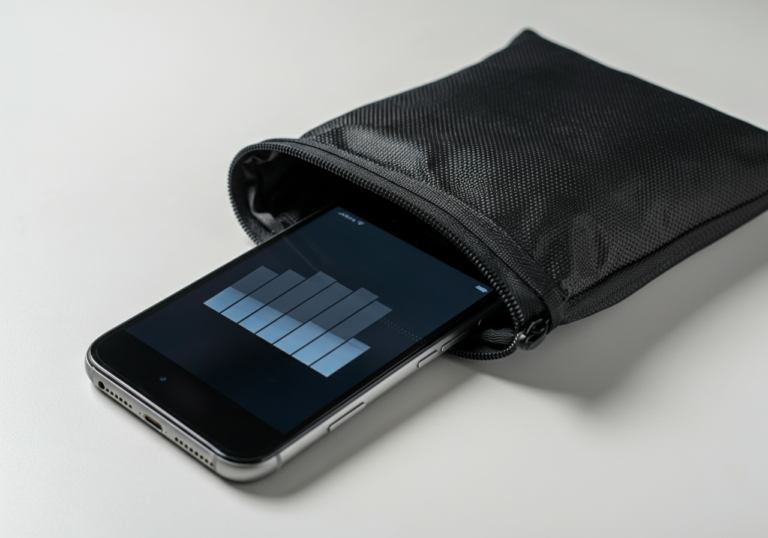
- Place a cell phone inside a Faraday pouch or bag
- Ensure the closure is completely sealed
- Call the phone from another device
- Wait at least 30 seconds
If properly shielded, the call should fail to connect. The phone shouldn’t ring at all. If the call connects, even going to voicemail after ringing, the enclosure has a leak. Try resealing or checking for damage to the shielding material.
The Signal Strength Test
For a more detailed evaluation:
- Check your phone’s signal strength in settings (usually displayed in dBm)
- Record the reading (typically -50 to -120 dBm, with numbers closer to zero indicating stronger signals)
- Place the phone inside the Faraday enclosure and seal it
- After a few minutes, check if the phone shows “No Service” or “Searching”
A phone that maintains signal inside the enclosure indicates inadequate shielding.
The WiFi Test
- Connect a device to a WiFi network
- Note the connection strength
- Place the device in a Faraday enclosure
- Check if the WiFi connection is lost
This test verifies shielding effectiveness at 2.4 and 5 GHz frequencies.
From Theory to Practice
The physics of Faraday shielding has remained unchanged since Michael Faraday’s experiments in the 1830s. What has evolved is our understanding of how to apply these principles to modern challenges.
Today, Faraday technology protects medical imaging equipment from interference, military communications from surveillance, personal devices from tracking and hacking, electronics from emp shielding requirements, and sensitive research instruments from ambient noise.
Whether you’re concerned about privacy, security, or EMFEMF stands for electromagnetic field (also called electromagnetic frequency or electromagnetic force). EMFs are invisible fields of energy produced by electrically charged objects. They exist on a spectrum ranging from... exposure, understanding how Faraday cages work helps you evaluate solutions and make informed decisions. Using the best emf detector can help you measure electromagnetic fields and verify the effectiveness of shielding solutions.
Expert Insight
“Shielding is a proven engineering solution to a well-understood problem. It’s used in places where performance and protection matter most: hospitals, research laboratories, government facilities. The same physics that protected Faraday’s instruments in the 1830s protects your devices today.”
— R Blank, CEO of Shield Your Body and author of Overpowered: The Dangers of Electromagnetic RadiationElectromagnetic radiation (EMR) is energy that travels through space as waves of oscillating electric and magnetic fields. It includes everything from radio waves to visible light to gamma rays. All...
The science behind Faraday cages is settled physics. The challenge isn’t understanding the theory. It’s implementing effective shielding in practical, affordable products that work reliably in real-world conditions.
Explore Our Faraday Guides
- What Is a Faraday Bag? — Complete guide to Faraday bags for phones and key fobs
- Faraday Cage Fabric — Shielding materials for DIY projects
- RFID Blocking Wallets — Faraday technology for card protection
- EMP Shielding — Protecting electronics from electromagnetic pulses
Frequently Asked Questions
A Faraday cage is a conductive enclosure that blocks electromagnetic fields. Named after scientist Michael Faraday, it works by distributing electric charges across its exterior surface, canceling out external fields inside. Faraday cages range from small pouches for phones to room-sized enclosures for sensitive equipment.
When electromagnetic waves hit the conductive exterior of a Faraday cage, they cause electrons in the material to redistribute. This redistribution creates an opposing field that cancels the incoming radiation inside the enclosure. The cage doesn't absorb the energy — it redirects it around the exterior surface.
Yes, a properly constructed Faraday cage blocks cell phone signals, Wi-Fi, Bluetooth, and other RF transmissions. The mesh or solid conductive material must have openings smaller than the wavelength of the signals being blocked. For cell frequencies, a fine metal mesh or solid conductive enclosure is effective.
Any conductive material works: copper mesh, aluminum foil, steel screening, conductive fabric, or even a metal trash can. The key requirement is continuous conductivity — gaps or seams reduce effectiveness. Copper mesh is popular for DIY projects because it's easy to work with and highly conductive.
No, a Faraday cage works by redistributing charges on its surface and does not need to be grounded to block electromagnetic fields. Grounding can help dissipate static charge buildup, which is useful in some industrial applications, but for blocking RF signals and EMF, an ungrounded cage is fully effective.