
SAR value measures how much radiofrequency radiationRadiofrequency radiation (RFR) is electromagnetic energy in the frequency range of 3 kHz to 300 GHz. This type of non-ionizing radiation is emitted by wireless devices and communication infrastructure. Cell... from a phone is absorbed by your body, expressed in watts per kilogram (W/kg). The U.S. limit is 1.6 W/kg; internationally it’s 2.0 W/kg.
You can find your phone’s SAR in settings or on manufacturer websites. However, SAR only tells part of the story, because testing uses an oversized mannequin at maximum power. Distance and duration matter more than small SAR differences between phones.
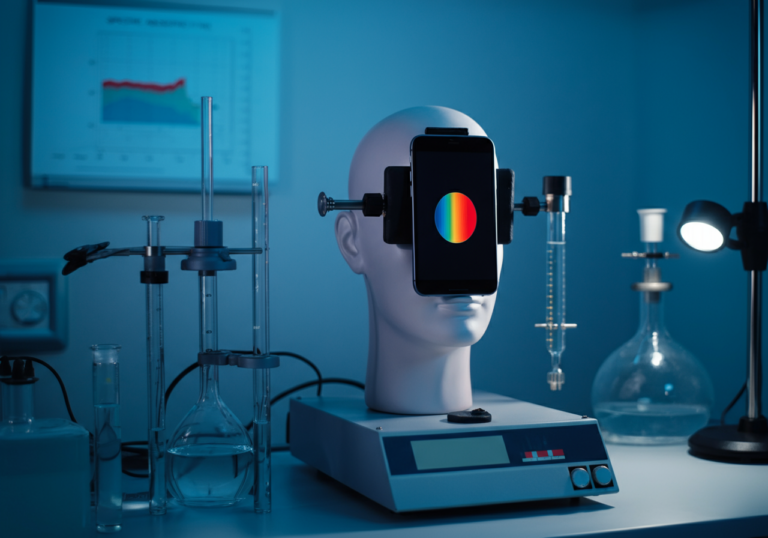
However, SAR values only tell part of the story. They’re measured at maximum power on an oversized test mannequin, so your real exposure varies based on signal strength, how you hold your phone, and how long you use it. Lower SAR is better, but distance and duration matter more.
Key Takeaways
- SAR (Specific Absorption Rate) is measured in watts per kilogram (W/kg) and indicates maximum radiation absorption from a device
- U.S. phones must have SAR below 1.6 W/kg; the international limit is 2.0 W/kg
- You can find your phone’s SAR in Settings > About/Legal on most devices, or through the FCC database
- SAR is tested at maximum power on a mannequin larger than 97% of adults, so real-world exposure differs
- How you use your phone (distance, duration, signal strength) affects your actual exposure more than small SAR differences between models
What is SAR Value? The Complete Definition
SAR stands for Specific Absorption Rate. It measures the rate at which radiofrequencyRadiofrequency (RF) refers to electromagnetic waves in the frequency range of approximately 3 kHz to 300 GHz. This portion of the electromagnetic spectrum is used for wireless communication. RF energy... (RF) energy is absorbed by the body when using a wireless device.
SAR is expressed in watts per kilogram (W/kg). A SAR value of 1.0 W/kg means that 1 watt of energy is absorbed per kilogram of body tissue at the point of maximum exposure.
Every cell phone sold in the United States must be tested for SAR and must fall below the legal limit of 1.6 W/kg. In Europe and most other countries, the limit is 2.0 W/kg.
Manufacturers test their phones and report two SAR values:
- Head SAR: Absorption when the phone is held against the ear
- Body SAR: Absorption when the phone is carried near the torso
The higher of these two values typically becomes the phone’s official SAR rating, though both are available in detailed test reports.
How SAR Values Are Measured and Tested
SAR testing follows a standardized process, but understanding how it works reveals why the numbers don’t fully represent your actual exposure.
The Testing Process
- The phone is placed next to a model of a human head or torso called SAM (Specific Anthropomorphic Mannequin)
- SAM is filled with liquid that simulates the electrical properties of human tissue
- The phone transmits at its maximum power level
- Sensors measure radiation absorption at multiple points
- The highest reading becomes the SAR value

What SAM Looks Like
| SAM Characteristic | Measurement | Reality |
|---|---|---|
| Height | 6’2″ (188 cm) | Taller than 97% of adults |
| Weight | 220 lbs (100 kg) | Heavier than 97% of adults |
| Skull thickness | Adult male | Children’s skulls are thinner |
| Tissue density | Average adult | Varies by age and individual |
Because SAM represents such a large body, smaller adults and children absorb more radiation than test results indicate under identical conditions.
Testing Distance Varies
Manufacturers can choose the distance between the phone and SAM during testing. Common testing distances include:
- 0mm (contact): Phone touching SAM
- 5mm: Small gap
- 10-15mm: Typical case thickness
- 25mm: Maximum distance some manufacturers use
A phone tested at 15mm will show a lower SAR than the same phone tested at 5mm. When comparing phones, check if testing distances were the same.
Understanding SAR Limits: FCC vs International Standards
Different regions use different SAR limits and measurement methods:
| Region | SAR Limit | Averaging Mass | Notes |
|---|---|---|---|
| United States | 1.6 W/kg | 1 gram | Strictest number, but smallest averaging area |
| European Union | 2.0 W/kg | 10 grams | Higher limit, but averaged over larger area |
| Canada | 1.6 W/kg | 1 gram | Follows U.S. standard |
| Australia | 2.0 W/kg | 10 grams | Follows ICNIRP guidelines |
| Japan | 2.0 W/kg | 10 grams | Follows ICNIRP guidelines |
| China | 2.0 W/kg | 10 grams | Follows ICNIRP guidelines |
| India | 1.6 W/kg | 1 gram | Adopted U.S. standard in 2012 |
The U.S. limit appears stricter, but it’s averaged over a smaller tissue mass. In practice, the two standards provide roughly comparable protection.
Both limits were designed solely to prevent tissue heating. Neither provides protection against non-thermal biological effects documented in research. For more information about safe emf levels for humans, these standards have significant limitations.
How to Find Your Device’s SAR Value
On iPhone
- Open Settings
- Tap General
- Tap Legal & Regulatory
- Scroll to find RF Exposure information
On Android
- Open Settings
- Tap About Phone (may be under “System” on some devices)
- Tap Legal Information or Regulatory Information
- Look for RF Exposure or SAR Information

Through the FCC Database
- Find your phone’s FCC ID (usually printed on the device, box, or in settings under “Regulatory”)
- Visit fcc.gov/oet/ea/fccid
- Enter the FCC ID
- View the complete SAR test report
On Manufacturer Websites
Most manufacturers publish SAR values in product specifications:
- Apple: Support pages for each iPhone model
- Samsung: Product specifications under “Legal Information”
- Google: Pixel product pages under “Tech specs”
SAR Comparison Databases
Websites that compile SAR data across models:
- GSMArena
- PhoneArena
- Deutsche Telekom SAR database
SAR Value Comparisons: Popular Phones
Here are SAR values for some popular phones (head SAR, U.S. FCC values):
| Phone | Head SAR | Body SAR | Release Year |
|---|---|---|---|
| iPhone 15 Pro Max | 1.12 W/kg | 1.15 W/kg | 2023 |
| iPhone 15 | 1.12 W/kg | 1.14 W/kg | 2023 |
| Samsung Galaxy S24 Ultra | 0.95 W/kg | 1.12 W/kg | 2024 |
| Samsung Galaxy S24 | 0.94 W/kg | 1.27 W/kg | 2024 |
| Google Pixel 8 Pro | 1.12 W/kg | 1.17 W/kg | 2023 |
| Google Pixel 8 | 1.17 W/kg | 1.19 W/kg | 2023 |
All these phones are well below the 1.6 W/kg limit. However, remember that these values represent maximum power under lab conditions, not typical daily use.
For phones with the lowest SAR ratings, see our guide to low emf phones.
The SAR Paradox: Why Lower SAR Doesn’t Always Mean Lower Exposure
Here’s something most people don’t realize: a phone with a lower SAR value might actually expose you to more radiation depending on how you use it.
Why the Numbers Mislead
SAR is a snapshot of maximum absorption under artificial conditions. Your actual exposure depends on:
Signal strength: A phone with SAR of 1.0 W/kg in a weak signal area might expose you to more radiation than a phone with SAR of 1.4 W/kg in a strong signal area—because the first phone is working harder to reach a tower.
Usage patterns: Someone who makes 3 hours of calls daily on a low-SAR phone has far more cumulative exposure than someone making 10 minutes of calls on a high-SAR phone.
Carrying habits: A low-SAR phone kept in your pocket all day exposes you to more radiation than a high-SAR phone kept on a desk.
What Matters More Than SAR
| Factor | Impact on Exposure |
|---|---|
| Distance from body | 6 inches away = up to ~97% reduction |
| Duration of use | 10x usage = 10x cumulative exposure |
| Signal strength | Weak signal = higher transmission power |
| Airplane mode usage | Eliminates RF exposure entirely |
Choosing a lower-SAR phone is reasonable, but changing your usage habits provides far greater reduction in exposure.
What SAR Doesn’t Tell You About EMF Exposure
SAR has significant blind spots:
It Ignores Cumulative Exposure
SAR treats a 5-minute call and 5 hours of daily use as equivalent. Regulatory standards don’t account for the fact that many people now spend hours daily with phones near their bodies.
It Measures One Device at a Time
You might have a phone, smartwatch, wireless earbuds, and tablet—all emitting RF radiation simultaneously. SAR testing measures each device in isolation, never together.
It Doesn’t Account for Children
SAR testing uses an adult male model. Research shows children absorb more radiation due to thinner skulls, higher water content in tissues, and smaller body size. No separate safety limits exist for children.
It Only Prevents Heating
SAR limits were designed to prevent tissue from heating up. They don’t address non-thermal biological effects such as:
- DNA strand breaks
- Oxidative stress
- Changes in brain activity
- Reproductive effects
For a complete understanding of SAR’s limitations, see our specific absorption rate guide.
Practical Daily Steps to Reduce EMF Exposure
Whether your phone has high or low SAR, these practices reduce your actual exposure:
-
Use speakerphone for calls. Keeping the phone even 6 inches from your head dramatically reduces absorption.
-
Don’t carry your phone in your pocket. Use a bag or place it on a desk. If you must pocket it, enable airplane mode first.
-
Avoid calls when signal is weak. Fewer bars means your phone transmits more power. Wait for better signal or use WiFi calling.
-
Text instead of call when practical. Brief data bursts expose you to less radiation than continuous voice calls.
-
Enable airplane mode when not using wireless features. Your phone can still function as a camera, calculator, and media player without RF transmission.
-
Keep devices away from your body while downloading. High data transfer means high radiation output.
-
Use wired headphones. Not wireless earbuds—wired connections don’t emit RF radiation.
-
Turn off WiFi and Bluetooth when not in use. These radios transmit constantly when enabled.

Common Misconceptions About SAR Values
Misconception: A phone with SAR under 1.0 W/kg is “safe” while one near 1.6 W/kg is “dangerous.” Reality: All phones sold legally meet safety limits. The difference between 1.0 and 1.5 W/kg is small compared to the difference made by using speakerphone versus holding the phone to your head.
Misconception: SAR values are verified by government regulators. Reality: Manufacturers test their own phones and self-report results. The FCC doesn’t independently verify SAR claims. France’s ANFR found 89% of tested phones exceeded their reported values.
Misconception: European phones are less safe because the limit is 2.0 W/kg. Reality: The EU averages over 10 grams of tissue while the U.S. averages over 1 gram. The practical difference is minimal. A phone meeting EU standards typically meets U.S. standards too.
Misconception: You can use a consumer EMFEMF stands for electromagnetic field (also called electromagnetic frequency or electromagnetic force). EMFs are invisible fields of energy produced by electrically charged objects. They exist on a spectrum ranging from... meter to verify your phone’s SAR. Reality: Consumer meters measure emissions. SAR measures absorption. They’re related but not the same. You can’t verify manufacturer SAR claims with a handheld meter.
Frequently Asked Questions
SAR stands for Specific Absorption Rate, which measures the rate at which radiofrequency energy is absorbed by the body when using a wireless device.
The SAR limit for phones sold in the U.S. is 1.6 W/kg, while the international limit is 2.0 W/kg.
You can find your phone's SAR value in the settings under 'About/Legal' or on the manufacturer's website, as well as through the FCC database.
No, actual exposure depends more on factors like signal strength, distance from the body, and duration of use rather than just the SAR value.
Yes, children absorb more radiation than adults due to thinner skulls and smaller body sizes, but there are no separate safety limits for them.