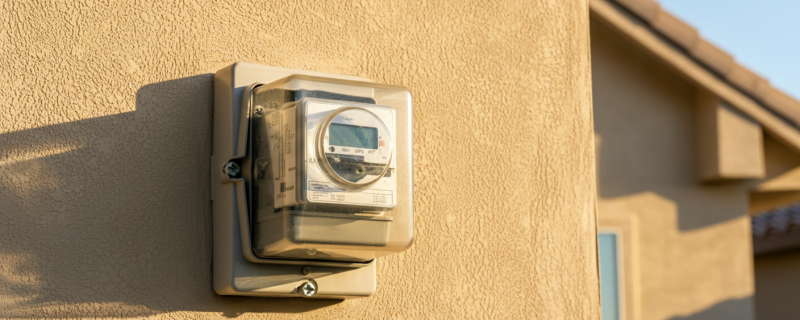

Smart meters emit radiofrequencyRadiofrequency (RF) refers to electromagnetic waves in the frequency range of approximately 3 kHz to 300 GHz. This portion of the electromagnetic spectrum is used for wireless communication. RF energy... (RF) radiation to transmit your energy usage data wirelessly. Research suggests a single smart meter can produce 160 times more cumulative whole-body exposure than a cell phone.
Thousands of health complaints have been filed following smart meter installations. While you may not be able to remove your smart meter, you can significantly reduce your exposure through distance, shielding, and opting out.
While you may not be able to remove your smart meter, you can significantly reduce your exposure through distance, shielding, and in some cases, opting out. This guide explains the science and shows you exactly what to do.
Medical Disclaimer: This article is for informational purposes only. It is not, nor is it intended to be, a substitute for professional medical advice, diagnosis, or treatment and should never be relied upon for specific medical advice.
Key Takeaways
- Smart meters emit RF radiation via wireless bursts, often dozens to hundreds of times per day, and RF mesh network meters emit continuously
- The Daniel Hirsch study found smart meters produce 160x more cumulative whole-body exposure than cell phones
- Over 2,000 health complaints were filed within months of California’s 2010 smart meter rollout
- Distance is your most effective protection: EMFEMF stands for electromagnetic field (also called electromagnetic frequency or electromagnetic force). EMFs are invisible fields of energy produced by electrically charged objects. They exist on a spectrum ranging from... drops exponentially as you move away from the source
- Opt-out programs, wall shielding, and smart meter guards can significantly reduce your exposure
What Are Smart Meters and How Do They Work?
Smart meters are digital utility meters that automatically transmit your electricity, gas, or water usage data to utility companies using wireless communication. Unlike traditional analog meters that require manual reading, smart meters send information via radiofrequency signals.
This wireless transmission is what concerns health-conscious homeowners. Every time your smart meter “reports in,” it emits RF radiation, the same type of non-ionizing radiationNon-ionizing radiation is electromagnetic energy that lacks sufficient power to remove electrons from atoms. This includes radio waves, microwaves, infrared, visible light, and lower-energy ultraviolet. The EMF from cell phones,... produced by cell phones, WiFi routers, and other wireless devices.
Smart meters are among the most controversial EMF-emitting devices in modern homes. As I explain in my book Empowered, these digital meters “automatically transmit energy usage data to utility companies using wireless communication, often via RF bursts that occur dozens or even hundreds of times per day.”
What makes smart meters particularly problematic:
- Involuntary exposure: Unlike your phone, which you choose to use, smart meters are often installed without consumer consent
- Continuous presence: The meter operates 24/7, whether you want it to or not
- Fixed location: You can’t move it away from living spaces
- Limited opt-out options: Many jurisdictions don’t allow removal, or charge significant fees
For a deeper understanding of the actual radiation levels, see my detailed guide on smart meter radiation measurements.
Understanding Smart Meter EMF Emissions
Smart meters emit radiofrequency electromagnetic fields in the 900 MHz to 2.4 GHz range, similar frequencies to cell phones and WiFi. The key question is: how much radiation, and how often?

| Smart Meter Characteristic | Standard Meter | RF Mesh Network Meter |
|---|---|---|
| Frequency Range | 900 MHz to 2.4 GHz | 900 MHz to 2.4 GHz |
| Transmission Pattern | Brief periodic pulses | Continuous relay operation |
| Transmission Power | 1 to 2.5 watts | 1 to 2.5 watts |
| Daily Exposure Type | Intermittent (seconds per day) | Constant (24/7) |
| Cumulative Exposure vs Cell Phone (at 3 ft) | Higher due to 24/7 operation | Up to 160x higher (Hirsch study) |
Transmission Patterns
There are two main types of smart meter communication systems:
Standard Smart Meters: These transmit data in brief pulses, typically reporting to the utility several times per day. Industry claims often focus on the brevity of each transmission, sometimes just milliseconds.
RF Mesh Network Meters: These are increasingly common and far more concerning. In a mesh network, your smart meter doesn’t just transmit its own data; it also relays data from neighboring meters. This means continuous EMF emission rather than brief pulses.
As I noted in my previous research: “These new smart meters have to continuously emit EMF to keep up with the data transfer demands. This means you’ll be constantly exposed to EMF emissions.”
The 160x Study: Cumulative Exposure Matters
The California Council on Science and Technology (CCST) initially claimed smart meters were safer than cell phones. Daniel Hirsch, a nuclear policy lecturer at UC Santa Cruz, analyzed their data and found critical errors.
After correcting the calculations to compare equivalent exposure metrics, Hirsch found that “the cumulative whole-body exposure from a Smart Meter at 3 feet appears to be approximately two orders of magnitude higher than that of a cell phone.”
Put simply: a single smart meter can produce 160 times more cumulative whole-body radiation exposure than a mobile phone.
Why the massive difference? Cell phones emit radiation intermittently when you use them. Smart meters emit constantly, whether you’re home or not, awake or asleep. And you can put your phone down, but you can’t put down your smart meter.
Documented Health Concerns and Symptoms
The scientific research on smart meter health effects is still developing. However, the pattern of reported symptoms is consistent with what we see from other RF radiation sources.
California Health Complaints
Within months of California’s 2010 smart meter rollout, over 2,000 health complaints were filed with the California Public Utilities Commission. Reported symptoms included:
- Severe headaches
- Nausea and dizziness
- Tachycardia (rapid heartbeat)
- Insomnia and sleep disturbances
- Tinnitus (ringing in the ears)
- Fatigue and difficulty concentrating
These symptoms align with what researchers call electromagnetic hypersensitivity (EHS), though the condition remains controversial in mainstream medicine.
Scientific Research
A 2018 study published in Bioelectromagnetics assessed RF exposure from smart meters and found that children absorbed the most energy, particularly when within 15 centimeters of 2.4 GHz meters. While levels stayed below current safety limits, the study confirms that smart meters cause measurable energy absorption in human tissue.
The broader body of RF radiation research—over 500 peer-reviewed studies—shows biological effects at non-thermal levels, meaning effects that occur without measurable heating. These include oxidative stress, DNA damage, and disruption of cellular processes.
Current safety standards, set by the FCC in 1996, only account for thermal (heating) effects. They were not designed to protect against the biological effects demonstrated in more recent research.
Vulnerable Populations: Who Should Be Most Concerned
Not everyone responds to EMF exposure equally. Certain populations may be at elevated risk:
Children: Developing bodies absorb more radiation than adults. The 2018 SAR study specifically noted higher absorption in children near smart meters. If your child’s bedroom shares a wall with your smart meter, this warrants attention.
Pregnant Women: The developing fetus is particularly sensitive

People with EHS: Those who have developed electromagnetic hypersensitivity often report severe reactions to smart meters. If you experience symptoms near other wireless devices, smart meter exposure may be especially problematic.
People with Pacemakers or Medical Devices: While modern pacemakers are designed to resist interference, any RF-emitting device near a medical implant warrants caution. Consult your cardiologist about smart meter proximity.
A Note on Apartment Buildings
Living in an apartment presents unique challenges. As I’ve heard from many customers dealing with extraordinary situations—a bank of 20 or more smart meters installed directly on the other side of their apartment wall.
In these scenarios, the exposure is far beyond typical “smart meter next door” levels. If you’re in this situation, I discuss solutions later in this article, though relocation may be the most effective option in extreme cases.
Your Legal Rights: Opt-Out Programs
Many utility companies now offer opt-out programs that allow you to keep or return to an analog meter. However, these programs vary significantly by state and utility.
What to Expect
Fees: Most opt-out programs charge an initial fee ($75-$250) plus ongoing monthly charges ($10-$30) for manual meter reading.
Availability: Not all utilities offer opt-outs. Some states have mandated opt-out options; others leave it to individual companies.
Process: Typically involves written request to your utility company. Some require certified letters.
Is Opt-Out Worth It?
If your utility offers an opt-out program, consider taking it. Even if it comes with a fee, it may be worth the reduced exposure and peace of mind. The ongoing cost is comparable to a streaming subscription, a small price for eliminating a significant RF source from your home.
If opt-out isn’t available in your area, the protection strategies below become even more important.
Practical EMF Reduction Strategies
You can significantly reduce your smart meter exposure through several approaches. I recommend using multiple strategies together for best results.
1. Maximize Distance
Distance is your most effective protection. EMF follows the inverse square law—the power drops exponentially as you move away from the source.
Immediate actions:
- Don’t place beds, desks, or seating directly against a wall that has the smart meter on the other side
- If possible, use the room adjacent to the smart meter for storage rather than living space
- Keep children’s bedrooms and nurseries away from the meter location
If building or renovating: Request meter installation on the outside of your garage or any area far from living spaces—especially bedrooms.
2. Shield the Interior Wall
If your smart meter is installed on an exterior wall, radiation passes directly into your home. Shielding the interior wall behind the meter can make a significant difference.
Options include:
EMF Shielding Paint: Products like YShield can be applied to the wall behind the meter, then painted over with regular paint.
Shielding Fabric: RF-blocking fabric can be installed behind drywall, framed as a decorative element, or hung on the wall nearest your smart meter to reduce radiation penetration into your living space.
3. Smart Meter Guards
A smart meter guard is a metallic mesh cover—essentially a helmet—that fits over the glass dome of the smart meter. These guards work by forming a partial Faraday cage over the transmitting portion.
Since utility meter boxes are already metal on the back and sides, adding a shield to the glass face effectively surrounds the device in conductive material, blocking up to 98% of emissions.
Will this prevent the meter from transmitting? No. As one manufacturer explained to me: “The 2% or so that gets out is still enough for the utility company to get their signal because most utility receiving stations are only a few blocks from most people’s homes.”
For detailed comparisons of protection options, see my smart meter protection buyer’s guide.
4. Measure and Verify
Don’t guess—measure. A consumer-grade RF meter allows you to:
- Determine your actual exposure levels
- Identify whether you have a standard or mesh network meter
- Verify the effectiveness of any shielding you install
For meter recommendations, see my guide to the best EMF detectors.
These devices can also help you identify other sources of dirty electricity in your home that may be contributing to your overall EMF exposure.
When to Consider Professional Assessment
For most situations, the DIY strategies above provide adequate protection. However, some scenarios warrant professional help:
- Apartment meter banks: If 10+ meters are on your wall, standard shielding may be insufficient
- Extreme sensitivity: If you’re experiencing severe symptoms
- New construction: A building biologist can help design EMF-conscious spaces
- Verification needs: Professional-grade equipment provides more accurate measurements
A certified EMF consultant or building biologist can conduct accurate measurements, design custom shielding solutions, and develop a plan tailored to your exact installation.
Common Misconceptions
Misconception: Smart meters only transmit for a few seconds per day, so exposure is negligible
Reality: While each individual transmission may be brief, many smart meters are part of RF mesh networks that relay data from neighboring meters continuously. The cumulative 24/7 exposure is what matters, not the duration of any single pulse.
Misconception: Smart meters are no different from WiFi routers in terms of radiation
Reality: While both emit RF radiation at similar frequencies, the key difference is control. You can turn off your WiFi router, move it away from sleeping areas, or disable it at night. A smart meter operates continuously without your input, and its location is fixed by the utility company.
Misconception: If smart meters met FCC safety limits, they must be harmless
Reality: FCC safety limits were set in 1996 and only address tissue heating. They do not account for non-thermal biological effects documented in over 500 peer-reviewed studies, nor do they consider cumulative exposure from living near a meter 24 hours a day.
Taking Action
Smart meters present a unique challenge: unlike your phone or WiFi router, you can’t simply turn them off. But that doesn’t mean you’re powerless.
Start with the simplest steps: 1. Identify your meter’s location and which rooms share walls with it 2. Rearrange living spaces to maximize distance from the meter 3. Consider opt-out if available and affordable in your area 4. Add shielding for rooms that can’t be rearranged
The goal isn’t perfection—it’s meaningful reduction. Every bit of distance and every layer of shielding reduces your cumulative exposure.
For specific product recommendations and installation guidance, continue to my smart meter protection guide.
Related Reading:
- Smart Meter Radiation: How Much EMF Do They Emit?
- Smart Meter Protection: Guards & Shields That Work
- Best EMF Meters and Detectors
- EMF Health Effects: What the Research Shows
Frequently Asked Questions
Smart meters are digital utility meters that wirelessly transmit energy usage data to utility companies, unlike traditional analog meters that require manual reading.
Research indicates that a single smart meter can produce 160 times more cumulative whole-body radiation exposure than a cell phone due to its constant emissions.
Over 2,000 health complaints, including severe headaches, nausea, and insomnia, were reported shortly after the rollout of smart meters in California.
Many utility companies offer opt-out programs that allow you to keep or return to an analog meter, but availability and fees vary by state and utility.
You can reduce exposure by maximizing distance from the meter, using shielding materials, and considering smart meter guards to block emissions.