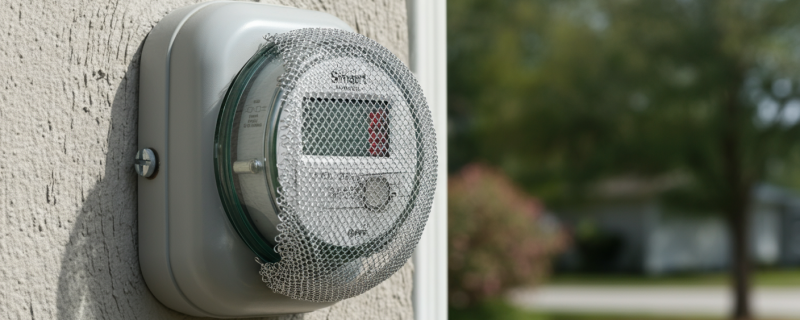

Smart meter protection options include external guards that cover the meter and interior wall shielding that blocks radiation from entering your home. Both approaches can reduce exposure by up to 98%.
For most homeowners, wall shielding is easier since it doesn’t require utility approval. Combining both approaches provides maximum protection.
Medical Disclaimer: This article is for informational purposes only. It is not, nor is it intended to be, a substitute for professional medical advice, diagnosis, or treatment and should never be relied upon for specific medical advice.
Key Takeaways
- Smart meter guards form a Faraday cage over the meter, blocking up to 98% of emissions while utilities still receive data
- Wall shielding protects interior spaces without touching the meter itself, using shielding paint, RF-blocking fabric, or metal mesh
- Measure before and after installation to verify effectiveness
- Combining external guards with interior wall shielding provides maximum protection
- Neither approach prevents the meter from functioning, so utility service is unaffected
Why Shield Your Smart Meter?
Smart meters emit radiofrequency radiationRadiofrequency radiation (RFR) is electromagnetic energy in the frequency range of 3 kHz to 300 GHz. This type of non-ionizing radiation is emitted by wireless devices and communication infrastructure. Cell... 24/7, and unlike your phone or WiFi router, you can’t simply turn them off. If your smart meter is mounted on a wall adjacent to living spaces—particularly bedrooms—that radiation passes directly into areas where you spend significant time.
Research suggests cumulative smart meter exposure at 3 feet can exceed cell phone exposure by a factor of 160. For detailed measurement data, see my guide on smart meter radiation levels.
The good news: effective shielding can dramatically reduce this exposure without interfering with your utility service.
Smart Meter Guards vs Wall Shielding: Two Approaches
There are two fundamental strategies for reducing smart meter radiation, each with distinct advantages.

External Smart Meter Guards
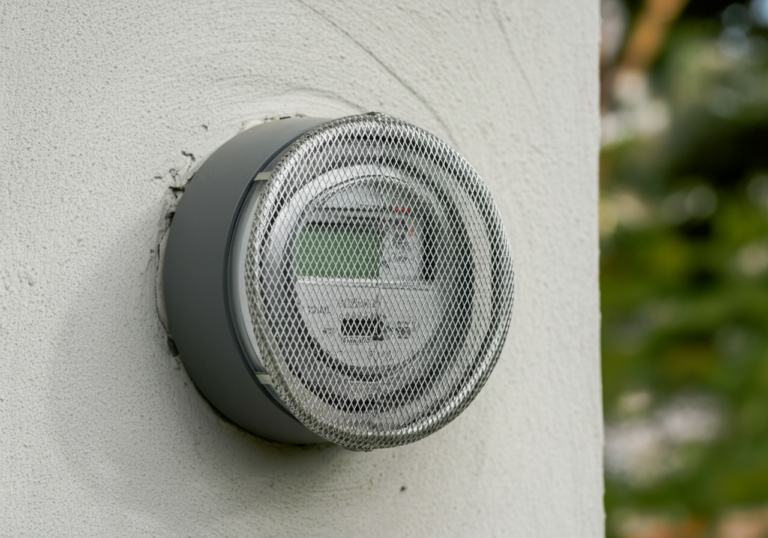
A smart meter guard is a metallic mesh cover that fits over the glass dome of your smart meter. It forms a partial Faraday cage over the transmitting portion of the meter.
How they work: Since utility meter boxes are already metal on the back and sides, adding a shield to the glass face effectively surrounds the device in conductive material. This blocks the majority of RF emissions while allowing a small percentage to pass through for utility communication.
Advantages:
- Blocks radiation in all directions (not just toward your home)
- Visible deterrent and statement of intent
- One-time installation
Disadvantages:
- May require utility company notification
- Some utilities prohibit covering meters
- Less discreet than interior solutions
- Doesn’t address radiation already inside the wall
Interior Wall Shielding
Interior shielding involves placing RF-blocking material on the wall inside your home, between your living space and the smart meter. The meter continues operating normally; you simply block the radiation from penetrating further into your home.
How it works: RF shielding materials (conductive fabric, paint, or mesh) absorb and reflect radiofrequencyRadiofrequency (RF) refers to electromagnetic waves in the frequency range of approximately 3 kHz to 300 GHz. This portion of the electromagnetic spectrum is used for wireless communication. RF energy... energy. When placed on the wall behind the smart meter, they create a barrier that prevents most radiation from entering the adjacent room.
Advantages:
- No utility company approval needed
- Invisible from outside
- Protects the specific room you care about most
- Can be decorative (picture frame, wall hanging)
Disadvantages:
- Only protects the shielded area
- Requires proper installation for effectiveness
- Multiple rooms may need separate shielding
How Smart Meter Guards Work
Let me explain the technology in more detail, since I often get questions about whether guards really work without interfering with utility service.
Faraday Cage Principles
A smart meter guard applies the same physics as a Faraday cage. When electromagnetic waves hit a conductive mesh, the metal distributes the electrical charge across its surface, canceling the field inside the enclosure.
The key is that the mesh doesn’t need to be solid—it just needs holes smaller than the wavelength of the radiation you’re blocking. Smart meters typically operate at 900 MHz to 2.4 GHz, with wavelengths of about 12-33 centimeters. A mesh with openings of a few millimeters effectively blocks these frequencies.
Why Utilities Still Get Their Signal
As one guard manufacturer explained to me: “The 2% or so that gets out is still enough for the utility company to get their signal because most utility receiving stations are only a few blocks from most people’s homes.”
The math works because utility receivers are designed with significant sensitivity margins. Your smart meter doesn’t need to transmit at full power to be received—it just needs enough signal to reach the nearest relay or collection point. An up to 98% reduction still leaves plenty of signal for utility purposes.
Wall Shielding: Materials and Methods
For many homeowners, interior wall shielding is the more practical solution. Here’s how to implement it effectively.
Shielding Materials Comparison
Several materials can provide effective RF shielding:
| Material | Attenuation | Best For | Installation |
|---|---|---|---|
| EMFEMF stands for electromagnetic field (also called electromagnetic frequency or electromagnetic force). EMFs are invisible fields of energy produced by electrically charged objects. They exist on a spectrum ranging from... Shielding Paint | 30-40 dB | Permanent installation, large areas | Apply like regular paint |
| Conductive Fabric | 40-70 dB | Flexible applications, DIY projects | Frame, hang, or install behind drywall |
| Metal Mesh/Foil | 50-80 dB | Highest shielding needs | More complex installation |
Attenuation is measured in decibels (dB). A 30 dB reduction means up to 99.9% of the radiation is blocked. A 60 dB reduction is up to 99.9999%.
EMF Shielding Paint
Shielding paint contains conductive particles (typically graphite or nickel) that form an EMF-blocking layer when applied to walls. Products like YShield are specifically designed for this purpose.
Pros: Permanent, invisible under regular paint, covers large areas easily Cons: Requires proper grounding for best results, can’t be easily removed
RF-Blocking Fabric
Conductive fabrics woven with silver, copper, or nickel threads can be used in various ways:
- Framed as a decorative wall hanging
- Installed behind drywall during renovation
- Hung as a curtain or tapestry
- Cut and sewn into custom shapes
We offer several shielding fabric options designed for wall applications.
Pros: Flexible, can be removed or repositioned, various aesthetic options Cons: Requires framing or mounting, may need multiple layers for maximum protection
Metal Mesh
Hardware cloth, copper mesh, or aluminum screen can provide excellent shielding when properly installed and grounded.
Pros: Highest attenuation possible, relatively inexpensive materials Cons: More difficult to install aesthetically, requires grounding knowledge
Smart Meter Guard Options
If you decide an external guard is right for your situation, here are the main types available:
Commercial Smart Meter Guards
Dedicated smart meter guard products (like those from Smart Meter Guard or similar manufacturers) are designed specifically for this purpose:
- Pre-formed to fit standard meter shapes
- Tested attenuation ratings
- Easy installation (typically friction-fit or strap-mounted)
- Price range: $80-150
DIY Guard Options
For a lower-cost approach:
- Aluminum window screen: Can be formed into a cage shape
- Hardware cloth: Galvanized metal mesh, readily available at hardware stores
- Copper mesh: Higher performance but more expensive
Important: Any DIY guard must allow the meter display to be read and should not completely seal the meter (which could cause overheating or utility issues).
Installation Best Practices
Whether you choose guards, wall shielding, or both, proper installation is critical for effectiveness.
For Wall Shielding
- Cover the full area: The shielded area should extend at least 12 inches beyond the meter’s footprint in all directions
- Ensure no gaps: RF radiation will find gaps like water finds holes
- Ground when possible: Grounding the shielding material improves performance (not required but helpful)
- Layer for higher protection: Multiple layers of lighter shielding can outperform a single heavy layer
For External Guards
- Check utility policies first: Some utilities prohibit meter covers
- Ensure proper fit: Guards should cover the glass dome completely
- Leave ventilation: Don’t completely seal the meter
- Secure firmly: Guards shouldn’t rattle or come loose
How to Verify Your Shielding Works
Don’t guess—measure. Testing before and after installation confirms your shielding is performing as expected.
Measurement Protocol
- Before installation: Measure RF levels at the interior wall location where you’ll install shielding
- Note peak and average readings over 2-3 minutes
- Install your shielding
- After installation: Repeat the same measurements at the same location
- Calculate reduction: (Before – After) / Before × 100 = % reduction
What to Expect
With quality shielding products and proper installation:
- Smart meter guards: up to 98% reduction in emissions through the shielded face
- Interior wall shielding: up to 99% reduction in radiation penetrating the wall
If your measured reduction is significantly lower, check for gaps, ensure full coverage, and verify the shielding material is appropriate for the frequencies involved.
For recommended measurement equipment, see my guide to the best EMF meters and detectors.
Common Misconceptions
Misconception: Smart meter guards block the utility signal entirely
Reality: Quality smart meter guards block up to 98% of emissions, but the remaining signal is more than enough for utilities to receive data. Utility receivers are designed with significant sensitivity margins, and the meter only needs to reach a relay point a few blocks away.
Misconception: You need professional installation for effective shielding
Reality: Most homeowners can install wall shielding or smart meter guards themselves. Shielding paint applies like regular paint, RF-blocking fabric can be hung as a wall decoration, and commercial guards simply fit over the meter dome. Professional help is mainly needed for complex scenarios like apartment meter banks.
Misconception: Shielding paint alone provides complete protection
Reality: Shielding paint is effective on the applied surface, but RF radiation can still enter through windows, gaps around the shielded area, and other walls. For best results, combine wall shielding with distance strategies, and always verify effectiveness with an RF meter before and after installation.
Making Your Decision
The right smart meter protection depends on your specific situation:
Choose an external guard if:
- Your utility allows meter covers
- You want to reduce emissions in all directions
- You’re comfortable with visible installation
Choose interior wall shielding if:
- Your utility prohibits meter covers
- You want a discreet, invisible solution
- You’re renting and can’t modify exterior
- You want protection only for specific rooms
Choose both if:
- You want maximum protection
- You have high initial readings
- A bedroom or nursery shares a wall with the meter
Whatever you choose, verification through measurement ensures your investment is working as intended.
Related Reading:
- Smart Meter Dangers: Health Risks & What You Can Do
- Smart Meter Radiation: How Much EMF Do They Emit?
- Faraday Shielding Materials: What Works Best
- Best EMF Meters and Detectors
Frequently Asked Questions
No. Quality guards reduce emissions by up to 98%, but the remaining signal is sufficient for utility communication. The guard blocks radiation directed toward your home while allowing enough signal to reach utility receivers.
Most guards are designed for DIY installation. However, some utility companies prohibit covering meters. Check your utility's policies before installing an external guard. Interior wall shielding requires no utility approval.
It depends on your situation. Guards block radiation in all directions but may face utility restrictions. Wall shielding is invisible and requires no approval but only protects the shielded room. For maximum protection, consider both.
Measure RF levels before and after installation using an RF meter. You should see at least a 90% reduction in readings at the shielded location.
Only in the immediate area of the shielding. A shielded wall section won't affect WiFi in other parts of your home. If you're shielding an interior wall, your WiFi router is likely in a different location.
Yes. Shielding paint becomes part of the wall and requires repainting to remove. For a non-permanent solution, use framed shielding fabric or removable wall hangings.