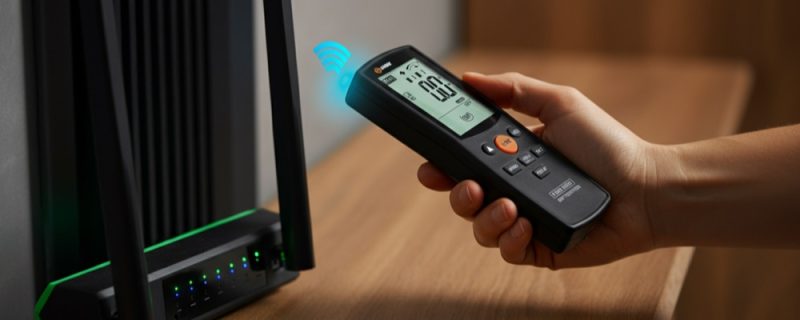

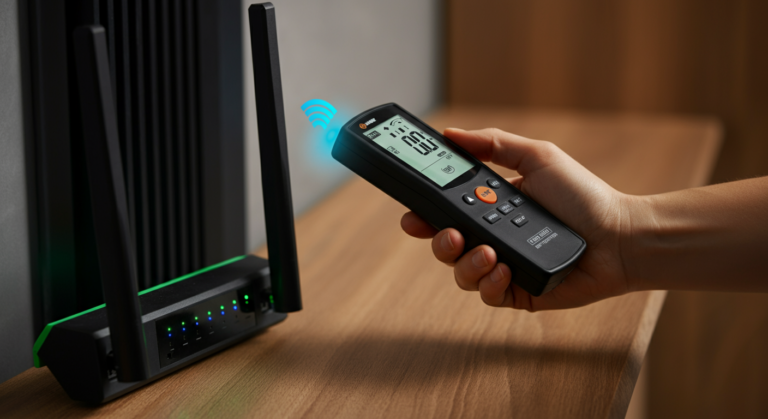
An EMFEMF stands for electromagnetic field (also called electromagnetic frequency or electromagnetic force). EMFs are invisible fields of energy produced by electrically charged objects. They exist on a spectrum ranging from... meter is a handheld device that detects electromagnetic fields from cell phones, WiFi, power lines, and appliances. It shows exactly where radiation is highest so you can reduce exposure.
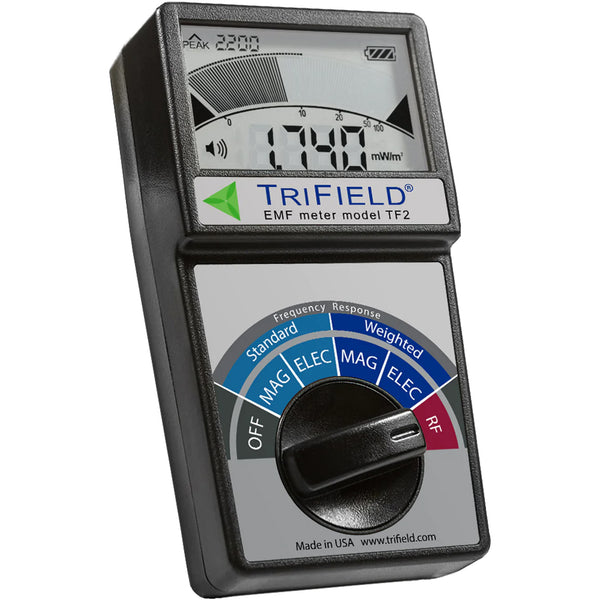
Different types measure different frequencies: RF meters for wireless radiation, gaussmeters for magnetic fields, and multi-function meters like the TriField TF2 for all three EMF types.
Key Takeaways
- EMF meters measure three types of fields: electric fields (from wiring), magnetic fields (from current flow), and RF radiation (from wireless devices)
- Consumer-grade meters cost $150-400 and provide sufficient accuracy for home assessment and protection verification
- Hold still when measuring: Most affordable meters need 3-5 seconds in a consistent position for accurate readings
- Direction matters: Single-axis meters only detect EMF in one direction, so rotate the meter to find the highest reading
- Cheap meters under $50 are unreliable: They often give inconsistent readings and can create false confidence or unnecessary alarm
What Are EMF Meters and How Do They Work?
An EMF meter is a diagnostic tool that detects invisible electromagnetic fields. Every wireless device, power line, and electrical appliance generates these fields. An EMF meter makes them visible through numerical readings on a display.
The meter contains sensors or antennas tuned to specific frequencies. When electromagnetic energy passes through these sensors, the meter converts that energy into a measurement you can see and interpret.
Think of it like a thermometer for radiation. Just as a thermometer reveals temperature you can’t see, an EMF meter reveals electromagnetic energy you can’t feel but that surrounds you constantly.
Why EMF Detection Matters
We live in an environment saturated with electromagnetic fields. Cell phones, WiFi routers, smart meters, Bluetooth devices, power lines, and household wiring all contribute to your daily exposure. The levels of nonionizing radiation from human-made sources today are vastly beyond anything our ancestors experienced.
Without a meter, you have no way of knowing which areas of your home have the highest exposure. Your bedroom might have elevated magnetic fields from a nearby circuit breaker. Your home office could have high RF levels from a WiFi router hidden in a closet. A meter transforms this uncertainty into actionable insight.
Primary Uses of EMF Meters: From Health to Professional Applications
EMF meters serve several practical purposes, from basic home assessment to professional building inspection.
Home EMF Assessment
The most common use is measuring your living environment. With a meter, you can:
- Identify hotspots: Find areas with unusually high readings, like near smart meters or circuit breaker boxes
- Compare environments: Measure different rooms to understand where exposure is highest
- Track changes over time: Establish baseline readings and see how they change when you add or remove devices
Verifying Protection Products Work
If you’ve invested in EMF shielding products, a meter lets you confirm they’re actually working. As I wrote in Empowered, “The only way to know if a product actually works is to test it yourself.” Without a meter, you’re trusting claims you can’t verify.
Take a reading before installing protection, then measure again after. The difference tells you exactly how much shielding you’re getting.
Finding Faulty Wiring
Unusual magnetic field readings can indicate wiring problems. If a wire is improperly grounded or there’s a net current issue in your electrical system, a gaussmeter will show elevated readings that flag the problem.
Professional and Industrial Applications
Electricians, building biologists, and EMF consultants use meters for detailed assessments. They help identify code violations, verify compliance with exposure guidelines, and create comprehensive reports for clients concerned about electromagnetic exposure in homes, offices, and schools.
Ghost Hunting (A Note)
You may have seen EMF meters marketed for paranormal investigation. While this is a legitimate market segment, SYB focuses on health and wellness applications. The same meters that detect “anomalies” in haunted houses are measuring real electromagnetic fields from ordinary sources. We recommend using your meter to understand and reduce your exposure, not to chase ghosts.
Types of EMF Meters and Their Specific Applications
Not all electromagnetic fields are the same, and neither are the meters that detect them. Here’s a breakdown of the main categories.
RF (Radio Frequency) Meters
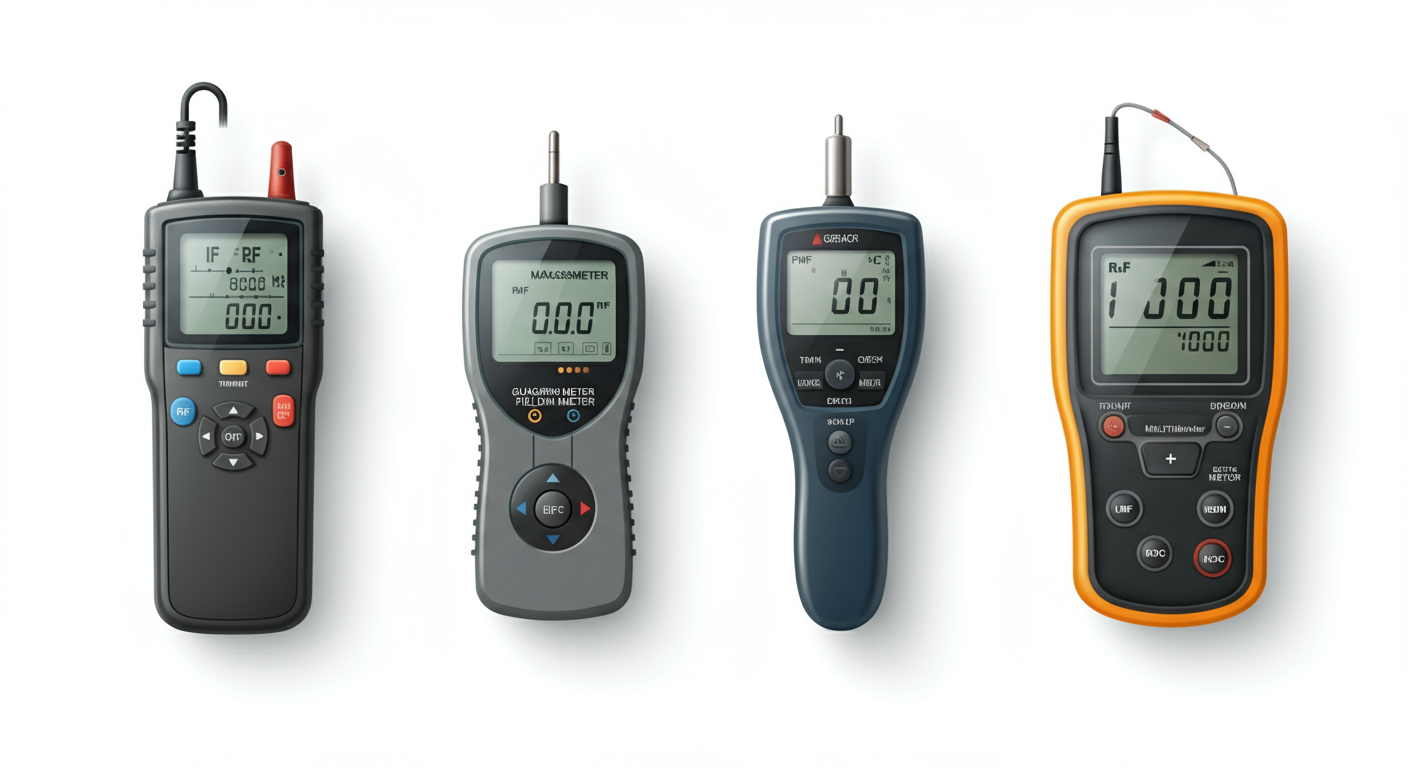
RF meters measure high-frequency radiation from wireless technologies. This includes:
- Cell phones and cell towers
- WiFi routers
- Bluetooth devices
- Smart meters
- Baby monitors
- 5G5G is the fifth generation of wireless cellular technology, offering faster data speeds, lower latency, and greater network capacity than 4G LTE. It began rolling out commercially in 2019. 5G... infrastructure
RF meters display readings in power densityPower density measures how much electromagnetic energy passes through a given area, expressed in watts per square meter (W/m²) or milliwatts per square centimeter (mW/cm²). This unit is primarily used... units like microwatts per square meter (uW/m2) or milliwatts per square meter (mW/m2). Some also show volts per meterVolts per meter (V/m) is the standard unit for measuring electric field strength. It quantifies how much electrical potential exists across a given distance. Electric fields measured in V/m are... (V/m).
Best for: Anyone concerned about wireless radiation in their home or workplace.
Example meters: Safe and Sound Pro II, Acoustimeter AM-10, Cornet ED88T
Gaussmeters (Magnetic Field Meters)
Gaussmeters detect low-frequency magnetic fields generated by electrical current flowing through wires. Common sources include:
- Power lines
- Home electrical wiring
- Electrical appliances (refrigerators, microwaves)
- Dimmer switches
- Electric motors
Magnetic fields are measured in milligauss (mG) or microtesla (uT).
Best for: Identifying exposure from electrical sources, especially near beds where you spend 6-8 hours nightly.
Example meters: Gigahertz Solutions ME3030B, ME3830B
Electric Field Meters
Electric field meters detect the voltage-driven fields present whenever an electrical device is plugged in, even if it’s turned off. You don’t need current flowing; just being connected to a live circuit creates an electric field.
Electric fields are measured in volts per meter (V/m).
Best for: Identifying exposure from electrical wiring, extension cords, and electronics near your body.
Dirty Electricity Meters
Dirty electricity meters measure high-frequency voltage transients on your home’s electrical wiring. These spikes and surges come from devices like LED lights, dimmer switches, and solar inverters.
Best for: Diagnosing electrical pollution issues that standard EMF meters don’t detect.
Example meters: Satic EMI Line Monitor
Multi-Function Meters
Multi-function meters combine RF, magnetic field, and electric field detection in a single device. They’re ideal for general home assessment because they let you check all three EMF types without switching between devices.
Best for: Beginners who want one device for comprehensive home assessment.
Example meters: TriField TF2 (the meter I use for travel because it covers all major EMF types in one device)
EMF Meter Comparison Table
| Meter Type | What It Measures | Common Units | Best For | Price Range |
|---|---|---|---|---|
| RF Meter | Wireless radiation (WiFi, cell, Bluetooth) | uW/m2, V/m | Wireless device exposure | $150-$400 |
| Gaussmeter | Magnetic fields | mG, uT | Power lines, wiring, appliances | $180-$350 |
| Electric Field Meter | Voltage fields | V/m | Wiring proximity, plugged-in devices | $180-$350 |
| Dirty Electricity Meter | Line noise/transients | GS units | Electrical pollution | $100-$200 |
| Multi-Function | All three EMF types | Various | General home assessment | $170-$300 |
Understanding EMF Measurements: Units, Readings, and Interpretation
A meter reading means nothing without context. Here’s how to interpret what you see.
Common Measurement Units
For RF radiation:
- Microwatts per square meter (uW/m2): Most common unit. Lower is better.
- Milliwatts per square meter (mW/m2): 1,000 uW/m2 = 1 mW/m2
- Volts per meter (V/m): Another way to express RF intensity
For magnetic fields:
- Milligauss (mG): Standard in North America. 1 mG = 0.1 uT
- Microtesla (uT): International standard. 1 uT = 10 mG
For electric fields:
- Volts per meter (V/m): Measures field strengthField strength measures the intensity of an electromagnetic field at a specific point. Electric field strength is measured in volts per meter (V/m), while magnetic field strength uses amperes per...
What the Numbers Mean
The FCC allows RF exposure up to 10 million uW/m2 depending on the frequency. However, many independent researchers and building biologists recommend much lower levels, especially for sleeping areas.
The Building Biology Institute suggests these RF guidelines for sleeping areas:
- Below 10 uW/m2: No concern
- 10-1,000 uW/m2: Slight concern
- 1,000-10,000 uW/m2: Severe concern
- Above 10,000 uW/m2: Extreme concern
For magnetic fields, many experts recommend keeping sleeping area exposure below 1-2 mG, though regulatory limits are far higher.
Context Matters
A reading of 500 uW/m2 from your WiFi router during the day is different from the same reading in your bedroom at night. Duration and proximity matter. Focus your mitigation efforts on areas where you spend the most time, especially where you sleep.
Home EMF Assessment: Step-by-Step Measurement Guide
Once you have a reliable meter, here’s how to use it properly.
Step 1: Understand Your Meter’s Modes
If you’re using a multi-function meter like the TriField TF2, it has separate settings for electric fields, magnetic fields, and RF radiation. Use the appropriate mode for what you’re testing:
- Near a laptop or phone? Use RF mode
- Near a wall outlet or appliance? Use magnetic or electric field mode
- Near a WiFi router? Use RF mode
Whatever meter you’re using, read the manual and understand the modes. This is vital for knowing what you’re actually measuring.
Step 2: Establish a Baseline
Before moving around, take readings in the center of each room. Record these as your baseline. This helps you identify which rooms have naturally higher levels.
Step 3: Identify Sources
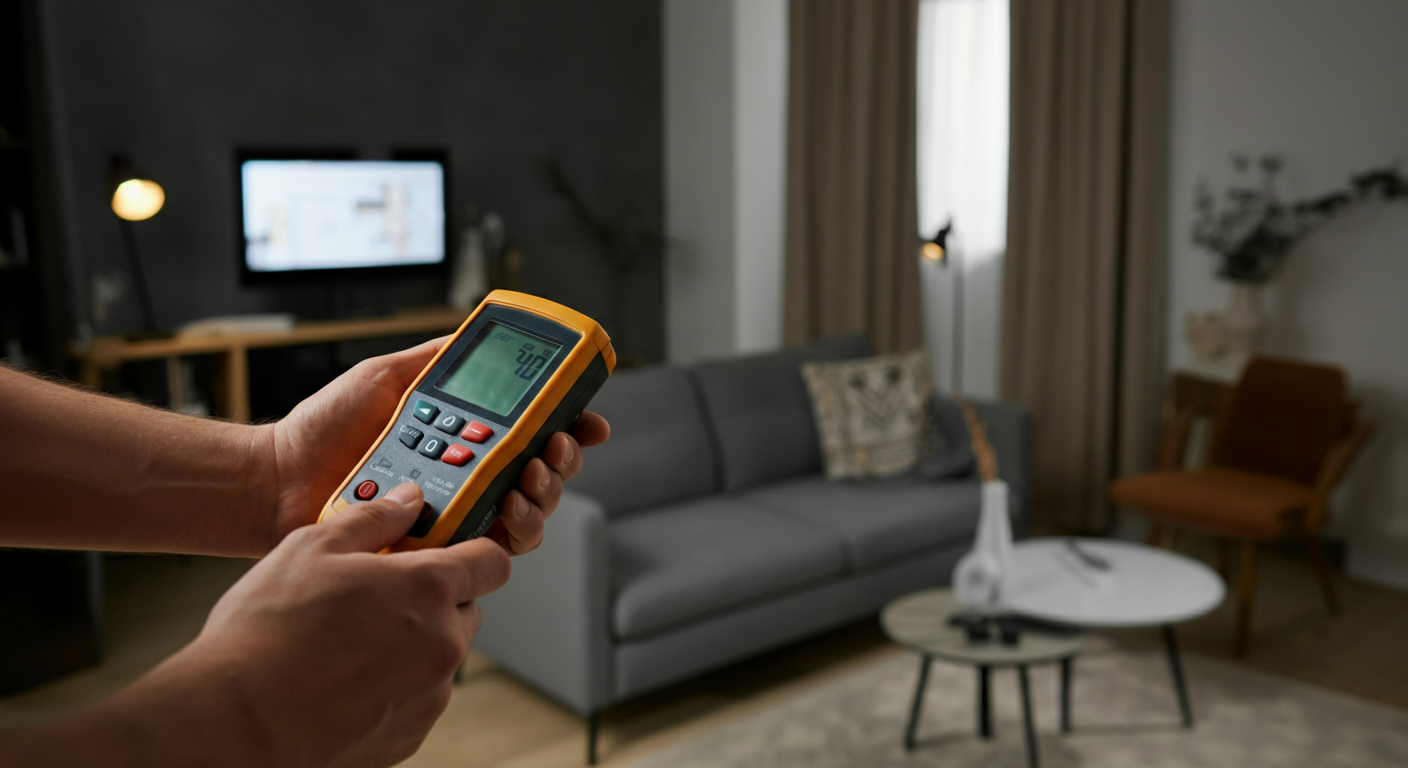
Slowly move toward suspected sources while watching the display:
- Walk toward your WiFi router
- Move near your smart meter
- Check around your circuit breaker box
- Measure near common appliances
The reading should increase as you approach the source.
Step 4: Hold Still
A lot of EMF meters, especially more affordable ones, need to be held still for at least a few seconds to get an accurate measurement. If you move the meter around too quickly, you’ll get inaccurate results.
Step 5: Account for Direction
Many meters are single-axis, meaning they only detect EMF coming from one direction. To get accurate readings, rotate the meter on all three axes (x, y, and z) and focus on the highest number you detect.
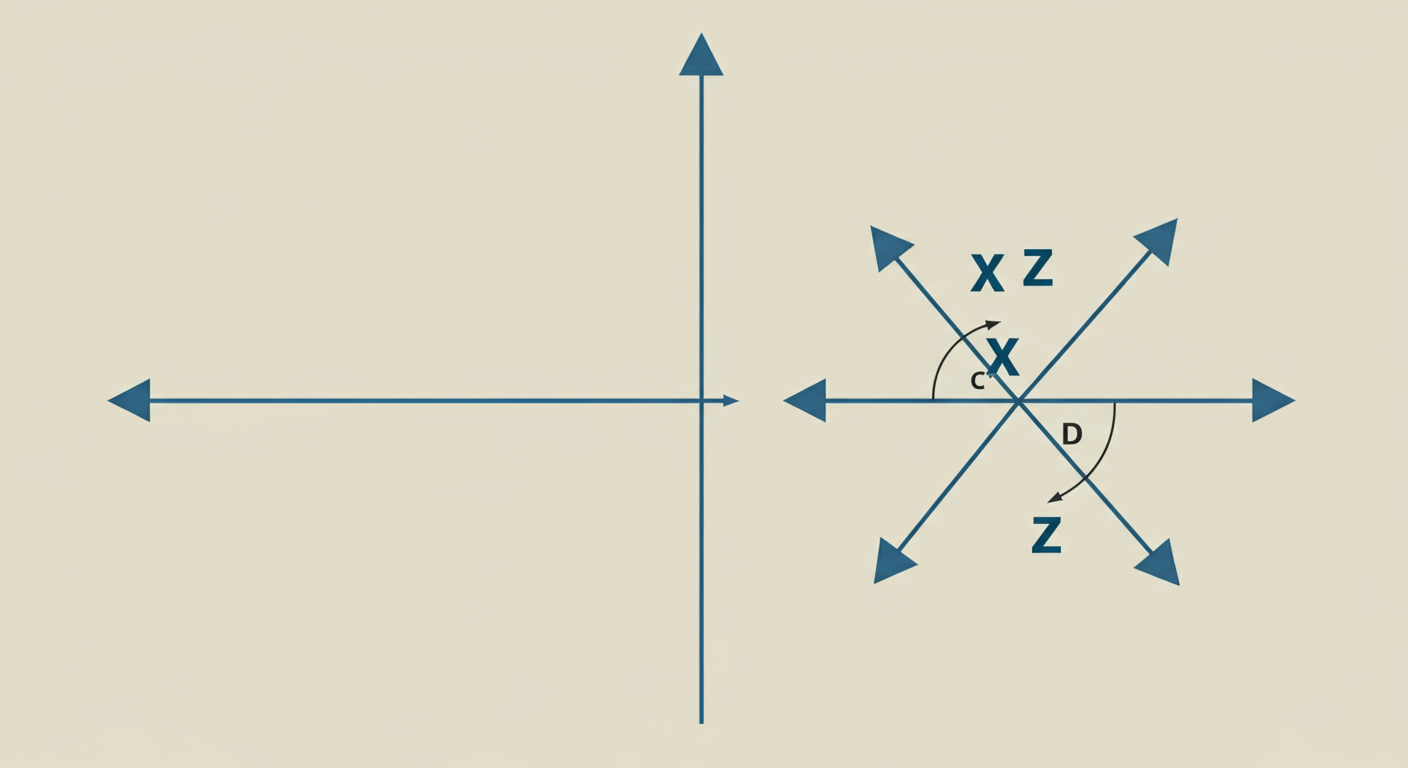
If you want increased accuracy without this extra step, invest in a triple-axis meter.
Step 6: Record Your Findings
Write down your readings by location. This creates a map of your home’s EMF profile that you can reference when making mitigation decisions or verifying that changes you make actually reduce exposure.
Professional vs. Consumer EMF Meters: When to Use Each
At the most basic level, EMF meters fall into two categories.
Consumer-Grade Meters ($150-$400)
These are affordable, user-friendly devices designed for basic testing around the home or office. They’re perfect for:
- Identifying hotspots
- Comparing environments
- Testing the effects of mitigation strategies
While not as precise as lab instruments, they’re more than sufficient for most everyday purposes. For most people, a reliable consumer-grade meter like the TriField TF2 is more than enough to measure electric fields, magnetic fields, and RF radiation with actionable precision.
Professional-Grade Meters ($400-$2,000+)
Used by researchers, engineers, and consultants, professional meters offer:
- Higher accuracy
- Greater frequency resolution
- Advanced features like spectrum analysis
- Data logging capabilities
They’re also expensive and typically require training to operate effectively. Unless you’re doing professional assessments or research, you probably don’t need this level of equipment.
The Right Tool for the Job
The key question isn’t “what’s the most accurate meter?” but “what accuracy do I need?” For home assessment and protection verification, consumer-grade meters provide the precision required to make informed decisions about your exposure.
EMF Meter Limitations and Accuracy Factors
No measurement tool is perfect. Understanding your meter’s limitations helps you use it more effectively.
Cheap Meters Are Cheap
I get it. EMF meters aren’t cheap. Who wants to buy a $150 or $200 meter when Amazon has options under $30? But those inexpensive meters are cheap for a reason. They’re not accurate and should not be used for testing.
Many budget meters found under brand names like Meterk, Erickhill, or generic “EMF detectors” suffer from serious problems:
- No calibration: Readings can be wildly inaccurate
- Inconsistent behavior: Values fluctuate randomly without correlating to actual exposure
- Confusing displays: No meaningful units or scales
- Lack of frequency specificity: Can’t distinguish between different EMF types
If you’re serious about reducing EMF exposure, avoid meters that prioritize gimmicks over accuracy.
Beware Max Levels
All meters can only measure up to certain levels. When your meter shows its maximum reading, you don’t know the actual level. It could be at the max, or it could be far higher. If you’re trying to measure shielding effectiveness and your meter maxes out, you can’t know how much protection you’re actually getting.
Environmental Factors
Temperature, humidity, and nearby metal objects can all affect readings. For consistent measurements, try to test under similar conditions each time.
User Error
The most common source of inaccurate readings is user error. Moving too quickly, pointing in the wrong direction, or misinterpreting display modes all lead to misleading data.
Common Misconceptions About EMF Meters
Misconception: A higher number always means danger.
Reality: Context matters more than raw numbers. A high reading during brief exposure is different from moderate readings during all-night exposure. Focus on areas where you spend the most time.
Misconception: Any EMF meter will give accurate results.
Reality: Budget meters under $50 often give random or inconsistent readings. Invest in a reputable consumer-grade meter from established manufacturers.
Misconception: EMF meters detect all types of radiation.
Reality: Different meters measure different frequency ranges. An RF meter won’t detect magnetic fields, and a gaussmeter won’t detect WiFi signals. Multi-function meters can measure multiple types but still have frequency limitations.
Misconception: If the reading is low, there’s no EMF present.
Reality: Low readings mean the specific type of EMF the meter detects is low. Other frequencies or field types may still be present but unmeasured.
Misconception: Phone apps can accurately measure EMF.
Reality: Smartphone “EMF detector” apps have severe limitations. They can only use the phone’s built-in sensors, which weren’t designed for EMF measurement and can’t detect RF radiation at all.
From Detection to Protection: Next Steps After EMF Measurement
Understanding your exposure is the first step. Here’s what to do with your findings.
Prioritize High-Exposure Areas
Start with where you spend the most time:
- Bedroom: You spend 6-8 hours here nightly. Even moderate readings matter.
- Home office/desk: Extended daily exposure adds up.
- Living areas: Where you relax and spend leisure time.
Distance Is Your Friend
Many sources show dramatically reduced readings with just a few feet of distance. Moving your WiFi router from your bedroom to a hallway, or positioning your desk away from a smart meter, can make a significant difference without costing anything.
Consider Shielding Options
For sources you can’t move or eliminate, shielding products can reduce exposure. But verify with your meter. Take readings before and after installation to confirm the shielding actually works.
Ready to Choose a Meter?
If you’re ready to take control of your EMF exposure, the next step is selecting the right meter for your needs. See our guide to the best EMF meters and detectors for detailed recommendations at every price point.
You can also browse our EMF meter collection for curated options we’ve tested and trust.
Frequently Asked Questions
An EMF meter detects and measures electromagnetic fields from sources like cell phones, WiFi routers, power lines, and household appliances. People use them to identify high-exposure areas in their homes, verify that EMF protection products actually work, and make informed decisions about reducing their daily electromagnetic exposure.
Some EMF meters can detect the RF emissions from wireless hidden cameras, but they're not specifically designed for this purpose. A camera emitting WiFi signals would register on an RF meter, but wired cameras or those not actively transmitting may not be detected. Dedicated RF bug detectors are more effective for this specific use.
Accuracy varies significantly by price and quality. Consumer-grade meters from reputable manufacturers ($150-$400) provide sufficient accuracy for home assessment. Budget meters under $50 often give inconsistent or meaningless readings. Professional meters offer the highest precision but cost $400 to $2,000+.
Smartphone EMF apps have severe limitations. They can only access the phone's built-in magnetometer, which measures magnetic fields but not RF radiation or electric fields. These apps cannot detect WiFi, cell phone, or Bluetooth emissions. A dedicated EMF meter provides far more accurate and comprehensive measurements.
Safety standards vary widely. The FCC allows RF exposure up to 10 million uW/m2, while the Building Biology Institute considers levels above 10,000 uW/m2 "extreme concern" for sleeping areas. For magnetic fields, many independent experts recommend keeping bedroom exposure below 1-2 milligauss, though regulatory limits are much higher.
EMF meters sold for paranormal investigation detect the same electromagnetic fields as any EMF meter. Whether fluctuating readings indicate ghostly activity or ordinary electrical interference is a matter of interpretation. The meters themselves are measuring real electromagnetic phenomena regardless of the user's purpose.
Single-axis meters measure EMF from one direction at a time. You need to rotate the meter on all three axes to capture the full reading. Triple-axis meters measure from all directions simultaneously, providing more accurate readings without manual rotation. Triple-axis meters cost more but save time and reduce user error.