
WiFi routers emit RF radiation in the 2.4 GHz and 5 GHz bands. While regulators consider current levels safe, research documents biological effects at non-thermal levels.
Complete WiFi avoidance isn’t realistic, but you can reduce exposure through distance, nighttime shutdown, and router optimization. For technical details, see my guide to WiFi radiation levels.
Medical Disclaimer: This article is for informational purposes only. It is not, nor is it intended to be, a substitute for professional medical advice, diagnosis, or treatment and should never be relied upon for specific medical advice.
Key Takeaways
- WiFi routers transmit RF radiation continuously at 1-2 watts of power, sending beacon pulses approximately 10 times per second
- Distance dramatically reduces exposure: moving from 1 foot to 6 feet away cuts exposure by approximately 97%
- The WHO classifies RF radiation as “possibly carcinogenic” (Group 2B), the same category as lead and DDT
- Current FCC safety standards were set in 1996 and only account for thermal (heating) effects, not chronic low-level exposure
- Children absorb more RF radiation than adults due to thinner skulls and developing nervous systems
What Is WiFi Radiation?
WiFi radiation is radiofrequencyRadiofrequency (RF) refers to electromagnetic waves in the frequency range of approximately 3 kHz to 300 GHz. This portion of the electromagnetic spectrum is used for wireless communication. RF energy... electromagnetic energy that wireless routers emit to communicate with your devices. Your router broadcasts signals in two main frequency bands: 2.4 GHz and 5 GHz (newer WiFi 6E routers also use 6 GHz).
This is non-ionizing radiationNon-ionizing radiation is electromagnetic energy that lacks sufficient power to remove electrons from atoms. This includes radio waves, microwaves, infrared, visible light, and lower-energy ultraviolet. The EMF from cell phones,..., meaning it doesn’t have enough energy to break chemical bonds or directly damage DNA the way X-rays can. However, non-ionizing doesn’t mean non-biological. Research increasingly shows that RF radiation can affect living systems through mechanisms other than heating.
What makes WiFi unique among household EMFEMF stands for electromagnetic field (also called electromagnetic frequency or electromagnetic force). EMFs are invisible fields of energy produced by electrically charged objects. They exist on a spectrum ranging from... sources is its constant presence. Unlike your cell phone, which you can put down, your WiFi router broadcasts continuously—typically sending beacon pulses about 10 times per second to announce its presence to nearby devices.
How WiFi Affects the Body: What Research Shows
The debate over WiFi safety often gets framed as “proven safe” versus “proven dangerous.” The reality is more nuanced.
The Official Position
Regulatory agencies like the FCC and FDA maintain that WiFi is safe at current exposure levels. Their position rests on the thermal standard: if radiation doesn’t heat tissue, it’s considered safe.
What Current Research Suggests
Over 500 peer-reviewed studies have documented biological effects from RF radiation at levels below the thermal threshold. These effects include:
| Effect Category | Research Finding |
|---|---|
| Oxidative stress | RF exposure increases reactive oxygen species in cells |
| Sleep disruption | EMF exposure affects melatonin production and sleep quality |
| Cellular changes | Changes in cell membrane permeability and calcium signaling |
| Neurological effects | EEG changes and reported cognitive effects in some studies |
The BioInitiative Report, a review of over 1,800 studies, concluded that existing public safety limits are inadequate to protect public health.
The Standards Gap
Current FCC safety standards were established in 1996, before WiFi was ubiquitous, before smartphones existed, and before extensive research on non-thermal effects. These standards only protect against tissue heating. They don’t account for:
- Chronic, low-level exposure over years
- Cumulative effects from multiple RF sources
- Non-thermal biological mechanisms
- Vulnerable populations like children
WiFi vs. Other EMF Sources
Understanding how WiFi compares to other radiation sources helps put exposure in context.
| Source | Typical Power | Frequency | Distance Factor |
|---|---|---|---|
| WiFi Router | 1-2 W | 2.4/5 GHz | Fixed location, continuous |
| Cell Phone (active call) | 0.5-2 W | 700 MHz-2.5 GHz | Against body, intermittent |
| Cell Phone (standby) | 0.001 W | 700 MHz-2.5 GHz | Variable distance |
| Bluetooth | 0.001-0.1 W | 2.4 GHz | Close to body, often continuous |
| Microwave Oven | 1000+ W | 2.4 GHz | Shielded, brief use |
The key difference with WiFi: it operates continuously in your living space. A cell phone call might last 10 minutes; your router runs 24 hours a day, 7 days a week.
Who Should Be Most Concerned?
While the precautionary approach applies to everyone, certain groups may want to take extra care.
Children
Children’s bodies absorb more RF radiation than adults. Their skulls are thinner, their nervous systems are still developing, and they’ll accumulate more lifetime exposure. A 2018 study in Bioelectromagnetics found that children absorbed significantly more energy from WiFi signals than adults, particularly at 2.4 GHz.
Pregnant Women
The developing fetus is particularly sensitive to environmental exposures. While direct research on WiFi and pregnancy is limited, the precautionary principle suggests minimizing unnecessary RF exposure during pregnancy.
People with Electromagnetic Hypersensitivity
Some individuals report symptoms—headaches, fatigue, difficulty concentrating—that they associate with EMF exposure. While the mechanism isn’t fully understood, these experiences are real for those who have them. Reducing WiFi exposure is one strategy these individuals often find helpful.
People with Sleep Issues
If you’re struggling with sleep and your router is in or near your bedroom, WiFi could be a contributing factor. Several studies have documented effects of RF exposure on melatonin production and sleep architecture.
Practical Steps to Reduce WiFi Exposure
You don’t have to give up WiFi to reduce your exposure. Here are evidence-based strategies that make a real difference.
1. Maximize Distance
This is your most effective tool. RF radiation follows the inverse square law—double your distance from the source, and exposure drops to one-quarter.
What to do:
- Keep your router out of bedrooms and main living areas
- Position the router in a hallway, utility room, or area where people don’t spend extended time
- Don’t sit directly next to the router while working
2. Turn Off WiFi at Night
Your router doesn’t need to run while you’re sleeping. Turning it off eliminates 8 hours of exposure daily.
What to do:
- Use a simple timer switch (under $10) to automatically power down the router at bedtime
- Or manually turn it off before bed
- This also reduces energy consumption
3. Use Wired Connections When Possible
Ethernet cables don’t emit RF radiation. Wherever practical, hardwire instead of using WiFi.
What to do:
- Connect desktop computers directly to your router via Ethernet
- Use powerline adapters to extend wired connectivity to other rooms
- Connect smart TVs and gaming consoles via Ethernet
4. Optimize Router Settings
Many routers let you reduce transmission power without significantly affecting performance.
What to do:
- Access your router settings (usually via a web browser)
- Look for transmit power settings and reduce from 100% to 50-75%
- Disable the 5 GHz band if you don’t need the extra speed (it has shorter range anyway)
5. Consider Low-EMF Router Options
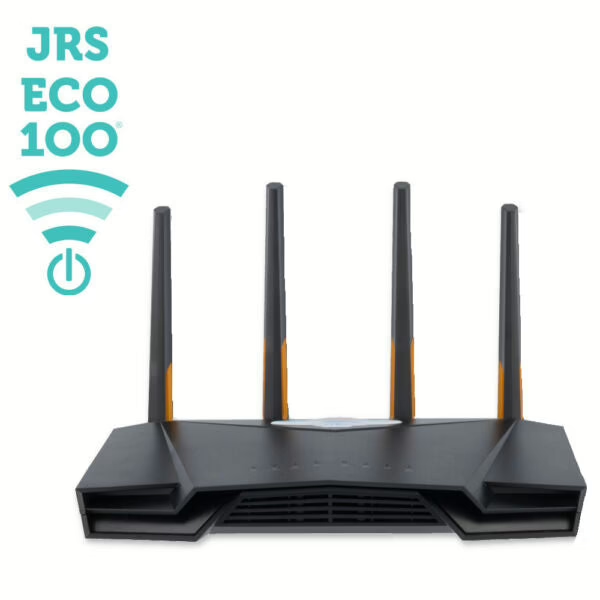
Some routers are specifically designed to reduce EMF output. The JRS Eco WiFi Router, for example, reduces beacon pulses from 10 per second to 1 per second—an up to 90% reduction in idle radiation.
For more detailed product recommendations, see my WiFi protection guide. You can also explore WiFi EMF blockers designed to reduce your router’s radiation output.
Common Misconceptions
Misconception: WiFi is completely safe because it’s non-ionizing radiation. Reality: Non-ionizing means it doesn’t directly break DNA bonds, but research documents biological effects through other mechanisms including oxidative stress and disruption of cellular signaling.
Misconception: If WiFi were dangerous, everyone would be sick by now. Reality: Health effects from environmental exposures often take years or decades to manifest. We’ve only had widespread WiFi since the mid-2000s.
Misconception: The government wouldn’t allow WiFi if it weren’t safe. Reality: FCC safety standards date from 1996 and only address heating effects. They don’t reflect current research on non-thermal biological effects.
Misconception: WiFi exposure is too low to matter. Reality: While individual exposure moments are low, cumulative 24/7 exposure adds up. And WiFi is just one source in an environment filled with RF-emitting devices.
Misconception: You’d have to live in a cave to avoid WiFi. Reality: Simple strategies like distance, timing, and hardwiring can reduce exposure by 80-90% without giving up connectivity.
The Bottom Line
WiFi isn’t something to panic about, but it’s also not something to dismiss entirely. The science continues to evolve, and reasonable precautions make sense, especially given how easy many of them are to implement.
Focus on the strategies that give you the biggest reduction with the least disruption: distance, nighttime shutdown, and wired connections where practical. These simple changes can reduce your WiFi exposure by 80% or more.
For technical details on WiFi radiation levels and how to measure them, continue to my guide on WiFi radiation.
For specific product recommendations, see my WiFi protection buyer’s guide.
Related Reading:
- WiFi Radiation: What You Need to Know
- WiFi Protection: Routers, Covers & EMF Solutions
- Best EMF Meters and Detectors
- EMF Radiation: What It Is & Potential Health Effects
Frequently Asked Questions
WiFi exposure at typical home levels doesn't cause immediate harm. However, research on long-term, low-level exposure is still developing. Taking precautions like maximizing distance and turning off routers at night represents a reasonable, balanced approach.
Some research suggests RF exposure can affect melatonin production and sleep patterns. If your router is in or near your bedroom, relocating it or turning it off at night may improve sleep quality.
5 GHz signals have shorter range and don't penetrate walls as easily, which can actually mean less whole-home exposure. However, both frequencies are in the microwave range and warrant similar precautions.
There's no official "safe distance," but increasing distance significantly reduces exposure. Keep the router at least 6-10 feet from areas where you spend extended time, and out of bedrooms entirely.
The WHO classifies RF radiation as "possibly carcinogenic" (Group 2B). This means evidence suggests a possible link, but it's not conclusive. Long-term studies are ongoing.
Yes, if practical. Turning off your router while sleeping eliminates approximately one-third of your daily WiFi exposure with zero impact on your daytime connectivity.
Children absorb more RF radiation than adults, and their developing systems may be more vulnerable. Extra precautions—like keeping routers out of children's rooms and limiting WiFi-enabled device use—are reasonable.