
Understanding Faraday shielding materials is essential for protecting yourself, your family, or your electronics from electromagnetic radiationElectromagnetic radiation (EMR) is energy that travels through space as waves of oscillating electric and magnetic fields. It includes everything from radio waves to visible light to gamma rays. All.... These conductive materials form the backbone of legitimate EMFEMF stands for electromagnetic field (also called electromagnetic frequency or electromagnetic force). EMFs are invisible fields of energy produced by electrically charged objects. They exist on a spectrum ranging from... protection.
Not all shielding materials are equal. Some work better for certain frequencies, some are practical for everyday use, and some products on the market don’t work at all.
Key Takeaways
- Silver has the highest EMF conductivity of any metal, which is why it is used in most quality EMF shielding apparel and wearables
- A Faraday cage works by redistributing electromagnetic energy across its conductive surface, not by absorbing it
- Shielding effectiveness depends on material continuity: even small gaps in coverage can significantly reduce protection
- Conductive fabrics woven with silver, copper, or stainless steel can block up to 99.999% of incoming RF radiation (50 dB attenuation)
- Standard building materials like brick and drywall already provide meaningful RF shielding, often 20-45 dB at higher frequencies
In this guide, we’ll cut through the confusion. You’ll learn which materials actually block EMF, how to choose the right one for your needs, and how to test whether your shielding is working. The science is straightforward, and the choices don’t have to be complicated.
Understanding Faraday Shielding: The Science Behind EMF Protection
In the early 1830s, inside the Royal Institution in London, a self-taught scientist named Michael Faraday conducted an experiment that would revolutionize our understanding of electromagnetic forces. His setup was simple: a room lined with metal foil, an electroscope at its center, and a static generator crackling with charge outside.
Faraday stepped inside the enclosure. Despite the intense electric activity buzzing around him, the instrument in the center remained still. No reaction. No flicker. The chaos outside had ceased to exist within those conductive walls.
What Faraday demonstrated was profound: a continuous layer of conductive material could prevent external electric fields from penetrating a space. He had created what we now call a faraday cage, a kind of electromagnetic refuge. His experiment proved that certain structures of conductive metals could block, redirect, or contain electromagnetic energy.
Though Faraday worked with electrostatics, the principles he uncovered remain at the heart of how we manage EMF exposure today. From hospital MRI suites to secure government facilities, and increasingly in the homes of health-conscious individuals, shielding remains a trusted method for limiting unwanted electromagnetic interference.
How Shielding Actually Works
At its core, EMF shielding reduces the amount of electromagnetic radiation that enters or escapes a given space. It works not by absorbing energy like a sponge, but by deflecting, redirecting, or attenuating it using conductive materials.
The principle is straightforward: when electromagnetic waves encounter a barrier made of certain materials, their energy is either reflected back, diverted away, or dissipated before reaching the other side.
Think of it like a window shade for invisible energy. Except instead of blocking sunlight, shielding materials deflect EMF radiation.
A question I often hear is: what happens to the deflected waves? Do they bounce off and hit someone else with concentrated radiation?
The answer is reassuring. When shielding deflects radiation, the waves do bounce in the opposite direction, but they don’t become more powerful. Quite the contrary. The rays gradually dissipate because EMF radiation diminishes exponentially with distance. Double the distance, and the exposure drops to one-quarter.
Electric Fields vs. Magnetic Fields vs. RF
Electromagnetic fields have electric and magnetic components, and different frequencies require different shielding strategies.
For electric fields, conductive materials like aluminum, copper, or silver create a barrier that redistributes electric charge across the surface, effectively canceling the field inside the shielded area.
For magnetic fields, particularly at lower frequencies from power lines and appliances, shielding is more challenging. These require specialized materials like mu-metal or ferrite, which redirect magnetic flux lines away from the protected space.
For RF (radio frequency) radiation from WiFi, cell phones, Bluetooth, and 5G5G is the fifth generation of wireless cellular technology, offering faster data speeds, lower latency, and greater network capacity than 4G LTE. It began rolling out commercially in 2019. 5G..., shielding involves conductive enclosures or meshes. These materials reflect and absorb high-frequency radiation, preventing it from penetrating protected spaces.
The effectiveness of any shield depends on several factors: material composition, thickness, continuity (no gaps or holes), and for certain electric field applications, proper grounding.
How Faraday Cages Work: From Theory to Real-World Application
A Faraday cage doesn’t need to be a literal cage. Any continuous conductive enclosure functions on the same principle. The key word is continuous. Even a small gap can compromise performance significantly.
When electromagnetic waves hit a conductive surface, the material’s free electrons redistribute themselves to cancel the incoming field. This happens almost instantaneously. The result is that the space inside the enclosure experiences dramatically reduced EMF levels.
This is why Faraday products, whether pouches, sleeves, or bags, function by completely enclosing a device in conductive material. When sealed properly, this creates a barrier that blocks electromagnetic signals including cellular (2G through 5G), WiFi, Bluetooth, GPS, and RFID.
What Makes a Faraday Enclosure Effective
The effectiveness of Faraday protection depends entirely on construction. Shielding material must be continuous, with no gaps or breaks, and closures must form a complete seal. Even a small opening can compromise performance.
That’s why quality matters. Sloppy design or cheap materials can turn a Faraday enclosure into little more than an expensive pouch. Used correctly, though, these products create spaces of digital silence in a world that’s always listening.
For a Faraday enclosure to work effectively:
- Complete coverage: The conductive material must surround the protected space entirely
- No gaps: Seams, closures, and openings must maintain conductivity
- Appropriate mesh size: For mesh materials, the openings must be smaller than the wavelength of the radiation you’re blocking
- Material conductivity: Higher conductivity generally means better shielding
Complete Guide to Faraday Shielding Materials and Their Effectiveness
All metals have some EMF conductive abilities. But certain metals are commonly used due to their high conductivity and practical characteristics. Here’s what you need to know about each.

Silver: The Gold Standard
In terms of EMF conductivity, silver holds the highest position of any metal. If you’ve purchased scientifically proven EMF shielding products, you may have noticed that many contain significant silver content.
Silver-coated textiles have been shown to attenuate radiofrequency radiationRadiofrequency radiation (RFR) is electromagnetic energy in the frequency range of 3 kHz to 300 GHz. This type of non-ionizing radiation is emitted by wireless devices and communication infrastructure. Cell... by up to 99%. These findings are consistent with laboratory testing and scientific validation used in the design of quality EMF protection clothing.
At Shield Your Body, we use silver as the shielding material in all of our apparel products because, in addition to being effective at deflecting electromagnetic radiation, silver is also naturally antibacterial and antimicrobial. This matters for products worn against the skin.
Copper: The Practical Powerhouse
Among non-precious metals, copper has the highest conductivity. It’s widely used in professional shielding applications, from building construction to electronics enclosures.
Copper mesh and copper fabric are popular choices for DIY shielding projects because they offer excellent performance at a reasonable cost. Copper is also more durable than aluminum for many applications.
Aluminum: Budget-Friendly Protection
While not as effective as copper or silver, aluminum provides powerful EMF shielding at the lowest cost. It’s lightweight, readily available, and effective for many applications.
You may have seen people using aluminum foil to block EMF. Does it work? Yes, aluminum foil does block EMF radiation when applied with complete coverage. The main limitations are durability (it tears easily) and maintaining continuous coverage over time.
For rigid applications like laptop shields, aluminum alloy is an effective and lightweight choice that reflects EMF radiation away from the body.
Gold: Effective but Expensive
Gold is highly conductive and effective for EMF shielding. However, due to its cost, gold is rarely used as a primary shielding material. You’ll occasionally find it in specialized electronics applications where its corrosion resistance justifies the expense.
Steel and Stainless Steel
Steel has lower EMF conductivity compared to aluminum, silver, and copper. However, steel mesh can provide strong structural and shielding properties without compromising airflow or breathability. It’s often used in panels, liners, and architectural applications.
Stainless steel offers the additional benefit of corrosion resistance, making it suitable for outdoor or high-humidity environments.
Comparative Effectiveness
| Material | Conductivity | Cost | Best For |
|---|---|---|---|
| Silver | Highest | High | Apparel, wearables, medical |
| Copper | Very High | Medium | DIY projects, building shielding |
| Aluminum | High | Low | Budget projects, rigid enclosures |
| Gold | Very High | Very High | Specialized electronics |
| Steel | Moderate | Low | Structural, architectural |
Faraday Fabrics vs. Metal Materials: Choosing the Right Solution
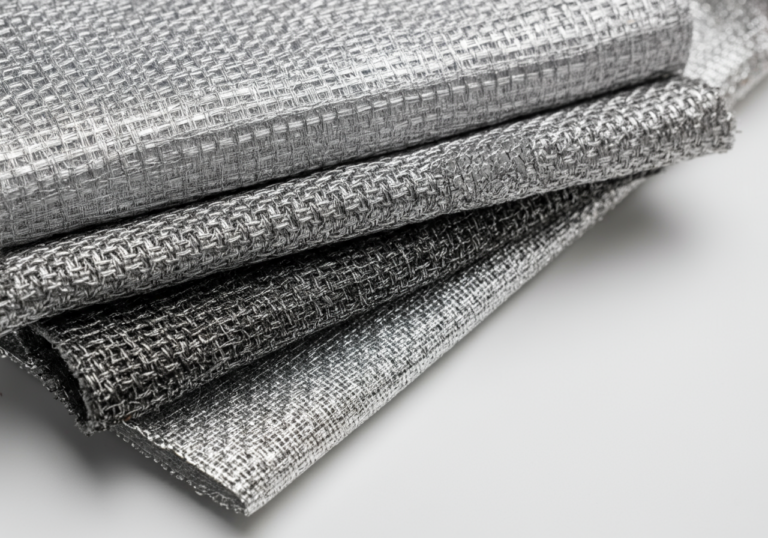
One of the most versatile forms of shielding comes in conductive fabrics, materials woven with threads of silver, copper, stainless steel, or carbon. These fabrics can be sewn into clothing, draped over beds, or used as window curtains.
When to Choose Fabric Shielding
Fabric shielding excels when you need:
- Flexibility: Clothing, canopies, curtains
- Comfort: Products worn against skin
- Breathability: Sleeping environments
- Portability: Travel and on-the-go protection
A study evaluating metal fiber-containing fabrics found that they effectively reduce the power densityPower density measures how much electromagnetic energy passes through a given area, expressed in watts per square meter (W/m²) or milliwatts per square centimeter (mW/cm²). This unit is primarily used... of incident electromagnetic waves across common wireless frequencies. This validates the use of conductive fabrics for everyday EMF protection.
Shielding bed canopies, for example, create a low-EMF sleeping zone. This is especially valuable for those with electrohypersensitivity or anyone looking to optimize their sleep environment by reducing nighttime EMF exposure.
When to Choose Rigid Metal Shielding
Solid metal shielding is preferred for:
- Permanent installations: Wall panels, window films
- Maximum attenuation: When you need the highest possible blocking
- Structural applications: Building integration
- Electronics enclosures: Device protection
Hybrid Approaches
Many effective shielding strategies combine both approaches. For example, you might use metal mesh on windows (rigid, high-performance) while using fabric for a bed canopy (flexible, comfortable).
DIY Faraday Shielding: When to Build vs. When to Buy Professional Solutions
The good news about Faraday shielding is that the physics are simple enough for DIY projects. The challenge is achieving the continuous coverage that makes shielding effective.
Successful DIY Projects
DIY Faraday cages are possible using metal containers, aluminum foil, or copper mesh. The key requirements are:
- Complete coverage with no gaps
- Proper sealing of seams
- Appropriate material selection for your target frequencies
- Testing to verify effectiveness
Common DIY applications include:
- Phone pouches: Lined containers for complete signal blocking
- Router enclosures: Reducing WiFi radiation while maintaining function
- Sleeping areas: Canopy frames with shielding fabric
- Small electronics storage: Protecting devices from EMP or data theft
When Professional Solutions Make Sense
Consider buying professionally designed products when:
- Wearability matters: Clothing and accessories require proper construction
- Aesthetics are important: Home integration needs professional finish
- Certification is needed: Medical or professional applications
- Time is valuable: DIY projects require significant effort
- Performance is critical: Professional testing ensures effectiveness
The Airplane Mode Alternative
Here’s something worth considering: if your goal is simply EMF protection from your phone (not privacy or security), there’s often a simpler solution than Faraday shielding.
Airplane mode accomplishes the same task as a Faraday pouch for EMF purposes. It stops all signal emissions without requiring any product. And airplane mode has another advantage: it conserves your battery.
A phone sealed in a Faraday pouch remains active and will continually ramp up its signal output attempting to reconnect to a network. This drains the battery faster and can generate heat. Airplane mode prevents this entirely.
Faraday pouches are powerful tools for privacy, security, and data isolation. They’re excellent for protecting key fobs, shielding sensitive electronics, or safeguarding against digital surveillance. Choose the right tool for your goal.
Testing and Measuring Faraday Shielding Effectiveness
One advantage of physics-based EMF protection is that you can actually measure whether it works. Unlike products claiming to “harmonize” or “neutralize” energy fields, shielding performance is quantifiable.

Basic Testing Methods
The Phone Call Test: For Faraday bags and pouches, place your phone inside and try calling it. A properly sealed Faraday enclosure will prevent the call from connecting. This is a simple pass/fail test anyone can perform.
RF Meter Testing: For more precise measurements, use an RF meter to measure radiation levels before and after applying shielding. Measure on both sides of the material to calculate attenuation.
WiFi Signal Test: Check your phone’s WiFi signal strength before and after placing shielding between your phone and router. The signal should drop dramatically with effective shielding.
Understanding Attenuation Ratings
Shielding effectiveness is typically measured in decibels (dB). Here’s what the numbers mean:
| dB Reduction | % Blocked |
|---|---|
| 10 dB | Up to 90% |
| 20 dB | Up to 99% |
| 30 dB | Up to 99.9% |
| 40 dB | Up to 99.99% |
| 50 dB | Up to 99.999% |
Quality shielding fabrics typically provide 30-50 dB attenuation across relevant frequencies. This means blocking up to 99.9% to 99.999% of incoming radiation.
Professional Testing
At Shield Your Body, we have our products tested at independent laboratories to demonstrate shielding effectiveness. But you don’t need to take our word for it. You can measure the efficacy of shielding products yourself using meters you can buy online.
Integrating Faraday Shielding into Your Complete EMF Protection Strategy
Shielding is one tool in your EMF protection toolkit. The most effective approach combines shielding with distance and time reduction.
The EMF Protection Triangle
- Minimize: Reduce your use of EMF-emitting devices
- Maximize Distance: Keep devices away from your body
- Shield: Use shielding when you can’t avoid exposure
Prioritizing Your Shielding Efforts
Focus shielding efforts where you spend the most time and have the closest exposure:
- Bedroom: Where you spend 6-8 hours nightly in close proximity
- Workspace: Extended exposure during work hours
- Devices you carry: Phone, laptop, tablet
What Building Materials Already Provide
Here’s something often overlooked: many standard building materials offer significant shielding benefits.
- Brick: Traditional clay bricks provide 35-45 dB attenuation at 5G frequencies
- Roof tiles: Clay and concrete roofing blocks up to 99.68% to 99.97% of high-frequency radiation
- Gypsum drywall: Standard interior walls offer 20-30 dB attenuation
- Low-E glass: Coated windows can block 20-30 dB of RF
These materials demonstrate that shielding isn’t always an add-on. Sometimes it’s already built into the walls around us. When understood and optimized, these baseline protections can reduce ambient exposure significantly.
Common Mistakes and How to Avoid Them
Mistake #1: Incomplete Coverage
The most common failure in DIY shielding is gaps in coverage. Even small openings can allow significant radiation to pass through. Always test your shielding after installation and seal any gaps.
Mistake #2: Wrong Material for the Frequency
Different frequencies require different approaches. A material that blocks RF effectively may do little for magnetic fields from power lines. Understand what you’re trying to block before selecting materials.
Mistake #3: Expecting Miracles from Cheap Products
In a largely unregulated market, many products make claims they can’t support. If a product promises to “neutralize” or “harmonize” EMF without using conductive materials, be skeptical. Legitimate shielding uses physics, and physics is measurable.
Mistake #4: Ignoring the Source
Sometimes the best solution isn’t shielding. It’s reducing or relocating the source. Moving your WiFi router to a less central location or switching to wired connections may be more effective than trying to shield against it. Understanding the wifi router radiation safe distance can help determine optimal placement strategies.
Mistake #5: Creating Unintended Antenna Effects
Improperly grounded or partially shielded enclosures can sometimes concentrate or redirect EMF in unexpected ways. When in doubt, test your setup or consult with an EMF professional.
Maintenance and Longevity: Keeping Your Faraday Protection Effective
Shielding materials can degrade over time. Here’s how to maintain effectiveness.
Fabric Care
- Follow manufacturer washing instructions carefully
- Avoid harsh detergents that can damage conductive fibers
- Air dry when possible to preserve conductivity
- Inspect regularly for wear or damage
- Test periodically to verify continued effectiveness
Metal Shielding Maintenance
- Check for corrosion, especially in humid environments
- Inspect seams and connections for breaks in continuity
- Clean with appropriate materials that won’t damage conductivity
- Replace damaged sections promptly
When to Replace
Consider replacement when:
- Testing shows reduced effectiveness
- Visible damage to conductive elements
- Fabric shielding becomes worn or thin
- Metal shows significant corrosion
Common Misconceptions
Misconception: Aluminum foil is just as effective as professional shielding fabric
Reality: While aluminum foil does block EMF radiation, it tears easily, cannot maintain continuous coverage over time, and is impractical for wearable or flexible applications. Professional shielding fabrics use woven silver or copper threads that maintain conductivity through repeated use and washing.
Misconception: Thicker shielding material always provides better protection
Reality: Shielding effectiveness depends more on material conductivity and coverage continuity than on thickness alone. A thin layer of silver fabric with no gaps outperforms a thick layer of lower-conductivity material that has seams or openings.
Misconception: EMF shielding paint blocks all types of radiation
Reality: Carbon-based shielding paints can reduce RF radiation from external sources, but they are less effective against low-frequency magnetic fields from wiring and appliances. Different radiation types require different shielding approaches.
Taking the Next Step
Understanding Faraday shielding materials gives you the foundation to make informed decisions about EMF protection. Whether you’re building a DIY solution or choosing professional products, the physics are the same: continuous conductive coverage blocks electromagnetic radiation.
The choice is yours. You might shield your sleeping area, protect sensitive electronics, or simply carry your phone in a shielding pouch. Start with your highest-priority exposure and build from there.
What matters is that you now have the information to make these decisions wisely. For those ready to explore professional shielding solutions, Shield Your Body offers lab-tested products using the materials and principles discussed in this guide.
Frequently Asked Questions
Silver has the highest EMF conductivity of any metal and is used in most quality EMF shielding apparel and wearables, capable of blocking up to 99.999% of incoming RF radiation.
A Faraday cage works by redistributing electromagnetic energy across its conductive surface rather than absorbing it.
Shielding effectiveness depends on material continuity: even small gaps in coverage can significantly reduce protection, highlighting the importance of seamless materials.
Conductive fabrics woven with silver, copper, or stainless steel can block up to 99.999% of incoming RF radiation, equating to 50 dB attenuation.
Standard building materials like brick and drywall already provide meaningful RF shielding, often blocking up to 20-45 dB at higher frequencies.