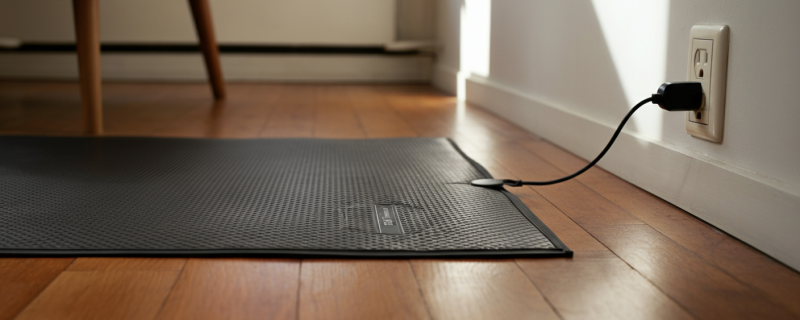

Grounding mats can expose you to contact current, dirty electricity, and shock hazards if your home’s grounding carries stray voltage. Those with pacemakers and homes with faulty wiring face highest risks.
These dangers are manageable. Understanding proper grounding, verifying outlet wiring, and using safety devices lets you enjoy benefits while minimizing risk.
Medical Disclaimer: This article is for informational purposes only. It is not, nor is it intended to be, a substitute for professional medical advice, diagnosis, or treatment and should never be relied upon for specific medical advice.
Key Takeaways
- Grounding mats connect to your home’s electrical ground, which often carries stray current from the power grid
- Contact current exposure through grounding products can reach 10-50 microamps in typical homes
- The National Electrical Code states that earth should not be considered an effective ground-fault current path
- People with pacemakers or other implanted medical devices should consult their doctor before using grounding products
- Using a resistor-based safety device like the NCB can reduce contact current by up to 99%, and direct grounding to earth (bypassing your home’s electrical system) is often safer than plugging into wall outlets
What Are Grounding Mats and How Do They Work?
A grounding mat is a conductive pad that connects your body to the earth’s electrical potential through your home’s grounding system. When you touch the mat with bare skin, electrons can flow between your body and ground, theoretically neutralizing excess charge.

The concept is simple: the earth maintains a slight negative electrical charge. Making conductive contact allows your body to equalize with this charge. Proponents claim this reduces inflammation, improves sleep, and offers other health benefits.
Here’s how most grounding mats work:
- Conductive surface – The mat contains conductive materials like silver threading or carbon fiber
- Ground cord – A wire connects the mat to the ground port of a standard electrical outlet
- Electron transfer – When you touch the mat, you complete a circuit to ground
The problem? That “ground” isn’t the earth itself. It’s your home’s electrical grounding system, and that system often carries current you don’t want flowing through your body.
The Real Safety Concerns with Grounding Mats
Contact Current from Your Home’s Grounding System
The most significant danger isn’t electric shock in the traditional sense. It’s contact current, the small but continuous flow of electricity that passes through your body when you touch a grounded surface.

Your home’s grounding system wasn’t designed for therapeutic use. It was designed to protect you from electrical faults by providing a path for dangerous current to trip circuit breakers. But this same system carries:
- Return current from appliances – Every device in your home contributes some current to the neutral wire, which connects to ground
- Harmonics and dirty electricity – Modern electronics create high-frequency distortions that travel on grounding conductors
- Stray voltage from the power grid – The multigrounded neutral system used in North America puts current into the earth around your home
When you connect a grounding mat to this system, you become part of the circuit. The current may be small, typically measured in microamps, but you’re exposed for hours if you sleep on a grounding sheet.
| Exposure Type | Typical Level | Duration | Concern Level |
|---|---|---|---|
| Contact current (grounding mat) | 10-50 µA | 6-8 hours (sleep) | Moderate |
| Contact current (with NCB) | < 1 µA | 6-8 hours | Minimal |
| Direct earth grounding | Near 0 µA | Variable | Minimal |
| Ground fault (faulty wiring) | > 5 mA | Milliseconds | Severe |
Electrical Shock from Faulty Wiring
A more acute danger exists if your home has wiring problems. Ground faults occur when a live wire contacts metal framing or the ground system. In a properly wired home, this trips the circuit breaker. But in homes with:
- Missing or corroded ground connections
- Reverse polarity outlets (hot and neutral swapped)
- Bootleg grounds (neutral wire connected to ground terminal)
- Damaged insulation allowing current leakage
The grounding mat could become energized with dangerous voltage. This is why testing your outlet with a simple outlet tester before using any grounding product is essential.
Interference with Medical Devices
People with pacemakers, defibrillators, insulin pumps, or other implanted electronic devices face additional risks. While research is limited, there are theoretical concerns that:
- Stray current could interfere with device function
- Electromagnetic fields on the grounding system could affect sensitive electronics
- Changes in body voltage could trigger false readings
If you have any implanted medical device, consult your cardiologist or device manufacturer before using grounding products.
Quality and Manufacturing Concerns
The grounding product market is largely unregulated. This means:
- No standardized testing requirements
- Wide variation in material quality
- Inconsistent conductivity between products
- Some products may contain allergens or irritants
Low-quality grounding mats may have:
- Poor connections that create intermittent contact
- Materials that degrade quickly and lose conductivity
- Inadequate cord insulation
- No built-in safety features
Who Should Avoid Grounding Mats?
While grounding can offer benefits for many people, certain groups should exercise particular caution or avoid grounding mats entirely:

Avoid grounding mats if you:
- Have a pacemaker, defibrillator, or other implanted electronic medical device (consult your doctor first)
- Live in a home with known electrical wiring issues
- Cannot verify your outlet is properly grounded
- Are taking blood-thinning medications (some practitioners suggest caution due to potential effects on blood viscosity)
Use with extra precaution if you:
- Have electrical sensitivity or are sensitive to EMFEMF stands for electromagnetic field (also called electromagnetic frequency or electromagnetic force). EMFs are invisible fields of energy produced by electrically charged objects. They exist on a spectrum ranging from...
- Live in an area with known ground current pollution
- Have a home built before modern electrical codes
- Experience unusual sensations when using grounding products
How to Use Grounding Mats More Safely
Step 1: Test Your Electrical Outlet
Before connecting any grounding product, verify your outlet is properly wired:

- Purchase an outlet tester (available at any hardware store for under $15)
- Plug it into the outlet you plan to use
- Check the indicator lights against the chart on the tester
- Only use outlets that show “Correct” wiring
A properly grounded outlet has three requirements: hot wire on the smaller slot, neutral on the larger slot, and a working ground connection on the round hole.
Step 2: Consider Your Home’s Electrical Environment
Even with a properly wired outlet, your grounding system may carry significant current. Consider:
- How many electronics are running in your home – More devices means more return current
- Your home’s age – Older electrical systems may have accumulated problems
- Your location – Rural areas near power substations often have higher ground current
If you’re concerned, a building biologist can measure the current on your grounding system using specialized equipment.
Step 3: Use a Safety Device
A resistor placed between your grounding product and the wall outlet can dramatically reduce contact current while still allowing grounding benefits. The NCB (Nuisance Current Blocker) is specifically designed for this purpose:
- Contains an adjustable resistor (14 to 500,000 ohms)
- Reduces contact current by up to 99%
- Maintains ground-fault protection (crucial for safety)
- Allows you to find the optimal resistance for your situation
Step 4: Consider Direct Earth Grounding
For the safest grounding experience, bypass your home’s electrical system entirely:
- Use a grounding stake – Drive a grounding rod directly into the earth outside your home
- Run a dedicated cord – Connect your grounding product to the stake, not your outlet
- Choose the right location – Ensure the grounding spot doesn’t have elevated ground current from nearby power lines
This approach eliminates exposure to your home’s electrical noise while maintaining connection to the earth’s natural charge.
Step 5: Start Gradually
When first using grounding products:
- Begin with 20-30 minutes rather than sleeping on a grounding sheet all night
- Pay attention to how you feel
- Some people experience a detox-like response initially
- Gradually increase duration as your body adjusts
Common Misconceptions About Grounding Safety
Misconception: Grounding protects you from electric shock.
Reality: Grounding in the electrical sense provides a path for fault current to trip breakers. It does not protect you from becoming part of that path. The earth itself has too much resistance to be an effective fault-current path.

Misconception: If the outlet tester shows “correct,” my grounding is safe.
Reality: An outlet tester confirms wiring configuration, not the quality or safety of the ground connection for therapeutic use. It doesn’t measure current on the ground wire or overall electrical system health.
Misconception: More grounding is always better.
Reality: Grounding for longer periods or with multiple products doesn’t necessarily increase benefits and may increase exposure to unwanted electrical noise. Quality of the grounding connection matters more than quantity of time.
Misconception: Grounding mats work the same as walking barefoot on grass.
Reality: Direct earth contact provides true grounding without exposure to your home’s electrical system. Indoor grounding through wall outlets is fundamentally different and carries additional considerations.
Misconception: All grounding products are essentially the same.
Reality: Product quality varies enormously. Conductivity, material safety, cord quality, and design all affect both effectiveness and safety.
For a deeper look at the claims made about grounding, see our post on common grounding myths.
Making an Informed Decision
Grounding mats can be a valuable wellness tool, but they’re not without considerations. The key is understanding that you’re connecting to your home’s electrical system, not directly to the earth, and taking appropriate precautions.
Before purchasing a grounding mat:
- Test your outlets to verify proper grounding
- Consider the quality and reputation of the manufacturer
- Evaluate whether direct earth grounding might work better for your situation
- Plan to use a safety device like the NCB if you’re concerned about electrical exposure
The bottom line: Grounding offers documented benefits for many people, but the safety of your grounding practice depends on your electrical environment and the precautions you take. With proper setup and awareness, you can ground more safely and enjoy the potential benefits.
For more information on how grounding mats work and what the science shows, see our guide: Do Grounding Mats Work? The Science Behind Earthing.
Frequently Asked Questions
Grounding mats are conductive pads that connect your body to the earth's electrical potential through your home's grounding system, allowing electrons to flow and theoretically neutralizing excess charge.
The main risks include exposure to contact current, potential electric shock from faulty wiring, and interference with medical devices like pacemakers.
To ensure safety, test your electrical outlet for proper wiring, consider using a safety device like the NCB, and evaluate your home's electrical environment.
Individuals with pacemakers, those living in homes with known electrical issues, and people taking blood-thinning medications should avoid grounding mats or consult a doctor first.
Direct earth grounding involves connecting a grounding product directly to the earth, bypassing your home's electrical system, which can provide a safer grounding experience.