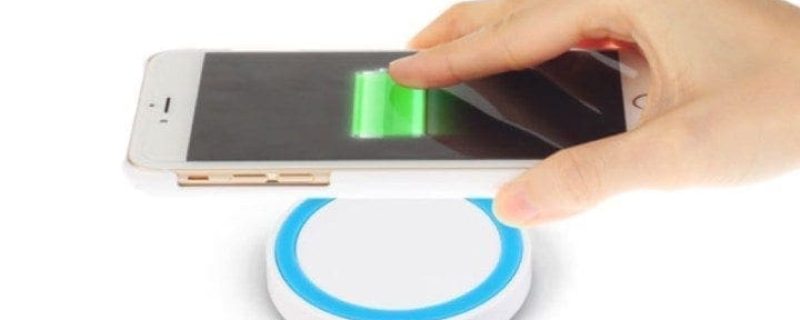

Do wireless chargers emit significant EMFEMF stands for electromagnetic field (also called electromagnetic frequency or electromagnetic force). EMFs are invisible fields of energy produced by electrically charged objects. They exist on a spectrum ranging from... radiation? That’s the question I had while watching my friend’s phone charge on its sleek wireless pad.
It’s a convenient way to power up — but understanding the EMF exposure involved is worth a closer look. I took my testing to CES to find out.
Well, I wasn’t content to just wonder, so I decided to take my testing on the road to CES in Las Vegas and see what these chargers are really up to.
So, before you toss your trusty cables into the gadget graveyard, let’s uncover the surprising results of my wireless charging experiment.
Disclaimer: This article is for informational purposes only. It is not, nor is it intended to be, a substitute for professional medical advice, diagnosis, or treatment and should never be relied upon for specific medical advice.
Key Takeaways
- Wireless chargers emit measurable EMF radiation, with RF emissions detected at levels above background during testing at CES 2020
- Qi inductive charging (used by most phones including iPhone) operates at very close range, requiring direct contact between device and pad
- MagSafe uses Qi-compatible inductive charging with magnets for alignment, not a fundamentally different technology
- EMF exposure from wireless charging is highest during active charging and drops with distance from the pad
- Wired charging produces virtually no EMF compared to wireless alternatives, making it the lower-exposure option
Medical Disclaimer: This article is for informational purposes only. It is not, nor is it intended to be, a substitute for professional medical advice, diagnosis, or treatment and should never be relied upon for specific medical advice.
How Does Wireless Charging Work?
Before we dive deep into my test and what I discovered, let’s tackle the question that’s probably buzzing in the minds of most tech lovers: how do wireless chargers actually work?
| Charging Method | EMF Type | Exposure During Use |
|---|---|---|
| Wired (USB cable) | Minimal ELF | Low |
| Wireless (Qi pad) | ELF magnetic field | Moderate (while charging) |
| MagSafe | ELF magnetic + magnets | Moderate-High (phone attached) |
For wireless charging to do its thing, you generally need two key components: a transmitter (like that sleek charging pad or stand on your desk, which is connected to a power outlet), and a receiver (which could be built into your phone or tablet, or even a fancy phone case).
The concept is delightfully simple: you just place your device on top of the charging station and, like magic, your battery starts to recharge.
That might answer how you use wireless charging, but you’re likely curious about the deeper question: What makes this wireless technology work?
Inductive vs Resonant Charging
There are two key players behind the scenes when it comes to juicing up your devices wirelessly: inductive and resonant charging.
Let’s look at them individually.
First up, we have inductive charging—the classic method that’s been the go-to for most wireless charging setups.
Here’s how it works: inside the charging base station, there’s a transmitter coil, and inside your device, there’s a receiver coil.
When you place your device on the charging pad, the electrons in the transmitter coil start to flow, creating a magnetic field.
This magnetic field then gets the electrons in the receiver coil moving, which generates the electricity needed to charge your device’s battery.
The catch? Inductive charging only works when there’s direct (or almost direct) contact between the charging pad and your device, and they need to be lined up just right.
Now, let’s move on to resonant charging, the cooler, more flexible cousin of inductive charging.
While it still relies on electromagnetic induction, resonant charging uses a more advanced design to transfer energy between the coils.
The big win here is that your device doesn’t need to be perfectly aligned with the charging pad, and it doesn’t even need to be touching it!
This method allows power to be transmitted over a greater distance, making it a bit more convenient.
Resonant charging operates at a higher frequency (around 6.78MHz) compared to inductive charging, which uses a lower frequency range of 112kHz to 250kHz.
So, whether you’re charging up close or from a slight distance, these two methods are what make wireless charging possible, each with its own set of quirks and perks!
But wait. That’s not all.
While inductive and resonant charging are the two main stars of the wireless charging world, there’s a new player crashing the party: radiofrequencyRadiofrequency (RF) refers to electromagnetic waves in the frequency range of approximately 3 kHz to 300 GHz. This portion of the electromagnetic spectrum is used for wireless communication. RF energy... (RF) wireless charging.
Radiofrequency Wireless Charging
Picture this: instead of carefully placing your phone on the charging pad like you’ve been doing so far, you can now toss your device just about anywhere in the room, and it still charges!
Yep, this tech is real. It’s called radiofrequency wireless charging, and it will soon be in our homes.
It’s a more flexible approach to wireless charging.
No need to worry about alignment or even contact—just pure, no-strings-attached power-up.
How does it work?
Well, instead of fiddling with coils and magnetic fields, RF charging sends out radio waves, which your device can pick up and convert into battery power.
It’s a bit like how your WiFi router spreads internet signals around your home.
However, just like with WiFi, the further away your device is from the transmitter, the less efficient the charging becomes.
There are two types of RF charging: near-field and far-field.
Near-field works best when your device is closer to the transmitter, such as placing it in a specific spot like a drawer or box.
Far-field, on the other hand, can charge devices from a greater distance, similar to how WiFi signals spread throughout a room, but with some loss in efficiency as the distance increases.
If you’ve been with us for a while, or you know even a bit about EMF and its effects, I’m sure whether wireless chargers add meaningfully to your EMF exposure is becoming clearer.
Anyway, before we talk about that, we have a bit more ground to cover.
And the next thing we’ll talk about is different wireless charging standards.
Learning about this is super important because it’s intricately linked to my test at CES, Las Vegas, and the answer you’ve come here for.
So, bear with me.
Different Wireless Charging Standards
When it comes to wireless charging, not all methods are created equal. The tech world has spawned several competing standards, each with its own perks and quirks.
Let’s understand them so we can navigate the wireless charging landscape like a pro.
Qi Charging
The most widely known standard is Qi (pronounced “chee”).
The Wireless Power Consortium developed Qi, and it has the backing of major tech companies like Apple, Philips, Samsung, and Google.
Qi focuses specifically on mobile devices, such as smartphones and tablets, using inductive charging with power levels between 5 and 15 watts.
You’ll find Qi in most wireless chargers available today.
AirFuel
Another significant standard is AirFuel, formerly known as Rezence.
The AirFuel Alliance drives innovation by developing both resonant and radiofrequency wireless charging technologies, known as AirFuel Resonant and AirFuel RF.
These technologies operate at higher power transmission frequencies than Qi and can charge multiple devices simultaneously, offering greater efficiency and flexibility.
Besides Qi and AirFuel, emerging platforms like Energous WattUp and Humavox ETERNA are also gaining attention.
Is MagSafe the Same as Qi Charging?
If you’re an Apple user, you might be wondering how MagSafe fits into the picture.

Apple reintroduced MagSafe with the iPhone 12 series as its version of wireless charging.
While MagSafe uses the Qi standard, Apple enhances it with magnets that align your iPhone perfectly with the charging coil.
This magnetic alignment ensures a more efficient charge.
So, while MagSafe operates on the Qi standard, it offers an upgraded experience with its magnetic feature.
How Much EMF Do Wireless Chargers Emit?
Ok, now to the core question: how much EMF do wireless chargers actually emit, and what does that mean for your exposure?
Wireless charging developers often claim that the frequency and power of wireless chargers is very low. And this is actually true, especially for the Qi standard.
Powermat, the largest supplier of Qi-compatible wireless chargers, said that “the electromagnetic field created by a wireless charger is insignificantly little, no more than a home or office WiFi network.”
So, according to them, the EMF from wireless chargers is comparable to a home WiFi network.
But that comparison actually raises its own questions about EMF exposure.
In 2019, Japanese researchers found that exposing human sperm to WiFi for just two hours dramatically increased their death rate and lowered their motility.
I have covered this in-depth in my post, “EMF and Male Fertility.“
Another study in Oakland, California, revealed that pregnant women exposed to higher levels of EMF radiation from cell phones and WiFi had triple the risk of miscarriage.
Learn more about this in my post, “EMF Radiation Health Dangers for Women.“
And that’s not to mention the countless other diseases and negative health effects caused by EMF exposure.
Comparing wireless charging to WiFi doesn’t settle the question — it simply shifts the frame of reference.
On top of that, the radiation from wireless chargers, in addition to all the other EMFs, bounce around in your home and office. So the effects are cumulative.
All of this said the different standards and the products that use them are not all equal. Some emit stronger and higher frequency radiation than others.
Let’s see how they test in the real world.
My 2016 Initial Test at CES Las Vegas
At the Consumer Electronics Show (CES), Las Vegas 2016, I had the chance to measure the electromagnetic field (EMF) emissions from two different types of wireless chargers: those using the Qi standard and those using Airfuel Resonant technology.

The difference was striking.
Qi chargers emitted a very low level of EMF—comparable to what you’d find near a basic household appliance.
When a device was actively charging, the EMF level was around 3 milligauss (mG), which is roughly equivalent to the magnetic field you might experience standing a few feet away from your refrigerator.
When the charger wasn’t being used, the EMF emissions dropped to almost zero, meaning it wasn’t emitting any unnecessary radiation.
On the other hand, the Resonant chargers emitted at least 100 mG, even when they weren’t charging anything.
I say ‘at least’ because 100 mG is the maximum measurement on the Trifield meter I brought with me.

What’s more troubling is that this high level of radiation was present whether the charger was in use or not, constantly emitting EMF into the environment.
The BioInitiative Working Group, an independent team of international scientists, recommends exposure levels of around 1 mG or lower— 100x lower than what I measured from the Resonant chargers.
The Qi chargers, with their minimal emissions, were well within this safer range, whereas the Resonant chargers were far beyond it.
I reached out to both Qi and AirFuel Resonant for their thoughts.
Qi explained that their low emissions are a result of careful design and engineering to minimize unnecessary radiation.
Unfortunately, AirFuel Resonant didn’t respond.
My Return To CES, Vegas in 2020
I returned to CES in 2020–four years after my initial tests–and took additional measurements.
This time around, the Qi chargers emitted notably higher levels of EMF radiation.
First, let’s take a look at a wireless charger from a company called AirCharge, which builds its technology on the Qi standard.
Take a look at what I measured.
Right up against the charger, you can see that the TriField measured ELF-magnetic fields between 50 mG all the way up in excess of 100 mG!
(That’s what it means when the TriField reads ‘1 —-‘ —it means that the readings exceed 100 mG, which is the max that the TriField can measure.)
That’s a significant level of exposure.
As this was 2020 (four years after my initial tests), and technology continues to evolve, the Qi technology is now available in additional products.
Here’s a video I took of measurements of a device called a Charterhouse, which is a wireless kitchen cooktop.
As you can see in that video, even about a foot away, I was measuring over 5 mG (milligauss)!
That’s huge for being so far away. Then, as I got closer, you can see the levels exceeded 20 mG!
That’s approximately 10 to 20 times the level of low-frequency magnetic power than a standard charger plugged into a wall.
I Switched to RF Emissions
This time I switched my meter to measure radio frequency (RF) emissions.
I figured the readings would be quite low, since in my prior testing wireless chargers were a significant source of ELF radiation, but not radio frequency (which is the type of EMF used for wireless communication).
It turns out I was mistaken.
You can see that a foot away, it’s already reading over 4 mW/m2 (milliwatts per square meter).
That’s about what you could expect to read directly from a cell phone that’s making a call.
But remember: in this video, that’s about a foot away. And as I got closer, the levels exceeded 16 mW/m2!
That’s like four cell phones running at high power.
So, in the four years between 2016 and 2020, it appears that manufacturers implementing the Qi wireless charging standard have been building devices that emit even more EMF radiation, not less.
And it’s a vivid illustration of how outdated current EMF exposure guidelines are, and how little manufacturers consider EMF emissions in their product design.
So, what do you think? The data from my CES testing suggests real variation in exposure levels depending on the charging standard used.
How Much EMF Does iPhone Wireless Charging Emit?
Given the popularity of iPhones, a lot of people specifically ask how much EMF iPhone wireless charging emits.
So we’ll address that here.
If you have an iPhone 8 or later, it uses the Qi standard, which means your phone needs to sit directly on a charging pad.
This keeps the radiation levels relatively low compared to more advanced, distance-based charging methods that Apple hasn’t adopted yet.
However, your iPhone isn’t just emitting EMF from wireless charging.
It’s also emitting radiation from other sources like your cellular connection, WiFi, Bluetooth, and NFC, which supports features like Apple Pay.
That’s already four different sources of EMF radiation.
And let’s not forget about AirPods.
By encouraging the use of wireless AirPods, Apple is adding a fifth source of EMF radiation, which goes directly into your ears and is very close to your brain.
With the introduction of wireless charging, you now have a sixth source of EMF radiation from just one device.
Each additional source of radiation increases your overall exposure.
Common Misconceptions
- Wireless charging and wired charging produce equivalent EMF: Wireless charging generates measurable EMF radiation during energy transfer. Wired charging, by contrast, produces virtually no RF emissions since the energy travels through a cable, making it the lower-exposure option.
- MagSafe is a completely different technology from Qi: MagSafe uses Qi-compatible inductive charging. The magnets help with alignment, but the underlying wireless power transfer method is the same as standard Qi charging.
- Wireless charger EMF only affects you while charging: While EMF is highest during active charging, some wireless charging pads emit low-level standby EMF even when no device is on them, especially if they remain plugged in.
Final Thoughts
So, there you have it. Despite weird looks at CES Las Vegas, I found answers to the question of how much EMF wireless chargers emit.
When it comes to EMF radiation, the evidence suggests measurable exposure from wireless chargers — particularly resonant and newer Qi devices — and the precautionary principle supports minimizing unnecessary sources.
Despite what some may claim, a significant body of research — including studies reviewed by the BioInitiative Working Group — suggests that even lower levels of EMF exposure may be associated with biological effects.
The growing use of wireless chargers adds to the cumulative EMF sources in our daily environment.
And it’s not just wireless charging.
Your phone, with its cell connection, WiFi, Bluetooth, NFC, and AirPods, is already a significant source of EMF radiation.
When you combine all these factors, your daily exposure adds up — and reducing unnecessary sources where possible is a reasonable precaution.
Don’t just take my word for it—dive deeper into the research yourself here at Shield Your Body.
Curious to know more? You might be surprised to learn that AirPods, which sit right in your ear canal, just inches from your brain, could be more dangerous than you think. Dive deeper into the risks in my in-depth post: Are AirPods Bad for You?
If you’re concerned about reducing EMF exposure while you sleep, consider creating an emf free bedroom to minimize radiation sources in your sleeping environment. Also, it’s worth understanding how wireless chargers contribute to dirty electricity in your home’s electrical system.
Frequently Asked Questions
Wireless chargers emit electromagnetic field (EMF) radiation which adds to your total exposure from various devices like phones and WiFi, but the safety of these emissions is a concern.
No, EMF emissions vary by technology; Qi chargers initially had lower emissions while newer models and other standards like AirFuel can emit much higher levels of EMF.
Prolonged exposure to EMF from multiple sources, including wireless chargers, especially with newer devices emitting higher radiation levels, can potentially affect your health.
The testing revealed that all wireless chargers emit measurable EMF radiation, with RF emissions detected at levels above background during the tests.
While not specifically addressed in the article, it's noted that different technologies have varying emission levels, suggesting potential differences between brands like iPhone and others.