

By R Blank
Last Updated: May 17, 2026

Answer Summary
Peer-reviewed studies link maternal EMFEMF stands for electromagnetic field (also called electromagnetic frequency or electromagnetic force). EMFs are invisible fields of energy produced by electrically charged objects. They exist on a spectrum ranging from... exposure to higher miscarriage risk and altered fetal development. Lab-tested shielding fabric using silver, copper, or nickel mesh can reduce RF exposure by up to 99% on the shielded side.
Coverage depends on where your exposure comes from. This guide shows which categories address which sources and what lab data to demand.
Key Takeaways
- Developing tissues absorb RF more readily than adult tissues, and the first trimester is the most sensitive window for fetal development
- Peer-reviewed studies have linked prenatal EMF exposure to increased miscarriage risk, altered fetal growth, and behavioral changes in children
- Lab-tested conductive shielding (silver, copper, nickel mesh) can reduce RF exposure by up to 99% on the shielded side, when verified by an independent lab report with attenuation measured in decibels
- The highest-leverage protections layer behavior changes (distance, sleep environment) with targeted products (belly band, baby blanket, phone pouch)
- Products that claim to “harmonize” or “neutralize” EMF without conductive materials have no published lab evidence and should be avoided
Why EMF Exposure Matters More During Pregnancy and Infancy

Before comparing products, it helps to understand why pregnancy and infancy are different from adult exposure.
Developing Bodies Absorb More
A developing embryo, fetus, or infant undergoes the most rapid cell division and tissue differentiation of an entire lifetime. Fetal and infant skulls are thinner than adult skulls, and a smaller body absorbs a proportionally higher dose of radiofrequencyRadiofrequency (RF) refers to electromagnetic waves in the frequency range of approximately 3 kHz to 300 GHz. This portion of the electromagnetic spectrum is used for wireless communication. RF energy... (RF) energy at the same exposure level. The first trimester, when organogenesis occurs, is generally considered the most sensitive window: the second and third trimesters are more resilient but not exposure-neutral.
What Research Has Found
Recent peer-reviewed reviews have synthesized the evidence base. A 2024 meta-review by Johnson et al. (cited 22 times) concluded that RF-EMF exposure could have detrimental effects on pregnancy outcomes including miscarriage, congenital anomalies, low birth weight, and pre-term birth. A 2023 review by Kashani et al. (cited 39 times) found that RF-EMF during pregnancy can affect fetal growth and pregnancy duration through changes in maternal physiology. A 2023 review by Irani et al. (cited 17 times) reported that pregnant women exposed to high levels of EMF had an increased risk of miscarriage.
The science is not fully settled, and individual study results vary. National health regulators, including the Australian Radiation Protection and Nuclear Safety Agency, recommend that pregnant people stay within public exposure limits. Many researchers go further and recommend exposure reduction during pregnancy under the precautionary principle.
For a deeper dive into the individual studies, see our cell phone radiation research hub.
How EMF Shielding Products Work
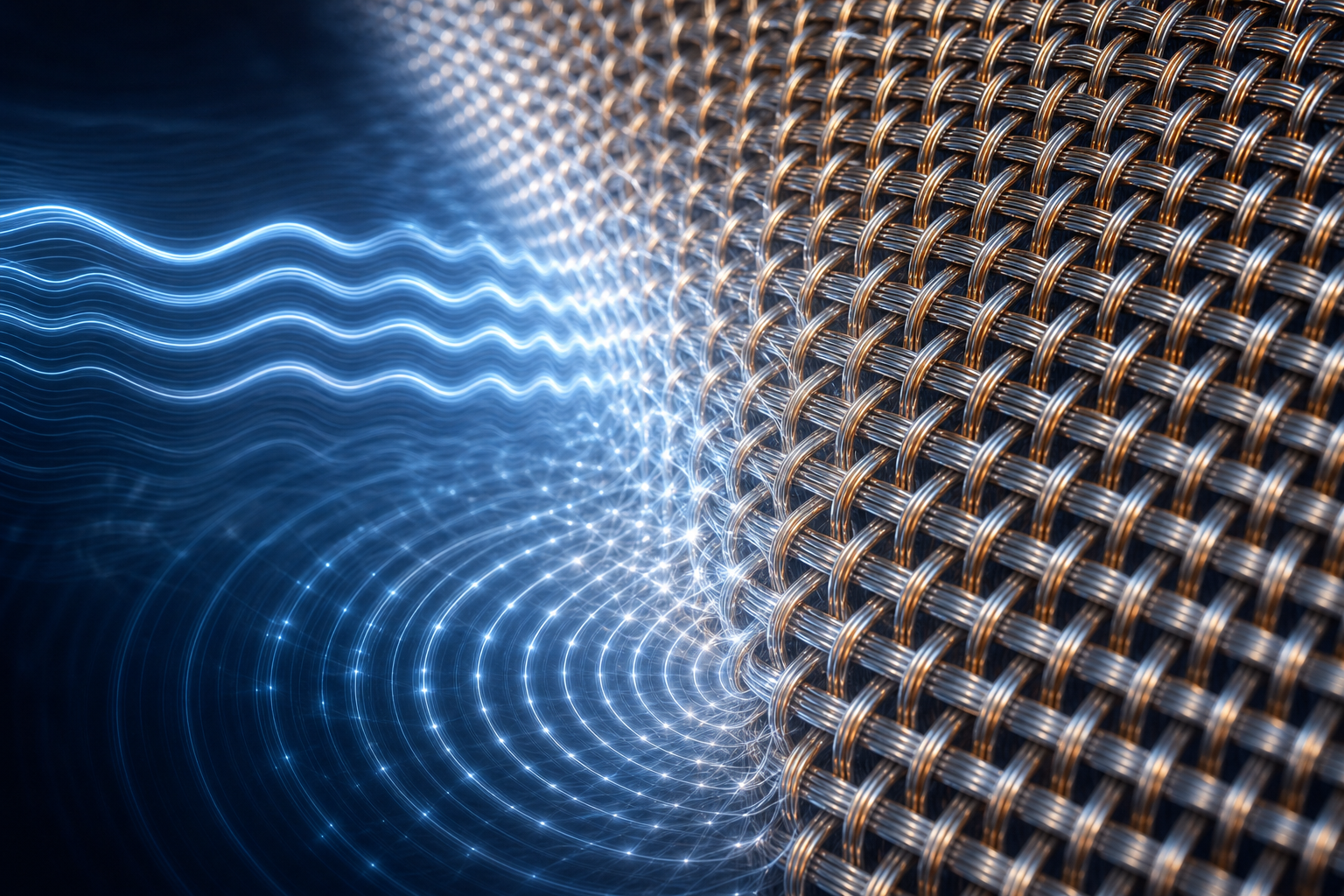
Shielding is a physics problem, not a marketing problem. Knowing the basics tells you which products are credible before you read a single product page.
The Physics of Shielding
Electromagnetic fields, including the RF emissions from phones, routers, and other wireless devices, are reflected and attenuated by conductive materials. Silver, copper, and nickel mesh are the materials most commonly used in lab-tested shielding apparel because they combine high conductivity with the ability to be woven into fabric or laminated onto a flexible substrate.
A shielding layer creates a directional barrier: incoming RF on one side is reflected and absorbed, reducing what passes through to the other side. The same physics is used in radio-frequency rooms, anechoic chambers, and Faraday cages.
What Lab Testing Measures
Credible shielding products are tested in independent labs and report attenuation in decibels (dB) across a specified frequency range. A dB rating tells you the order-of-magnitude reduction: a 20 dB result means the field strengthField strength measures the intensity of an electromagnetic field at a specific point. Electric field strength is measured in volts per meter (V/m), while magnetic field strength uses amperes per... on the protected side is one-hundredth of the field on the unprotected side; a 30 dB result means one-thousandth. Percentage figures like “up to 99%” are a consumer-friendly translation of the same dB measurement under specified test conditions.
One-Sided Shielding and Why It Matters
A good pregnancy-focused product is shielded on the side that faces the body and unshielded on the opposite side. The reason is signal: fully enclosing a phone or device in a conductive layer blocks the antenna, which can cause the device to ramp up transmit power to maintain a connection, potentially increasing exposure. One-sided design preserves connectivity while reducing exposure on the side that matters most.
What to Look For in a Pregnancy or Baby EMF Product
The category is full of well-meaning products and a fair number of marketing-driven ones. Five criteria separate the credible from the rest.
1. Published Lab Test Data
Look for a published lab report from an independent, accredited testing facility. The report should specify the test method, frequency range, and the attenuation result in decibels. “Lab-tested” without a publicly available report is a marketing claim, not evidence.
2. Conductive Shielding Materials
The shielding layer should use silver, copper, nickel, or a comparable conductive material. Avoid products that rely on:
- Stickers or chips claiming to “harmonize” radiation
- Crystals, shungite, or other minerals marketed as EMF blockers
- Pendants or wearables without a published dB rating
These categories do not show measurable attenuation in controlled lab tests, and the U.S. Federal Trade Commission has specifically warned consumers about unsubstantiated radiation-protection claims.
3. Honest Attenuation Numbers
Reputable manufacturers state shielding percentages as “up to” a peak value, because real-world results depend on positioning, frequency, and source distance. A product that promises to “block all radiation” or a flat near-total reduction without qualification is overstating what physics actually allows in real-world use.
4. Coverage That Matches the Source
Different exposure sources need different products. A belly band addresses chronic close-range exposure from a phone in a pocket; an EMF blanket addresses laptop and lap exposure during work or feeding sessions; a phone pouch addresses the moment the phone is on your body. No single product covers every source.
5. Care and Durability
Shielding fabrics lose effectiveness if washed incorrectly or worn through. Look for products with explicit care instructions and a reasonable expected lifespan, and treat shielding apparel like a piece of technical gear, not a regular textile.
Top Categories of Protection: How They Compare

These are the product categories worth knowing about, with the SYB options and the use cases they each address.
Maternity Belly Bands and Shielding Apparel
A belly band sits over or under everyday clothing and places a layer of lab-tested shielding fabric between your phone (or other nearby sources) and your abdomen. It is the highest-leverage purchase for anyone who routinely carries a phone in a pocket or sits near other RF sources during the workday.
SYB carries the Juunaday Belly Band, and our broader baby and maternity collection includes additional apparel options designed for daily wear during pregnancy.
EMF Blankets for Lap and Crib Use
A shielding blanket places a conductive barrier between a laptop, tablet, or other wireless device and the body. During pregnancy, it addresses lap-based laptop use. Postpartum, the same blanket can be used over a baby carrier or as a barrier between an infant and a nearby device.
For a side-by-side comparison of two popular options, see our SafeSleeve RF Blocking Blanket vs HAVN WaveStopper review.
Phone-Side Protection
A lab-tested phone pouch or shielding case is the single most useful product for daily exposure reduction, because the phone is the device most people carry closest to the body for the longest time. The SYB Phone Pouch carries the phone in a directional shielded sleeve, with the shielded side facing your body. For a full walkthrough of phone-side options, see our EMF blocking phone case buyer’s guide.
Baby-Specific Apparel
After delivery, the SYB Baby Blanket and Baby Beanie provide lab-tested shielding sized for infants. They are designed to reduce a newborn’s exposure during the highest-vulnerability months, when sleep, feeding, and proximity to parental devices are constant.
Bedroom and Nursery Mitigation
A meaningful share of a pregnant person’s, and later an infant’s, daily exposure comes from the room they sleep in. Router placement, smart-meter shielding, and electronics-free bedside habits often deliver larger exposure reductions than any single product. Our EMF-free bedroom guide walks through the room-by-room changes.
EMF Meters for Measuring Exposure
You can’t reduce what you don’t measure. An entry-level EMF meter tells you where the high-exposure zones in your home actually are, so you can prioritize protections. Our best EMF meters and detectors guide compares the options that are appropriate for non-specialist use.
Practical Steps to Reduce EMF Exposure During Pregnancy

Products complement behavior. The following five steps cost nothing and address the largest sources of personal exposure.
1. Create Distance From Your Phone
RF exposure drops sharply with distance: doubling the distance from a source reduces exposure by up to approximately 75%, following the inverse square law. The single most impactful change is not carrying your phone against your body.
- Carry the phone in a bag or purse, not a pocket or waistband
- Use speakerphone or a wired headset for calls instead of holding the phone to your head
- When the phone is on a desk or table, keep it screen-down and a few feet away
- Do not rest the phone on your abdomen
2. Reduce Your Sleep-Environment EMF
Pregnant people spend more time in bed than at any other point in adult life. Sleep quality matters more during pregnancy, and the bedroom is one of the easiest rooms to clean up.
- Move the phone out of the bedroom, or use airplane mode overnight
- Turn off the WiFi router at night, or move it out of the sleeping area
- Unplug bedside electronics and charging cables
- Follow the EMF-free bedroom guide for a full room walkthrough
3. Manage Laptop and Tablet Habits
Laptops and tablets combine RF emissions with magnetic fields from the processor and power supply, plus direct heat at close range.
- Do not use a laptop directly on your lap during pregnancy: place it on a desk or table
- Use a wired ethernet connection when possible
- Keep tablets off your abdomen when reading or streaming
4. Be Aware of Public RF Sources
Outside your home, the dominant exposure sources are 5G5G is the fifth generation of wireless cellular technology, offering faster data speeds, lower latency, and greater network capacity than 4G LTE. It began rolling out commercially in 2019. 5G... small cells on utility poles, dense WiFi access points in offices, smart meters on home exteriors, and other people’s devices in shared spaces. You cannot turn these off, but you can avoid sitting directly next to them and you can choose to carry your own phone in airplane mode in environments where you do not need it active.
5. Layer Targeted Shielding Products
Once the behavioral baseline is in place, lab-tested shielding apparel and blankets address the residual exposure from sources you cannot avoid: a phone you need to keep on, ambient RF in a coworking space, a partner’s bedside electronics, or a laptop you have to use during the workday.
Common Misconceptions About EMF and Pregnancy
A few persistent myths shape the advice that pregnant people get from search engines and forums. Each one is worth correcting before deciding what to buy.
“The placenta protects the baby from EMF.” The placenta is a biological barrier that filters pathogens and certain chemicals. Electromagnetic fields are not chemical substances, and the 2007 study on fetal exposure to low-frequency fields confirmed that EMF penetrates to the developing fetus. Distance, not biology, is the main protective factor.
“Only high-power sources like cell towers matter.” Duration and proximity matter as much as power. A cell tower a few hundred meters away contributes a far smaller personal dose than a phone carried in a pocket for ten hours a day. Chronic close-range exposure over nine months is the variable to manage.
“WiFi is too weak to affect a pregnancy.” WiFi operates continuously, creating 24/7 ambient exposure. Animal studies have shown 2.45 GHz radiation can affect implantation and offspring oxidative stress at typical exposure levels. The issue is cumulative exposure during a critical developmental window, not peak power. For more on WiFi-specific exposure, see our WiFi and health guide.
“If EMF were dangerous, regulators would ban it.” Current exposure standards were established decades ago and were designed around thermal effects, not the non-thermal biological effects that recent reviews continue to investigate. Several scientific bodies have called for updated standards that account for vulnerable populations including pregnant women and infants.
“All EMF shielding products are scams.” Some are. Lab-tested products that use conductive materials are not: the physics is well established and the dB attenuation can be independently verified. The question to ask is always the same: where is the lab report?
A Coordinated Starter Set for New Parents

If you want a single, layered approach to start with, the products below cover the four highest-exposure sources for a typical pregnancy and postpartum period:
- The Juunaday Belly Band — daily abdominal shielding while the phone is on or near your body
- The SYB Phone Pouch — directional shielding for the phone you actually carry
- The SYB Baby Blanket — lab-tested shielding sized for newborn use, on laps, in carriers, or over a bassinet edge
- The SYB Baby Beanie — head shielding for infants in high-RF environments
Browse the full baby and maternity collection or shop for babies for additional options.
A Note on the Research
We present this research because it exists, it is peer-reviewed, and it is well-cited. We do not claim that EMF definitively causes miscarriage or developmental problems in every exposed pregnancy. What the literature supports is this: the evidence is sufficient to warrant precaution, particularly during pregnancy and infancy, when the stakes are highest and the developing organism is most vulnerable.
The precautionary principle, which is standard practice in maternal-fetal medicine, is to take reasonable protective action when evidence suggests risk, even before absolute proof exists. We apply the same principle to alcohol, tobacco, and environmental toxins during pregnancy. The current EMF evidence, with hundreds of peer-reviewed studies behind it, justifies the same level of precaution.
This content is for informational purposes only and is not a substitute for professional medical advice.
Frequently Asked Questions
Peer-reviewed studies have linked high-level RF-EMF and magnetic-field exposure during pregnancy to increased miscarriage risk, altered fetal growth, and pre-term birth. The science is not fully settled, and individual study results vary. The mainstream precautionary recommendation, supported by recent meta-reviews, is to reduce avoidable exposure where practical, particularly during the first trimester.
Developing tissues absorb RF more readily than adult tissues, and fetal and infant skulls are thinner than an adult's. Multiple peer-reviewed studies have associated prenatal EMF exposure with behavioral and neurodevelopmental changes in children. The precautionary recommendation is to reduce exposure during pregnancy and through infancy.
The first trimester is generally considered most sensitive, because organogenesis (organ formation) occurs from weeks two through seven. The second and third trimesters are more resilient but not exposure-neutral. Start exposure-reduction habits as early in pregnancy as possible, and continue them through breastfeeding and infancy.
Several studies have examined 2.45 GHz WiFi exposure in animal models and reported effects on implantation and oxidative stress in offspring. Human data is mixed. The most defensible practical step is reducing close-range, prolonged WiFi exposure: keep routers out of the bedroom, turn WiFi off at night, and avoid placing laptops or tablets directly on the abdomen.
Three steps in priority order: use speakerphone or wired headphones for calls; carry the phone in a bag rather than a pocket or waistband; when the phone must be on your body, use a lab-tested shielding pouch or case with the shielded side toward you. See our phone case buyer's guide for product details.
There is no single product. Coverage depends on your exposure profile. The highest-leverage starting points are a maternity belly band for daily phone-distance protection, a shielding blanket for laptop and lap use, and bedroom mitigation. Always look for published lab attenuation data, not slogans, when comparing options.