ZMIANY HISTOPATOLOGICZNE W JĄDRACH SZCZURÓW PODDAWANYCH JEDNORAZOWEMU I WIELOKROTNEMU DZIAŁANIU MIKROFAL (PASMO „S")
L. CIECIURA, L. MINECKI · 1962

Of 1,603 studies examining cellular effects, 85% found measurable biological effects from EMF exposure.
Research found effects on cellular effects at exposures as low as:
The science demonstrates a striking consistency: of 2,018 peer-reviewed studies examining how electromagnetic fields interact with human cells, 1,736-or 86 percent-documented measurable biological effects. This isn't a fringe finding or a handful of outlier studies. This is the weight of accumulated evidence across multiple independent research groups, institutions, and countries.
When 86 percent of independent research shows biological effects but safety guidelines remain essentially unchanged, there's a credibility gap worth noticing.
Research shows that 66% of studies published after 2007 report measurable effects on protein and gene expression at intensity levels commonly used by wireless devices, indicating a clear biological response to EMF exposure at current regulatory limits.
Source: BioInitiative Working Group. BioInitiative Report: A Rationale for Biologically-based Public Exposure Standards for Electromagnetic Radiation. Edited by Cindy Sage and David O. Carpenter, BioInitiative, 2012, updated 2020. www.bioinitiative.org
Showing 1,633 studies
L. CIECIURA, L. MINECKI · 1962
V. R. Faitel'berg-Blank · 1962
Boleznei, S., Gaverdovskaya · 1961
Bruce M. Cameron, M.D. · 1961
L. A. Dolina · 1961
Minecki, L., Bilski, R. · 1961
Miklos Nadasdi, M.D. · 1961
Victor T. Tomberg · 1960
R. L. Carpenter, D. K. Biddle, C. A. Van Ummersen · 1960
Charles Susskind and Staff · 1960
A. A. TEIXEIRA-PINTO et al. · 1960
S. J. Gill, Y. Downing · 1959
G. Piccardi · 1959
Charles Süsskind and Staff · 1959
John H. Heller, H. P. Schwan, D. W. C. Shen · 1959
Louis Daily Jr. et al. · 1959
Helmut Pauly, Lester Packer, H. P. Schwan · 1959
Researchers measured the electrical capacity of rat liver mitochondrial membranes by analyzing the frequency dependence of admittance in suspensions of swollen mitochondria. The membrane capacity was found to be 0.5 to 0.6 /F/cm2 and depended on potassium chloride ion concentration. The swollen mitochondria had internal ion concentrations proportional to the external medium, suggesting they could adjust their internal ion concentration. Internal mitochondrial conductance was approximately half that of the external medium, even with a 10-fold KCl concentration difference. The data suggested anisotropic electrical behavior explained by internal membranes.
John H. Heller, A. A. Teixeira-Pinto · 1959
Researchers used a pulsed radio-frequency source at 27 Mc./s. with pulses of 5 X 10⁻⁵ sec. and 80 to 180 pulses per second. Garlic root tips were exposed for 5 minutes between insulated electrodes with no temperature rise in the water. Observed chromosomal aberrations included linear shortening of chromosomes, pseudochiasmiata, amitotic division, bridging, and irregularities in the chromosomal envelope.
H. P. Schwan · 1959
Herman P. Schwan · 1958
Robert T. Nieset et al. · 1958
Terrell L. Hill · 1957
The paper theorized that an electric field can alter or reverse the relative stability of different macromolecular configurations. It stated that the field will shift the equilibrium between molecular configurations. The analysis identified three possible consequences: separation of DNA double helix chains, partial or complete protein denaturation, and changes in protein chain elasticity between long and short states. The author noted these processes might occur in artificial conditions or be relevant in natural biological membranes due to changes in membrane potential or charge distribution.
J. B. MILLARD · 1955
George H. Brown, Wendell C. Morrison · 1954
P. J. W. AYRES, H. McILWAIN · 1953
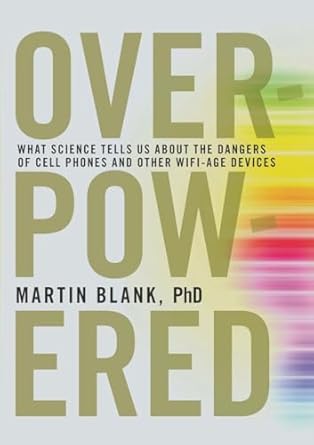
For a comprehensive exploration of EMF health effects including cellular effects, along with practical protection strategies, explore these books by R Blank and Dr. Martin Blank.